
Laser Pointer Types Guide: Best Classic to Modern & High-End
Confused by all the laser pointer types? From classic pen-style greens to compact EDC and modern tactical hosts, this guide helps you match the right type to your needs.
Image Gallery
Buying a laser pointer seems simple until you start comparing products. One model is a 5mW presentation pointer, another promises several watts of burning power, and a third claims to be the perfect all-purpose laser. All are sold under the same name, yet each is designed for completely different jobs.
The key to a smart purchase is understanding the different laser pointer types available. The handheld laser market includes classic pen-style pointers, compact EDC models, modern tactical hosts, enthusiast-grade high-end instruments, and versatile configurations that adapt to multiple uses. Each type solves a different problem for a different user.
This guide explains how each category differs, who it serves, and where its strengths and limitations become apparent. Real user experiences, regulatory references, and representative products are included throughout, so you can evaluate laser pointers based on practical performance rather than marketing claims.
Rather than asking which laser has the most milliwatts, the better question is: which type of laser pointer best fits the way I plan to use it?
Key Takeaways
- Five distinct laser pointer categories exist: classic pen-style, compact EDC, modern tactical, high-end enthusiast, and versatile configurations, each optimized for a different user
- A reputable 5mW green pen laser remains the most practical choice for indoor presentations and general pointing
- Compact EDC lasers like the B025 offer higher power in a pocket-friendly size for outdoor use
- Modern tactical hosts prioritize thermal management, USB-C charging, and rugged builds over raw power numbers
- High-end lasers justify their price through diode quality, beam precision, and engineering, not just higher wattage
Classic Pen-Style Laser Pointers: The Familiar Choice That Still Works
For many people, a laser pointer is the slim pen-shaped device used in classrooms and conference rooms for decades. Lightweight and inexpensive, this design remains the most recognizable form factor on the market. Models based on the 301 and 303 platforms have been produced in enormous quantities and dominate general online marketplaces.
A quality 5mW green pen laser performs well within its intended role. It is bright enough for indoor presentations, educational demonstrations, casual stargazing, and even interactive pet play. According to laser safety guidance from the Rochester Institute of Technology, most red and green laser pointers operate between 1–5mW and fall under Class 2 or Class 3R, making them suitable for general pointing when used responsibly.
The strengths of the pen-style design come with clear limitations. The narrow aluminum body leaves little room for heat dissipation. Batteries are small, runtime is limited, and there is no space for the larger optics or driver circuitry found in more capable handheld lasers. These compromises are acceptable at 5mW but become significant as power increases.
Advertised specifications deserve careful scrutiny in this category. The FDA limits laser pointers for pointing and demonstration to 5mW visible output in the 400–710nm range. Any pen-style laser claiming dramatically higher power is either violating regulations or misrepresenting its output. NIST random testing has confirmed that many commercial laser pointers exceed their labeled output, sometimes by several orders of magnitude.
Build quality matters far more than exaggerated power claims in this price range. One Reddit user who purchased more than a dozen inexpensive Amazon laser pointers reported:
"Most of the ones I bought on Amazon had batteries rattling loose and clear QA issues, as well as seriously concerning overheating issues."
Another buyer searching for a reliable Class II pointer reached a similar conclusion:
"Nothing yet. Haven't found anything that has a reasonable chance of being good quality / legitimately class II."
In our analysis of user reports across Amazon, Reddit, and Laser Pointer Forums, we found that loose battery compartments, poor thermal contact, unstable drivers, and questionable quality control are reported far more frequently than insufficient brightness. A well-built 5mW green pen laser from a reputable seller remains practical and cost-effective for indoor pointing. Once outdoor visibility, extended runtime, or durability becomes necessary, a different category is worth considering.
Best for: Indoor presentations, classroom teaching, educational demonstrations, casual astronomy pointing, pet toys.
Primary trade-off: Excellent portability and affordability, but limited thermal capacity, fixed-focus optics, and no credible performance above the regulated 5mW limit.
Compact EDC Laser Pointers: Portable Power for Everyday Carry
Compact EDC (everyday carry) lasers fill the gap between low-power pen-style pointers and larger tactical hosts. They offer higher output in a pocket-friendly size, making them suitable for outdoor pointing, astronomy, and general use without the bulk of full-sized tactical models.
The B025 Compact Green Laser 1.5W exemplifies this category. It produces a 1.5W 520nm green beam that appears exceptionally bright to the human eye, yet its body remains compact enough for pocket carry. Green wavelengths at this power level are visible across long distances at night, making the B025 a practical choice for stargazing, outdoor signaling, and field work.
What distinguishes compact EDC lasers from pen-style pointers is usable power in a similar footprint. A 5mW pen laser is adequate for indoor use but disappears in outdoor daylight or at distance. A compact EDC like the B025 delivers 300 times the output while remaining small enough to carry daily. The trade-off is higher cost and greater responsibility, as lasers above 5mW require careful handling and eye protection.
For users who need more than a presentation pointer but do not want a full-sized tactical host, compact EDC lasers offer the most practical balance of portability and performance.
Best for: Astronomy, outdoor pointing, everyday carry, users who want more power than a pen laser without the bulk of a tactical host.
Key advantage: Higher output in a pocket-sized form factor, bridging the gap between basic pointers and larger tactical lasers.
Modern Tactical & Rugged Laser Pointer Types: Built for Demanding Conditions
Modern tactical laser pointers prioritize durability, thermal management, and runtime over slimness. Their wider bodies accommodate larger batteries, substantial heat sinks, and stronger driver electronics. The difference from pen-style lasers is engineering rather than simply output power.
Most tactical models use aircraft-grade aluminum housings with copper or brass internal modules. This construction allows the entire host to function as a heat sink, pulling heat away from the laser diode. For higher-powered handheld lasers, thermal management is often the limiting factor in real-world performance.
A slim pen laser attempting to run a 1.6W blue diode would overheat within seconds. A purpose-built host like the B018 Rugged Build Laser Pointer spreads heat through a larger aluminum body with machined cooling grooves and a rotating variable-focus head. The difference in sustained output is easily observed during extended use.
Durability is another differentiator. Tactical lasers are designed to survive drops, impacts, and daily carry alongside flashlights and multitools. One Reddit user working in industrial maintenance described the need for a laser that could survive pocket carry, accidental drops, and exposure to oil. That expectation is difficult for inexpensive pen pointers to meet but reflects the design philosophy behind modern tactical hosts.
Power systems have also evolved. The B017USB incorporates built-in USB-C charging, eliminating the need for a separate battery charger. The B017 includes both a compact 16340 tube and a longer 18650 extension, letting users choose between pocketability and extended runtime.
Variable Focus in Tactical Lasers
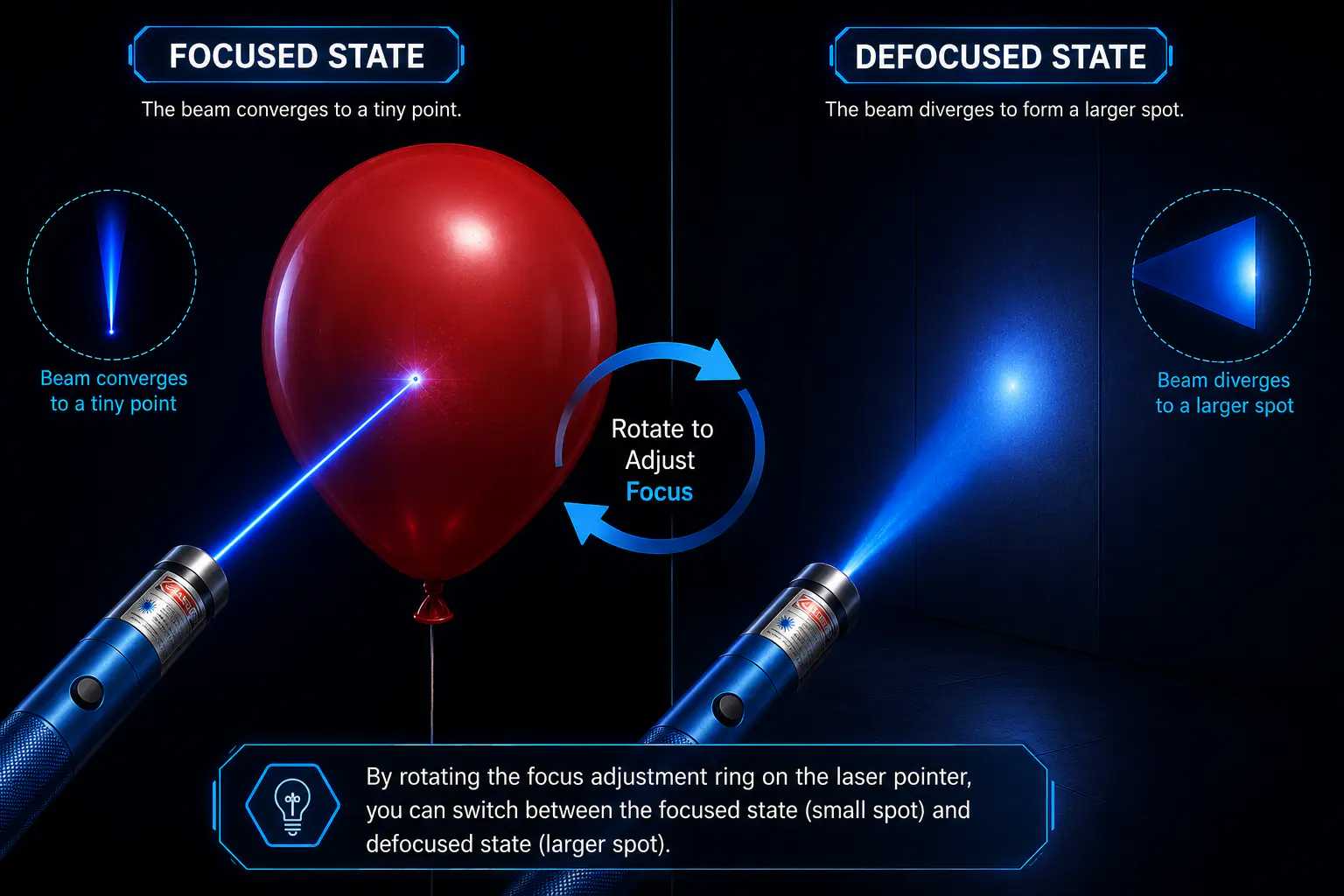
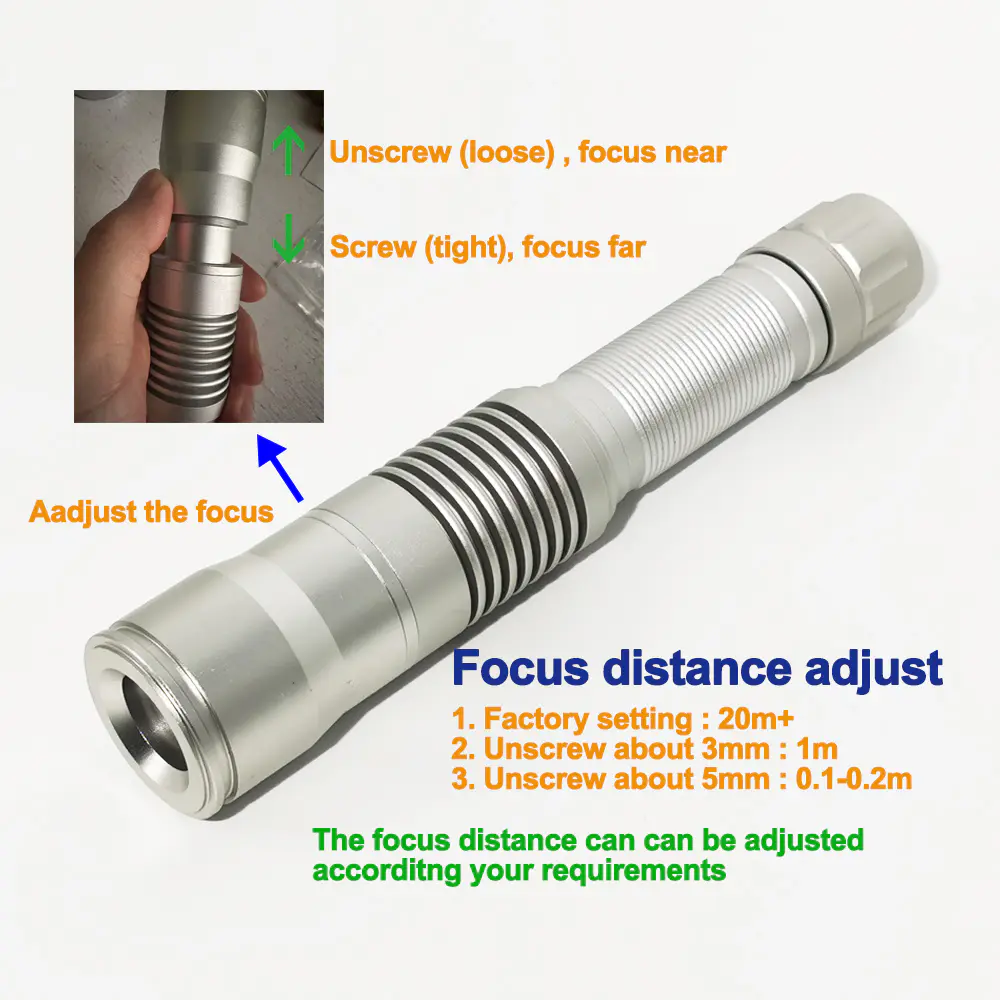
Variable focus is one of the most useful features found on tactical lasers. Unlike fixed-focus pointers that are factory-set to a specific divergence, variable focus lets users adjust the lens position to change the beam from a tight pinpoint to a wider spread.
This capability changes what a laser can do. A fixed-focus laser adjusted at the factory produces a beam profile suitable for general pointing, but the user cannot change the lens position. A variable-focus laser allows the same device to switch between long-distance pointing and close-range concentration of energy.
One Laser Pointer Forums user purchased a fixed-focus green laser labeled 100mW and found it would not burn at any distance because the beam could never be focused to a small enough spot. The limiting factor was optical adjustment, not raw power. A variable-focus laser would have solved this by letting the user adjust the focal point.
The quality of the focus mechanism varies by price range. Low-cost assemblies often use plastic threads that can strip, jam, or separate during adjustment. Higher-quality systems use machined metal components designed for repeated adjustment. A focus ring should not merely rotate; it should stay where the user leaves it.
Best for: Outdoor activities, industrial work, field applications, astronomy, and users who expect long-term durability.
Key advantage: Superior thermal management, USB-C charging, variable focus, and engineering that supports sustained performance.
High-End & Enthusiast-Grade Laser Pointers: What Your Money Actually Buys
Above roughly $150, the conversation shifts from power ratings to engineering quality. Two lasers may claim similar output but deliver completely different experiences because of how they are designed and assembled.
A premium laser maintains stable output as battery voltage drops. Its beam stays round and clean over distance. The focusing mechanism feels smooth and resists accidental movement. Internal components fit precisely, reducing vibration and improving reliability.
These are incremental improvements individually, but together they create a noticeably different ownership experience. A well-designed constant-current driver compensates for battery voltage changes, maintaining stable brightness throughout the discharge cycle. Duty cycle limits also differ between cheap and premium designs, with better thermal engineering allowing longer continuous operation.
The Nichia Precision Blue Laser 4W (B022) demonstrates the diode quality gap. It uses a genuine Nichia NUBM-series diode, the same family used in commercial laser projectors, paired with AR-coated glass optics. A generic diode at a fraction of the cost typically produces an elliptical, multi-mode beam that cannot be focused as cleanly regardless of the lens.
Beam quality is one of the least understood specifications among first-time buyers. The laser diode itself determines beam shape before light reaches the lens, with divergence measured in milliradians (mrad). Higher-quality diodes produce a more uniform emission profile.
In our comparison of advertised specs against measured performance using a laser power meter (LPM), we found that fake mW claims and spec inflation are common among budget models, while premium brands typically deliver output closer to their rated levels. A laser with lower divergence maintains a smaller spot over greater distances, making it appear cleaner and more precise during long-range pointing.
Optical coatings, thermal engineering, and driver electronics all contribute to the premium experience. Quality AR-coated glass lenses transmit more energy while reducing internal reflections. Copper or brass thermal modules distribute heat away from the diode. A well-designed constant-current driver compensates for battery voltage changes, maintaining stable brightness throughout the discharge cycle.
One buyer who upgraded from Amazon cheapies to a premium model commented:
"I feel much safer using this as it is filtered for inferred and a safer power output than some of the laser pointers that you can get on Amazon. Also, it's obviously much higher quality."
Another Reddit user expressed the mid-range spending anxiety:
"I've looked at a number of Chinese companies, but am a bit concerned about the quality I'd be getting."
For users seeking maximum handheld performance, the B023 Single Beam and B020 High Power represent the upper end of the current lineup. Both are available in blue or green wavelength variants: B023 offers 7W blue or 2.4W green, while B020 offers 4W/8W blue or 2W green. These use large 9mm laser diodes with copper modules and heavy aluminum hosts. The G019 Professional Focusing Laser Pointer comes in either 4W 450nm blue or 2W 520nm green configuration with premium focusing mechanics.
Precision Focusing in Premium Lasers
High-end lasers distinguish themselves through precision focusing mechanisms. The G019 Professional Focusing Laser Pointer uses a precision assembly designed for smooth adjustment without tools or disassembly. Its focusing ring incorporates positive detents that resist accidental movement during normal handling.
The difference in mechanism quality is significant. Another Laser Pointer Forums discussion noted on a premium laser:
"The focusing mechanism is marked, which is nice, but far too easy to spin and can bump out of focus by just setting the laser down on something."
Attention to mechanical details separates enthusiast-grade lasers from alternatives. A properly designed focus ring stays exactly where the user sets it. Combined with a high-quality diode and coated optics, precision focusing allows the same laser to perform both long-range pointing and close-range concentration of energy effectively.
Best for: Enthusiasts, collectors, researchers, and professionals who value reliability and verified performance over headline specifications.
Key differentiator: Superior diode selection, optical quality, thermal engineering, and precision focusing mechanisms, not simply higher power numbers.
Versatile Configurations: One Laser, Multiple Uses
Not every buyer wants a collection of specialized lasers. Some prefer a single device that adapts to different situations. Versatile laser configurations achieve this through interchangeable components and accessories rather than multiple wavelengths in one host.
Battery platform flexibility is one approach. The B017 ships with both a compact 16340 tube and a longer 18650 extension. The shorter setup improves portability for everyday carry, while the extended tube increases runtime for longer outdoor sessions. Having both options makes the same host suitable for pocket carry and extended use without buying a second laser.
Accessories expand what a handheld laser can do. The B018 Rugged Build Laser Pointer includes five solid copper diffraction caps that project a single beam into multiple visual patterns. These caps make the same device useful for educational demonstrations, creative photography, and visual effects beyond standard pointing.
One Reddit user perfectly captured the search for balance:
"Can I get one that's powerful enough to be seen but not a mini death ray?"
The answer is often a versatile configuration with adjustable output, multiple operating modes, or accessory support. Rather than purchasing several single-purpose lasers, one adaptable platform covers more territory.
Infrared laser systems like the LP40 (1064nm) serve a separate purpose entirely. Their beams are invisible without night vision equipment, making them suitable for tactical, experimental, or imaging applications. As one r/NightVision user described: "5mw, not lightsaber / 50mw, straight lightsaber / 100mw, actually scary." Infrared lasers follow a different purchase logic than visible pointers and should be evaluated based on equipment compatibility rather than direct comparison.
Best for: Astronomy enthusiasts, photographers, educators, and anyone who prefers one adaptable laser over several specialized devices.
Key advantage: Battery platform flexibility and interchangeable accessories allow a single laser to perform across a wider range of applications.
Quick Specs: Category Comparison at a Glance
How to Choose the Right Laser Pointer: Step by Step
If you are still unsure which category fits your needs, work through these four questions in order.
Step 1: What is your primary use case? Indoor presentations point toward classic pen-style or a compact EDC. Outdoor use, industrial work, or signaling requires a modern tactical host with proper thermal management. Enthusiast hobbies or burning experiments need high power with manual focus. Specialist applications like night vision point toward IR wavelengths.
Step 2: What form factor fits your carry situation? If the laser stays in a desk drawer, any category works. For pocket carry, the pen-style B303 at $27 or compact EDC B025 fits best. For a tool bag or backpack, the tactical cylinder form factor (B017, B018, B022) offers better durability.
Step 3: Do you need adjustable focus? If you only point at distant objects, fixed focus is sufficient. If you want to switch between distance pointing and close-range tasks, variable or precision focus is essential.
Step 4: What is your budget for credible quality? Below $50, you are in pen-laser territory with limited performance. The $89–$149 range offers verified output and proper thermal design. Above $149, you enter enthusiast territory with premium diodes and precision engineering.
Safety & Legal Considerations for All Laser Pointer Types
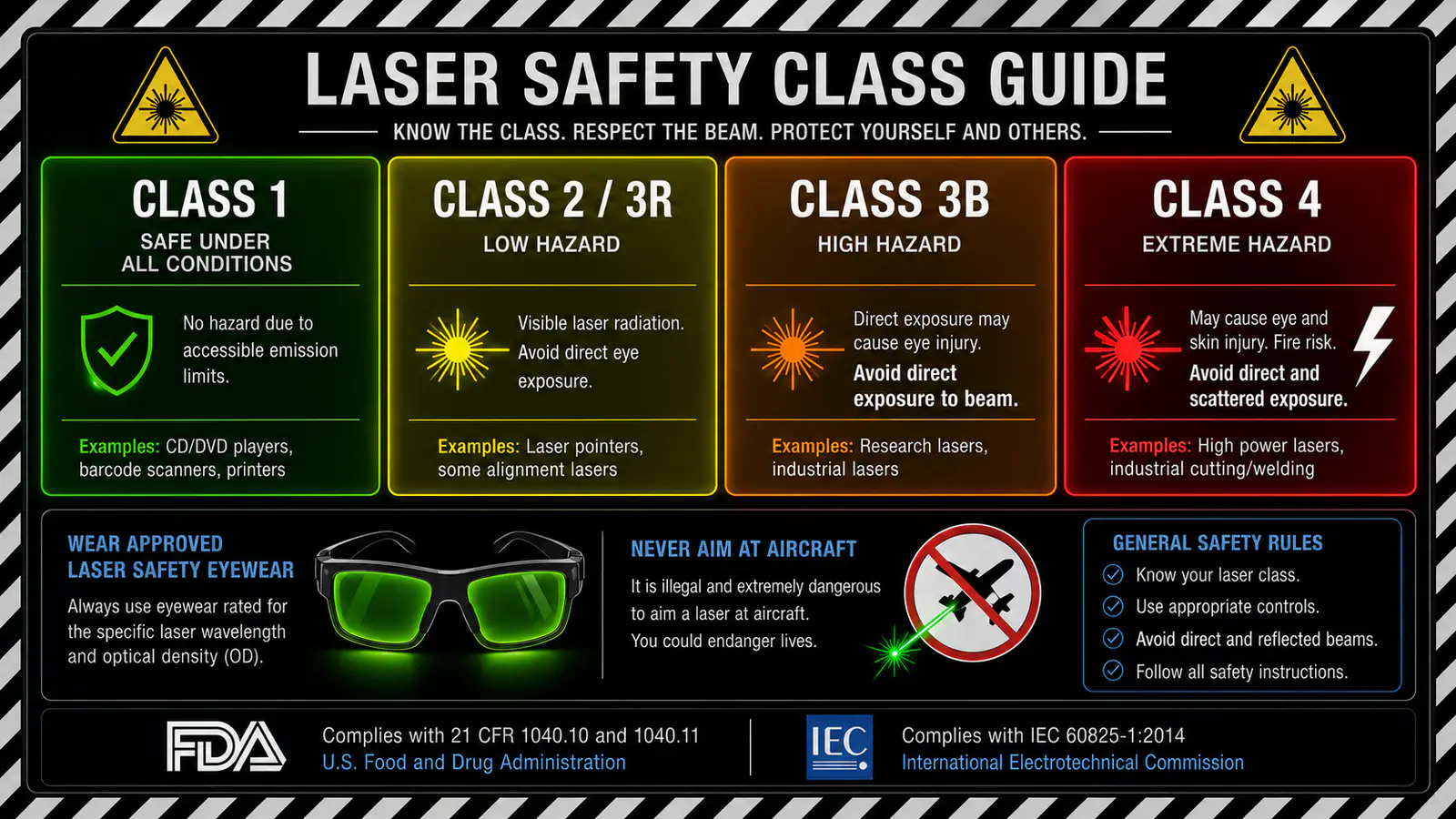
Safety should always take priority over performance, regardless of which category you choose. The level of responsibility increases dramatically as output power rises. Class 3B and Class 4 handheld lasers present genuine risks to eyesight, skin, and property and require significantly greater care than presentation-level devices.
Regulations and Laser Classifications
The FDA classifies laser products intended for pointing separately from higher-powered handheld lasers. According to FDA regulations, visible laser pointers are limited to 5mW within the 400–710nm wavelength range. Products exceeding this limit fall into higher classes and cannot legally be marketed as laser pointers in the United States. These rules are codified under 21 CFR 1040.10 and 1040.11.
The IEC 60825-1 classification system divides lasers by hazard level: Class 1 (safe during normal operation), Class 2 (≤1mW, aversion response/blink reflex provides protection), Class 3R (1–5mW, low risk during brief exposure), Class 3B (5–500mW, serious eye injuries from direct exposure and reflections), and Class 4 (>500mW, skin injury and fire risks requiring full safety protocols including wavelength-matched laser safety glasses and beam stops). Knowing your laser's class is more important than focusing on the advertised power number.
Eye Safety and Medical Evidence
Visible lasers can permanently damage the retina because the eye focuses incoming light onto a very small area. Retinal tissue does not regenerate after injury. Infrared lasers present additional risk because the beam may be invisible while carrying enough energy to cause serious damage. The distinction between retinal damage (permanent, from visible wavelengths) and corneal damage (often heals, more common with IR/UV exposure) is critical for understanding risk.
A systematic review on PubMed covering 48 studies and 111 patients with laser pointer retinal injuries found that 55% of affected eyes had best-corrected visual acuity worse than 20/40. Class 3B and Class 4 lasers require wavelength-matched safety glasses with appropriate optical density. Our complete guide to laser pointer safety covers OD ratings, safe operating procedures, and concepts like Nominal Ocular Hazard Distance (NOHD) and Maximum Permissible Exposure (MPE), defined in standards like ANSI Z136.1.
Legal Consequences and International Regulations
Misusing a laser can result in serious legal penalties. The FAA recorded 10,993 reports of laser strikes involving aircraft during 2025, with civil penalties up to $32,646 per violation. Directing any laser at an aircraft is a federal offense, regardless of power level. Even low-power visible lasers can distract pilots during critical flight phases.
Laser laws vary by country. Some jurisdictions restrict consumer ownership of lasers above 1mW, while others regulate importation and sales differently. Our laser pointer laws by country guide provides a jurisdiction-by-jurisdiction overview of current restrictions and legal considerations.
Frequently Asked Questions
What laser pointer should I buy?
Start by identifying your primary application. Indoor presentations need a reputable 5mW green pen-style laser, while outdoor use or everyday carry is better served by a compact EDC or modern tactical host. Users interested in beam experiments should prioritize power and adjustable focus. Night vision applications require dedicated infrared systems.
Is a 5mW laser powerful enough?
Yes, for presentations and general indoor pointing. Green wavelengths appear much brighter to the human eye than red at the same power level, making a quality 5mW green pointer sufficient for classrooms and conference rooms. Long-distance outdoor use, daylight visibility, and enthusiast applications require a different category of laser rather than simply a higher power rating.
Can I get one that's powerful enough to be seen but not a mini death ray?
Yes. A well-designed compact EDC or tactical laser in the 1.5–1.6W range offers visible beam performance without the extreme hazard profile of 7W+ devices. Adjustable focus provides flexibility to concentrate or spread the beam as needed.
What's the difference between 520nm and 532nm green lasers?
Traditional 532nm green lasers use DPSS (Diode-Pumped Solid-State) technology with an infrared pump diode, a neodymium crystal, and a frequency-doubling KTP crystal. This multi-stage process can introduce temperature sensitivity and infrared leakage in poorly designed systems. Modern 520nm green lasers emit directly from the laser diode, eliminating the crystal assembly and providing more consistent performance across temperature ranges with no risk of IR leakage. For a detailed technical comparison, see our 532nm vs 520nm comparison.
Is adjustable focus worth paying for?
If your laser is used only for pointing at distant objects, fixed focus is sufficient. If you plan to switch between long-distance pointing, close-range demonstrations, photography, or beam experiments, adjustable focus greatly increases versatility by allowing the beam to be optimized for each task.
Ready to Choose the Right Laser Pointer?
Choosing a laser pointer becomes much easier once you stop thinking about output power as the deciding factor. The right laser is the one whose design matches how you actually intend to use it.
For presentations and classroom demonstrations, a quality 5mW green pen laser remains difficult to beat for simplicity and value. If you carry a laser outdoors or want more power without bulk, a compact EDC such as the B025 offers the best balance of portability and performance. For demanding environments, industrial work, or extended outdoor sessions, a modern tactical host provides the durability and thermal management that pen lasers cannot match. Enthusiasts and professionals who value engineering quality, beam precision, and long-term reliability will find those characteristics in premium high-end models.
Start with your application, not your budget. Once you understand how you will actually use the laser, selecting the appropriate category becomes straightforward, and comparing individual models becomes more meaningful.
If you're looking for a durable all-around option, explore the B018 Rugged Build Laser Pointer to see how modern tactical design balances portability, thermal management, and everyday usability. Our collection includes models covering every category discussed in this guide. For a deeper look at performance tiers and engineering considerations, read our high power handheld laser guide.