
Laser Pointer Quality Verification: A 7-Step Checklist (2026)
Buying a laser pointer you can trust is harder than it should be. NIST testing found 90% of green laser pointers fail federal safety standards, and Reddit users report everything from melting plastic to dead-on-arrival units. This guide gives you a 7-step verification checklist to assess label compliance, IR leakage, power accuracy, beam quality, build construction, and seller credibility before and after you buy, no power meter required.
Image Gallery

Nearly 90% of green laser pointers and 44% of red ones fail to meet federal safety regulations.
That is not an estimate from a forum post. It is the finding of a peer-reviewed study published in the Journal of Laser Applications that tested 122 randomly purchased commercial laser pointers. The worst offender was labeled "5 mW" and output 66.5 mW, thirteen times the legal limit.
If you have ever stared at an Amazon listing wondering whether "10000mW" is real or whether that five-star review was paid for, you are not alone. As one Reddit user put it after buying a pointer labeled <5mW that promptly melted black plastic and hit 203 degrees Fahrenheit on a thermocouple: "Wish I had a power meter."
This guide gives you that power meter, in the form of seven verification steps you can execute before and after purchase.
By the end, you will have a printable checklist that transforms the question "Is this laser pointer legit?" from a guess into a systematic evaluation.
Key Takeaways
- A peer-reviewed study of 122 randomly purchased laser pointers found nearly 90% of green units and 44% of red units fail federal compliance, with the worst offender outputting 66.5 mW under a "5 mW" label.
- The FDA defines a legal laser pointer as a visible-wavelength device (400–710 nm) with a maximum output of 5 mW. Anything labeled "laser pointer" above 5 mW is, by definition, not a compliant pointer.
- A NIST investigation found that a green laser labeled 10 mW emitted nearly 20 mW of invisible infrared radiation directly into the beam path. IR filters reduce this leakage by 100 to 1,000 times, but most cheap lasers omit them.
Why the Laser Pointer Market Makes Verification Necessary
The numbers are bad. But the numbers alone don't capture why verification matters.
A Reddit user posted a warning about what happened after they spent real money on a "premium priced laser": the focusing mechanism did not work, the body threads were misaligned, an O-ring was stuck in the threading, the tail button was completely loose.
Worse: the seller told them to fix it themselves. "If I wanted to tinker and build the laser myself, I would have bought the parts separately," the user wrote. "I bought a premium priced laser to have it working and perfect out of the box."
This is not an isolated complaint. On BudgetLightForum, a user described buying an expensive, US-made, "calibrated" laser pointer rated under 5 mW. It died in less than a day.
The company took a week to respond and refused to process a return.
Another user in the same thread summed up the state of the budget market: "Buy two because one might not work, and you will have a higher chance of getting a working one. Expect maybe two months of shipping."
The market is broken in three ways simultaneously.
First, power claims are systematically fraudulent: a Reddit user who measured multiple lasers sold as "1 mW" found "they were all an order of magnitude more powerful than they claimed."
Second, information is severely outdated: a 2024 beginner searching for a safe, correctly labeled replacement found only "ancient forum posts and Reddit threads that recommend models from companies that no longer exist."
Third, quality failures span every dimension: not just power, but mechanical assembly, lens quality, IR safety, thermal stability, and after-sales support.
The rest of this guide breaks verification into seven discrete checks. Each one addresses a specific, documented failure mode.
Step 1, Label Check: Verify Laser Pointer Quality Starting with FDA Compliance
The easiest verification happens before you open the box.
A legal laser pointer sold in the United States must carry a certification label that complies with 21 CFR 1040.10 and 1040.11. The FDA explicitly instructs consumers to check for this label before purchase.
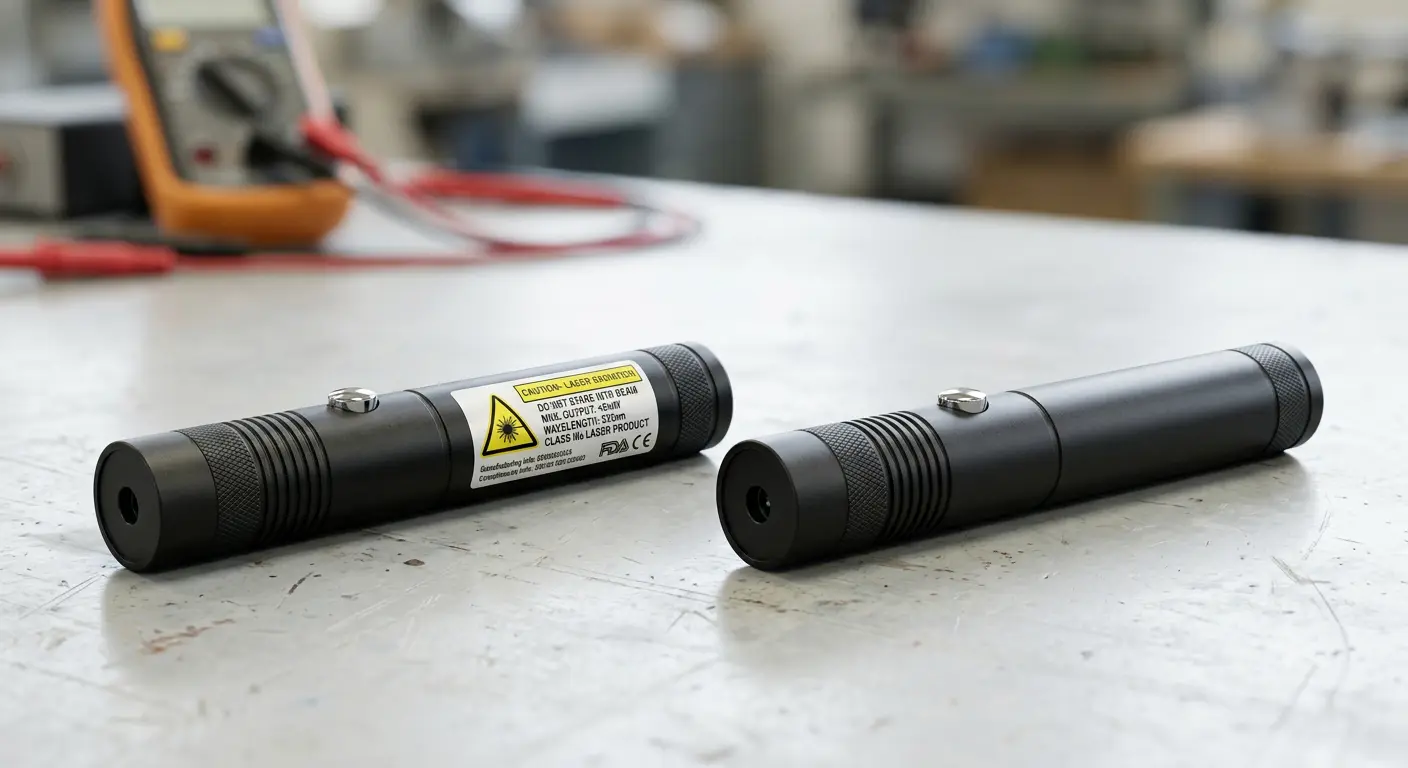
A compliant label includes: the laser classification (Class I, II, IIIa/3R, etc.), the wavelength in nanometers, the maximum output power in milliwatts, the manufacturer's name and location, and the date of manufacture. If the product photo or description shows none of this information, that is your first red flag.
For a deeper breakdown of what each label field means, see our guide to reading laser safety labels.
The FDA defines a laser pointer as a handheld device emitting visible light between 400 and 710 nanometers, limited to 5 mW maximum output.
Devices above 5 mW fall into Class IIIb (5–500 mW) or Class IV (above 500 mW). These are not pointers in any regulatory sense. A seller who calls a 100 mW device a "laser pointer" is already misrepresenting the product.
A genuine complaint low-power laser, like the Laserglow Galileo-3, lists its classification (3R), wavelength (532 nm), output (3–5 mW), IR filter status, and beam divergence (under 1.2 mrad) right on the product page.
This level of transparency is the baseline you should expect.
If a seller cannot or will not provide this information before purchase, assume they will not provide it after purchase either.
Step 2, Technology Check: 532 nm DPSS vs 520 nm Direct Diode
Not all green laser pointers use the same technology. The distinction between 532 nm DPSS (diode-pumped solid-state) and 520/525 nm direct-diode green lasers is the single most important technical decision for any buyer who cares about quality and safety.
A 532 nm DPSS laser works like this: an 808 nm infrared pump diode fires into a neodymium-doped crystal, which converts it to 1064 nm infrared. A second frequency-doubling crystal halves the wavelength to produce 532 nm green light. Each stage loses energy as heat. Each crystal alignment is temperature-sensitive.
If there is no IR filter between the crystals and the output aperture, invisible 808 nm and 1064 nm radiation leaks directly into the beam.
A NIST investigation quantified this risk precisely. Researchers found that a green laser pointer labeled 10 mW emitted nearly 20 mW of invisible infrared radiation, roughly double its visible output.
When they added an IR filter, the leakage dropped by a factor of 100 to 1,000 times.
Accessible IR emission is especially dangerous because the human eye cannot see it. The pupil does not contract. The retina receives the full dose without any natural defense.
A 520/525 nm direct-diode green laser skips the crystal conversion entirely. A semiconductor diode produces green light directly, the same way a blue 450 nm diode produces blue light.
The result: no IR pump, no frequency-doubling crystal, no temperature sensitivity, no hidden infrared leakage.
RP Photonics notes that modern green laser models increasingly use direct laser diodes in the 515–520 nm range instead of the older DPSS architecture.
The practical difference matters most for astronomy. As one BudgetLightForum user observed, DPSS green lasers "are absolutely useless for astronomy since the frequency doubling crystal stops working below about 40 degrees Fahrenheit or just above 0 degrees Celsius." A direct-diode 520 nm laser like the Compact Green Laser Pointer 1.5W 520nm works in the same cold without degradation.
The verification rule: if you are buying a green laser and the seller does not specify whether it is 532 nm DPSS or 520/525 nm direct diode, assume it is DPSS. If it is DPSS, demand explicit confirmation of an IR filter. No IR filter specification, no purchase.
Step 3, Power Proof: Verify Laser Pointer Quality Through Output Testing
A laser power meter (LPM) costs several hundred dollars and most buyers do not own one. That does not mean you are powerless to verify output. But it does mean you need to understand what indirect methods can and cannot tell you.
The "melting plastic" test is the most commonly cited DIY verification method online, and it is useful primarily as a red flag. If a laser labeled under 5 mW melts black plastic or burns paper, it is not under 5 mW. This test tells you only that the laser is dangerously above spec, not by how much.
The "capitalization test," described in our guide to laser pointer power testing, gives a rough tier classification. A laser that can pop a black balloon at close range is likely in the 50–100 mW range. One that can light a match from several inches away is likely above 200 mW. These are not precise measurements, but they do expose gross mislabeling.
For pre-purchase verification, the strongest signal is a seller who provides an LPM graph or a power certificate from a traceable meter.
The Z-Bolt JS-5 Job-Sight laser, a duty-grade green pointer, ships with a factory power certificate showing tested output. The Galileo series publishes beam divergence and certified power specs.
A seller who measures and publishes this data invites verification. A seller who hides behind "up to" or "maximum theoretical" language does not.
If a listing claims "10000mW" or "10W" from a single 18650 battery, the math alone disproves it. A single lithium-ion cell at 3.7 volts nominal can deliver roughly 20–30 watts of electrical power for short bursts.
Laser diodes convert 15–25% of electrical input to optical output. A handheld pointer claiming 10 watts of optical output from one 18650 battery is at the absolute physical limit and almost certainly fraudulent.
Actual verified outputs for single-18650 handhelds top out around 3–4 watts for blue diodes and 1–2 watts for green.
Step 4, Beam Quality Check: What a Healthy Beam Looks Like
Power is easy to lie about. Beam quality is harder to fake, and it is often the first thing to degrade in a cheap laser.
A healthy laser beam from a quality diode produces a round, symmetrical spot when focused to infinity.
The metric that quantifies this is beam divergence, measured in milliradians (mrad). A divergence under 1.2 mrad means the beam stays tight over long distances, critical for astronomy and long-range pointing. A divergence above 2.5 mrad produces a visibly spreading beam that loses intensity quickly.
The technology inside determines the beam profile. A genuine Nichia diode, used in premium pointers, produces a beam with a M-squared factor under 1.5. This means the beam can be collimated into a tight, clean spot. M-squared measures how close a real beam is to a perfect theoretical Gaussian beam; 1.0 is perfect.
A generic diode at one-fifth the price typically emits an elliptical, multi-mode beam with M-squared above 2 or 3. This cannot be focused to a tight spot regardless of lens quality.
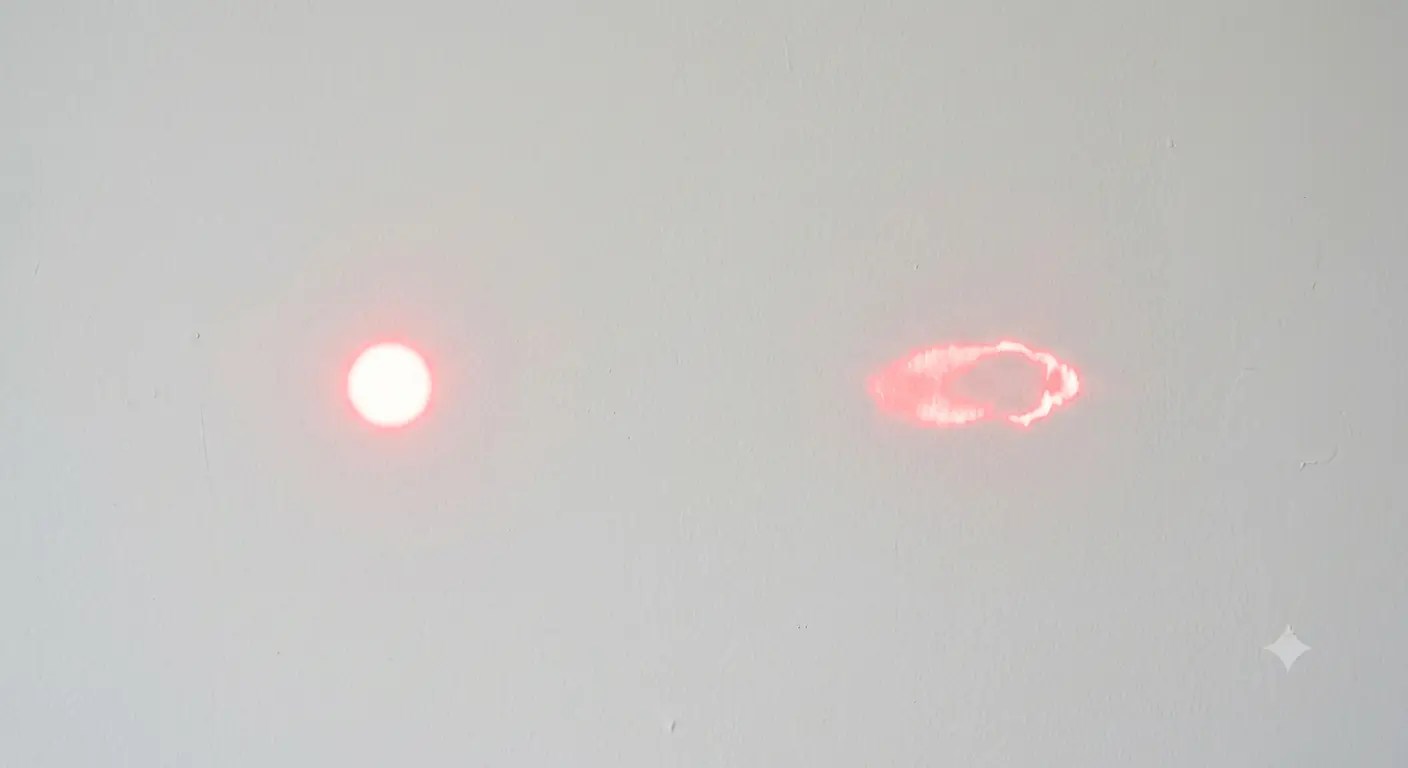
Three beam problems signal poor quality. Mode hopping, where the beam jumps between different spatial patterns, appears as a flickering or shifting spot profile. Dual beams, where two distinct spots appear instead of one, indicates a misaligned or damaged diode. Irregular spot shape, where the dot looks like a streak, a crescent, or a blob instead of a circle, signals a defective lens, a damaged diode facet, or both.
A Reddit user on the Laser Pointer Forums documented a common failure where "the beam mode hops between TEM00 and TEM01" (two different spatial energy distributions), producing a beam that shifts from a round dot to a figure-eight pattern every few seconds. This is a diode or crystal defect. No amount of focusing will fix it.
The pre-purchase check: if a listing shows a beamshot photo, zoom in on the spot. A clean, round, evenly illuminated dot is what you want. An oval, a streak, or a spot with dark patches or rings is what you are trying to avoid. If there are no beamshot photos at all, you are buying blind.
Step 5, Build Quality Check: 5 Things to Inspect When You Open the Box
Once the laser arrives, the physical inspection begins. These five checks catch the most common assembly failures that Reddit and forum users report.
One: the focusing mechanism. Rotate the focus ring through its full range. It should move smoothly with consistent resistance.
If it grinds, sticks, or has loose play, the threads are poorly machined or the lens assembly is misaligned.
A Reddit buyer of an expensive laser reported the "focusing part in the front does not work" out of the box.
Two: body threading and alignment. Unscrew the tail cap and the head if removable. The threads should engage smoothly without cross-threading. When reassembled, body sections should sit flush with no visible gap or misalignment. The same buyer found "the two parts don't line up at all" and an O-ring jammed in the threading.
Three: the tail switch. Press it repeatedly. It should click with consistent tactile feedback and return immediately. A loose, mushy, or intermittent switch is the most common point of failure in budget pointers. "The back button is completely loose," the same Reddit user reported.
Four: battery fit and contact. Insert a battery. It should slide in without excessive force and make firm contact at both terminals. A rattling battery means the tube is oversized or the spring contacts are weak. A BudgetLightForum discussion on generic 301/303 lasers noted that contact problems and battery mismatch are routine: some users even reported their goggles did not match the wavelength of the cheap 532 nm laser they bought.
Five: the lens and aperture. Inspect the lens under a bright light. It should be clear, without scratches, haze, or debris. A dirty or scratched lens indicates poor handling during assembly. If the lens is plastic rather than coated glass, it will degrade under the thermal load of continuous use, particularly with lasers above 500 mW.
Step 6, Seller Trust Check: The Final Laser Pointer Quality Verification Step
A laser pointer is only as good as the company that stands behind it. The seller trust check is the step most buyers skip, and it is the one that most often determines whether a problem becomes a disaster.
Three seller signals carry the most weight.
First, a specific, written warranty with clear terms. "Lifetime warranty" without a written policy is marketing. A warranty that states coverage duration, what is included (diode? driver? lens? switch?), and how to initiate a claim, is a contractual commitment.
BigLasers explicitly recommends checking whether a seller provides a warranty, a returns window, a reachable phone number, and responsive customer support before purchasing.
If you cannot find a phone number or a warranty page, that is information, not an oversight.
Second, a documented return and refund process. The BudgetLightForum user whose expensive calibrated laser died in less than a day illustrates the nightmare scenario: the company took a week to respond and refused to help.
The Reddit user whose premium laser arrived broken was told to fix it themselves.
Before buying, search for "[brand name] return" or "[brand name] warranty Reddit" and see what actual buyers report.
Third, transparent specifications that match physical reality. A seller who publishes beam divergence, diode manufacturer, driver type, IR filter status, and duty cycle rating is a seller who expects their products to be scrutinized. A seller whose listing contains only wattage claims and stock photos is a seller who expects buyers not to check.
The community trust signal: forums like Laser Pointer Forums maintain informal seller reputation tracking. A seller with a long thread of unresolved complaints is a risk regardless of what their website says. A seller consistently recommended by experienced community members carries more weight than any advertised claim.
Step 7, Laser Pointer Quality Verification: The Complete Checklist
The seven checks above combine into a single scorecard. Print this or keep it open when shopping.
Any three red flags is a hard pass. Two red flags is a very high risk purchase. One red flag demands closer inspection of the specific issue. Zero red flags and at least four passes: you are looking at a quality laser pointer.
A good laser passes these checks not because it is expensive, but because it is verifiable.
The Galileo series at around $80–$90 hits every pass criterion in the compliant low-power category: IR-filtered, APC-regulated, 100% duty cycle, divergence under 1.2 mrad, and a published datasheet.
At the premium end, the Nichia Precision Blue Laser 4W from Laserpointerhub uses a genuine Nichia NUBM44 diode with beam quality you can verify against published specifications.
Price does not guarantee quality. Verifiability does.
Conclusion
The laser pointer market rewards skepticism and punishes trust. When nine out of ten green laser pointers fail independent compliance testing, assuming a listing is honest is not optimism; it is a calculated risk with poor odds.
You now have a systematic approach to verification. Start with the label, because a missing label tells you everything you need to know. Understand the technology inside, because 532 nm DPSS without an IR filter is a fundamentally different product from a 520 nm direct diode.
Demand power proof or use indirect checks to catch gross mislabeling. Inspect the beam, the build, and the seller with the same rigor.
The verification checklist at Step 7 is designed to be used. Save it to your phone. Open it when you are looking at a listing. Run through the seven passes, warnings, and red flags. If a seller's product cannot survive this checklist, there is a reason.
If you want to see what a fully verifiable laser pointer looks like, browse Laserpointerhub's listings like the Elite 520nm Green Laser, where every product page includes diode manufacturer, wavelength, output power, and build specifications.
For a deeper explore specific verification topics, our guide to laser pointer build quality covers the four components inside every pointer, and the laser pointer power testing guide walks through exact LPM and DIY measurement procedures.
Author Bio: The Laserpointerhub team tests and reviews high-power laser pointers with a focus on verifiable specifications and safety compliance. Every recommendation is backed by community data, independent lab reports, and hands-on evaluation.
Frequently Asked Questions
How can I tell if a laser pointer is really under 5 mW?
Check the certification label first. A compliant pointer sold in the US must display classification, wavelength, maximum output, and manufacturer per FDA 21 CFR 1040.10. If the pointer melts black plastic, burns paper, or feels warm on skin within seconds, it is not under 5 mW. A power meter provides definitive measurement, but these indirect red flags are reliable disqualifiers.
Do 532 nm green laser pointers leak infrared?
Most do, unless they include an explicit IR filter. A 532 nm DPSS laser generates green light by converting 808 nm and 1064 nm infrared through crystals. Without an IR filter, invisible infrared radiation leaks directly into the beam. NIST testing found a 10 mW-rated green laser emitting nearly 20 mW of IR. An IR filter reduces leakage by 100 to 1,000 times.
Is a 520 nm green laser safer than a 532 nm?
A 520/525 nm direct-diode green laser eliminates the IR leakage problem entirely because it produces green light directly from a semiconductor, with no infrared pump stage. It is also immune to the temperature sensitivity that causes 532 nm DPSS lasers to fail below roughly 40°F, making it the better choice for astronomy and cold-weather use.
What should a trustworthy laser pointer seller provide?
A trustworthy seller publishes the laser classification, exact wavelength, verified output power (preferably with an LPM graph or certificate), diode manufacturer, IR filter status (for DPSS greens), beam divergence in mrad, duty cycle rating, a written warranty with clear terms, and a published return or refund policy. If any of these are missing, ask why.
Are Amazon laser pointers safe to buy?
The NIST and AIP studies that found 74–90% non-compliance rates purchased their test samples from online retailers including Amazon. The platform itself does not verify laser compliance. Safety depends entirely on the specific seller and product. Apply the verification checklist in this guide to any listing, regardless of marketplace. A product with no label, no specifications, and no seller transparency is equally risky on Amazon, eBay, or any other platform.