
Laser Pointer for Construction Work: A Practical Guide for Landscaping & Professional Use
A practical guide to using a laser pointer for construction work, landscaping, and industrial maintenance. Learn about daylight visibility, key features, safety compliance, and choosing the right laser.
Image Gallery

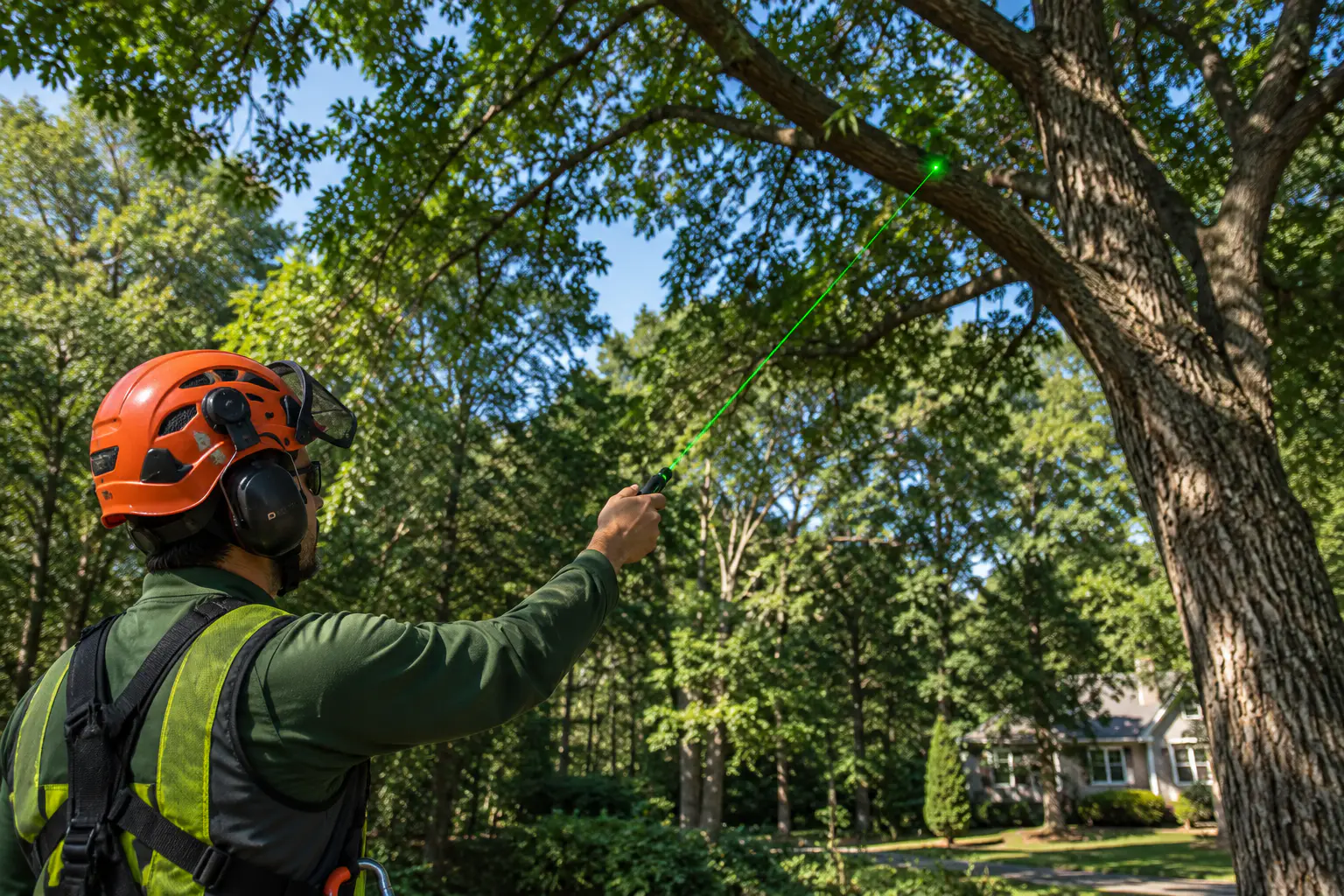
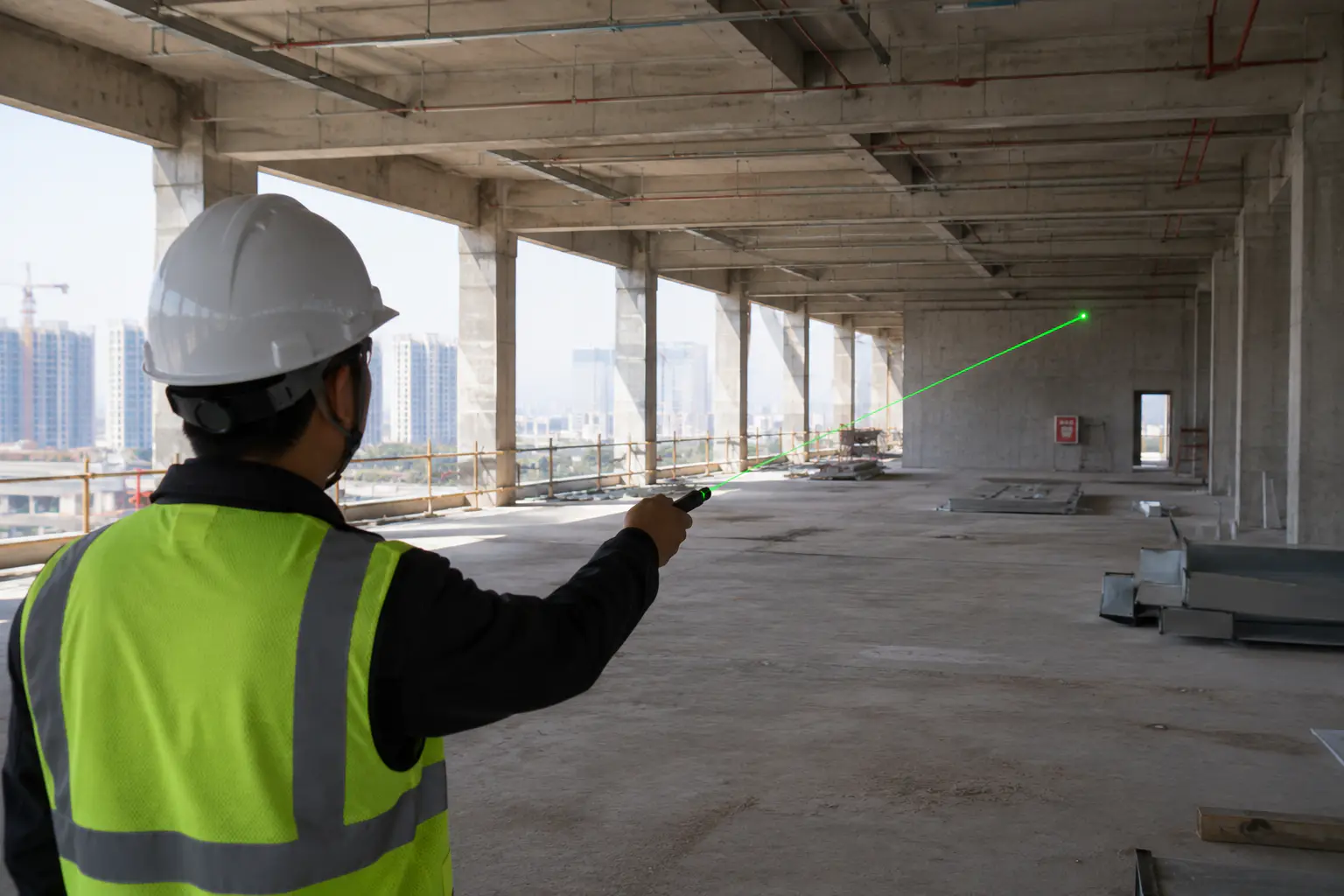
If you need a laser pointer for construction work, you already know that the cheap presentation pointers sold at office supply stores will not cut it on a real job site. Walk onto a commercial construction site or an arborist job, and you will see crews using purpose-built handheld lasers to point out ceiling defects 50 feet up, identify which specific branch needs trimming, or trace a conduit run across a crowded mechanical room. If you work in the trades and have wondered whether a better laser would make your job easier, the answer depends on understanding how these tools behave in real working conditions, not what the marketing specs claim.
This guide covers the four most common professional use cases, how daylight and indoor lighting affect what you can actually see, the five technical features that separate a job-site tool from a gadget, and the safety and compliance boundaries every professional should know. You will also find a scenario-based configuration table to match the right laser to your specific work.
Key Takeaways
- Construction QA inspectors regularly use handheld lasers at 100-200 feet to point out punch-list defects above ceilings and inside electrical gear.
- Daylight visibility is conditional: green is the brightest color to the human eye, but even a green laser becomes difficult to see past 30 feet in direct sun.
- OSHA classifies job-site laser use under 29 CFR 1910.132 and 1910.133, with specific PPE requirements that vary by laser class.
- The right laser choice depends on working distance, ambient lighting, target surface material, and whether you need a tight spot or a visible beam.
- Job-site lasers need ruggedness features, dust sealing, drop resistance, pocket clips, and accidental-activation prevention, that consumer pointers lack.
Why Professionals Use Handheld Laser Pointers on the Job
Handheld laser pointers earn their place in a professional's tool kit for one reason: they let one person direct another person's attention to a specific point at distance, without walking over, climbing a ladder, or playing "no, the other pipe." That sounds simple, but the productivity gain is real.
Arborist communication. An arborist using a green laser to point out a limb in a tree canopy can communicate with a homeowner or crew member in seconds, not minutes. One arborist on ArboristSite reported closing a $12,000 job the same day he switched to a stronger laser, because the homeowner could finally see exactly which branches he was recommending for removal.
Another described the laser as "very helpful in pointing out limbs or defects in the canopy or explaining where a cabling system will go." The common thread: a laser turns a vague conversation about "that branch up there" into a precise visual reference.
Construction QA and inspection. A quality assurance inspector walking a punch list on a commercial project may need to point out a missing conduit mount 30 feet above the floor, or a loose bolt deep inside an electrical switchgear. On Laser Pointer Forums, one QA inspector described needing a tool that could produce a "bright, sharp, focused point" at 100 to 200 feet. Without it, the alternative is climbing a ladder, or worse, trying to explain the location verbally while someone else squints upward.
MEP and industrial maintenance. Mechanical, electrical, and plumbing engineers doing site visits rely on lasers to trace specific pipes and conduits in crowded ceiling spaces. One MEP engineer on Reddit put it simply: "Laser pointer works great and makes communication easier when trying to point out and trace a specific conduit/pipe."
In industrial maintenance, a worker on the plant floor can point out a missing bolt on a catwalk 25 feet up without stopping work to find a ladder, get a permit for that ladder, set it up, and climb. The time savings add up fast.
Warehouse and logistics. In large distribution centers with shelving 30 feet or higher, crew members use lasers to identify which bin or pallet needs attention. This is one of the simplest applications, a green dot on a specific box eliminates "which shelf?" questions entirely.
How Daylight and Environment Affect Visibility
The most common complaint from professionals using lasers on the job is that what looks bright in a dark room becomes invisible outdoors or under bright industrial lighting. This is not a product flaw; it is physics.
Green is the brightest color by a wide margin. The human eye's photopic vision (daylight adaptation) peaks at 555nm, very close to 532nm green laser wavelength. A 200mW green laser appears 5 to 7 times brighter than a 200mW red laser at the same power. That is why green is the default recommendation for daytime use.
But even green has limits. One construction Reddit user noted: "as great as a green beam is, it is still difficult to see after about 30 feet outdoors." An arborist on ArboristSite confirmed: "I had a green laser pointer and it worked OK. Still was a little hard to see in very bright light."
Five lighting conditions, five different answers. Professional visibility depends on ambient light level more than any other variable:
- Open sun (direct daylight): Only high-power green (200mW+) works, and only for the dot, the beam is invisible. Range is limited to roughly 30-50 feet depending on target surface.
- Shade canopy (tree cover, building shadow): Green at 100mW+ works well for the dot. Beam becomes faintly visible in deeper shade.
- Bright indoor (warehouse lighting, fully lit factory): Green at 100mW+ or blue at 1000mW+ produces a clear dot. Beam visibility is minimal.
- Dim indoor (mechanical rooms, parking garages): Green at 50mW+ or blue at 500mW+ produces a visible dot and a faint beam. Red becomes usable here.
"Seeing the dot" is not the same as "seeing the beam." For most professional pointing tasks, the dot on the target surface is what matters, not the beam cutting through the air. Arborists need the dot on a specific branch. QA inspectors need the dot on a specific fastener.
Beam visibility matters only in low-light conditions where it helps the pointer's holder aim. Professionals evaluating a laser should test dot visibility on their actual work surface, not beam visibility in a dark room.
Target surface changes everything. A green dot that is crisp on white concrete may be nearly invisible on dark roofing material, rusted steel, or wet foliage. Reflective surfaces (metal ducts, polished floors) can create glare that washes out the dot entirely. The same laser performs differently on every surface, which is why adjustable power or a second wavelength option can be valuable for professionals who work across multiple environments.
5 Key Features of a Laser Pointer for Construction Work and Professional Use
Consumer laser pointers are designed for occasional use in dim rooms. Professional job-site lasers need a different set of capabilities. Here are the five that separate a work tool from a toy.
1. Beam divergence and spot size. Divergence measures how much a laser beam spreads over distance, expressed in milliradians (mRad). A laser with 1.2 mRad divergence produces a spot roughly 1.2 inches wide at 100 feet. At 200 feet, that same laser produces a 2.4-inch spot.
That matters because a large, fuzzy spot cannot pinpoint a specific bolt or bracket. On Laser Pointer Forums, professional users specifically discuss divergence as a key selection criterion.
For pointing tasks at 100 feet or more, look for divergence under 1.5 mRad, ideally under 1.2 mRad.
2. Focus adjustability. Fixed-focus lasers are set at the factory for a specific distance, typically 30-50 feet. A laser focused at 50 feet produces a blurry, oversized dot at 10 feet or 200 feet. Adjustable focus lets the user dial in a tight spot at whatever distance they are working.
This is especially valuable for professionals who switch between near (desk height) and far (ceiling height) targets throughout the day. The laser pointer build quality guide covers how focus mechanisms differ between consumer and professional-grade units.
3. Battery runtime that matches the shift. The biggest complaint about combination tools (flashlight-plus-laser units) is that "it has very limited battery capacity for its size," as one construction Reddit user put it. Professionals working an 8-hour shift need a laser that lasts the full day, or uses standard replaceable batteries (18650 or 16340) that can be swapped in seconds. Removable batteries are more practical than built-in USB cells because a worker can carry pre-charged spares and hot-swap without downtime.
4. Ruggedness for the job site. Construction sites, tree canopies, and plant floors are dusty, wet, and unforgiving. A professional laser needs to handle drops onto concrete, resist dust ingress, survive incidental oil submersion, and fit in a pocket with a clip. On Reddit's r/Tools, one industrial maintenance user asked for "a good, pen sized laser pointer with a pocket clip, that can handle being dropped and probably accidentally submerged in oil for less than say, $50." That combination of requirements, pocketable, rugged, affordable, is exactly what consumer pointers fail to deliver.
5. Safety features that prevent accidents. A high-power laser on a job site is not a toy, and it should not be treated like one. Key-lock switches prevent unauthorized use. Momentary-on buttons prevent the laser from being left on accidentally. Bright visual indicators show when the laser is active.
These features are especially important on sites where multiple crew members are working at different elevations and may not be aware that a laser is being aimed in their direction. The class 3R vs class 4 laser safety guide explains the differences between laser safety classes and what each means for job-site use.
Safety & Compliance on the Job Site
Using a laser pointer for professional work introduces regulatory obligations that most consumer users never encounter. OSHA and the FDA both have clear rules about what constitutes a "laser pointer" and what safety measures are required when higher-power lasers are used in the workplace.
What the FDA allows as a "laser pointer." The FDA's Center for Devices and Radiological Health regulates laser products sold in the United States. Per the FDA's guidance to manufacturers, products promoted for pointing and demonstration purposes are limited to Class IIIa (also called Class 3R), with a maximum output of 5 milliwatts in the visible spectrum (400-710nm).
Lasers above 5mW up to 500mW fall into Class IIIb (Class 3B).
The FDA explicitly states that "Class IIIb lasers cannot legally be promoted as laser pointers or demonstration laser products." This means that if you are using a high-power laser (100mW+) on a job site for pointing, you are using it outside its intended labeling, and your employer's safety program should account for that.
OSHA requirements. The Occupational Safety and Health Administration's laser hazard standards (29 CFR 1910.132 and 1910.133) require employers to assess laser hazards and provide appropriate personal protective equipment. OSHA references the ANSI Z136 series of laser safety standards, including Z136.6 (Safe Use of Lasers Outdoors) and Z136.9 (Safe Use of Lasers in Manufacturing Environments).
For Class 3B and Class 4 lasers, OSHA's guidelines require control measures, PPE (laser safety glasses with the correct optical density for the wavelength in use), and operator training. The laser safety glasses guide covers how to select the right eye protection for specific wavelengths and power levels.
What this means for professionals. If you use a handheld laser primarily for pointing at distance (not burning or cutting), a green laser in the 100-200mW range offers a practical balance of visibility and safety. These lasers are Class 3B devices.
While they produce a bright dot at distance, they also require awareness of the hazards: direct beam eye exposure can cause injury, and reflected beams from shiny surfaces can also be dangerous.
Berkeley Lab's official laser pointer advisory states that Class 3B and Class 4 lasers should not be used as laser pointers, and that all laser use at the lab must comply with ANSI Z136.1. Professionals should adopt the same standard: know your laser's class, wear appropriate eye protection when using Class 3B or higher, and never aim at people, vehicles, or aircraft.
When a Laser Pointer for Construction Work IS the Right Tool (and When It Isn't)
Handheld lasers excel at one thing: directing attention to a specific point at distance, quickly, with minimal setup. They are not the right tool for every job-site task. Knowing the boundary between what a handheld laser does well and what it does poorly prevents frustration and wasted money.
Good uses for a handheld laser:
- Pointing out a specific branch, defect, or fastener to another person
- Tracing a pipe or conduit run across a ceiling or wall
- Identifying inventory location in high shelving
- Walking a client through a punch list or estimate
- Signaling a location in low-light conditions
Better alternatives exist for:
- Layout and leveling over long distances: a rotary laser with a receiver can be seen at hundreds of feet in daylight and remains the standard tool for outdoor grading and foundation layout. One construction Reddit user noted: "I've yet to find a reliable, strong laser level that works outdoors" without a receiver, and recommended "getting the corresponding receiver for outdoor work."
- Precision measurement: laser distance measures (LDM) provide accurate distance readings. Handheld pointers do not.
- Alignment tasks requiring absolute parallelism: as noted on a CNC forum, "the issue is that the laser needs to be absolutely parallel to the Z axis", a requirement that consumer-style handheld lasers cannot meet without custom mounting.
Recommended Configurations for Professional Scenarios
Matching the right laser to the specific job prevents the "works in the showroom, fails on site" problem. The table below maps common professional scenarios to recommended specifications and compatible products from Laserpointerhub's lineup.
Each product in this table is designed for sustained professional use, with aluminum alloy bodies, replaceable batteries, and safety features that meet the requirements discussed in this guide.
Frequently Asked Questions
Can a laser pointer be seen in daylight?
Yes, but with significant caveats. Green lasers (532nm or 520nm) are the most visible in daylight because the human eye's peak sensitivity is near that wavelength. A 200mW green laser produces a visible dot on most surfaces in daylight, but the useful range drops to roughly 30-50 feet in direct sun. Red lasers are effectively invisible outdoors in daylight.
What laser pointer do construction workers use?
Construction workers who use lasers for pointing typically choose green lasers in the 100-200mW range for their combination of daylight visibility and manageable safety requirements. Blue lasers at higher power (1600mW+) are used in bright indoor environments where the extra power compensates for ambient lighting.
Is it legal to use a high-power laser pointer on a job site?
It depends on the laser class and the application. The FDA limits products sold as "laser pointers" to Class 3R (5mW maximum). Higher-power Class 3B lasers can be used on job sites for pointing, but they cannot legally be marketed as laser pointers, and OSHA requires employers to implement control measures, provide PPE, and ensure operator training.
What color laser is best for outdoor daytime use?
Green (520nm or 532nm) is the best choice for daytime outdoor use. It appears 5-7 times brighter than red at the same power and provides the most visible dot on foliage, concrete, and building materials.
How far can a professional laser pointer reach?
A 200mW green laser produces a clearly visible dot at 100-200 feet in low light, but that range drops to 30-50 feet in direct sunlight. Higher-power blue lasers (1600mW+) extend the useful daytime range further, but beam divergence becomes the limiting factor at longer distances, a laser with high divergence produces a spot too large to be useful for precise pointing beyond 200 feet.