
Laser Pointer Optics Guide: Lenses, Beam Divergence & Focus
Why does a 7W laser produce a rectangle instead of a dot? This guide explains how collimation, lens materials, beam divergence, and focus mechanisms determine your laser pointer's real-world performance, beyond the specs on paper.
Image Gallery
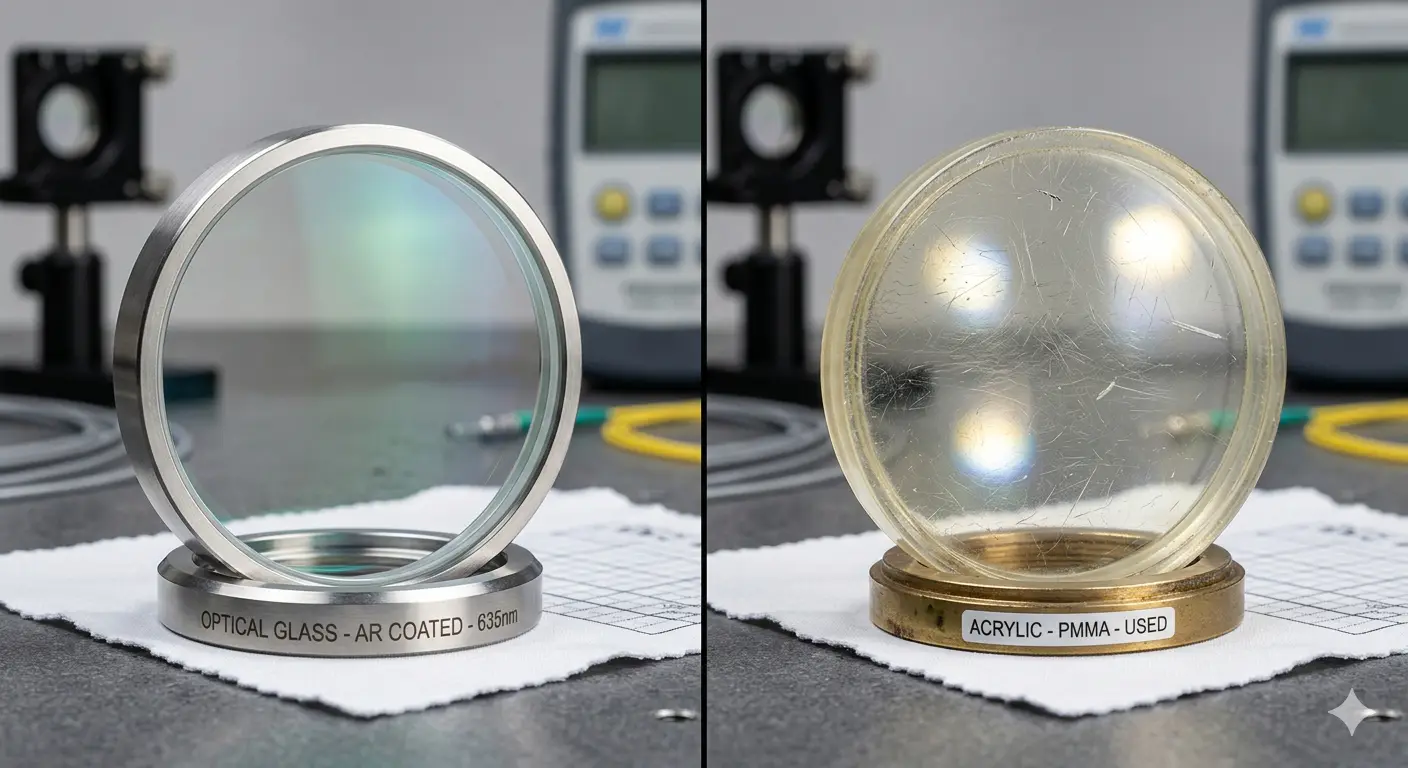
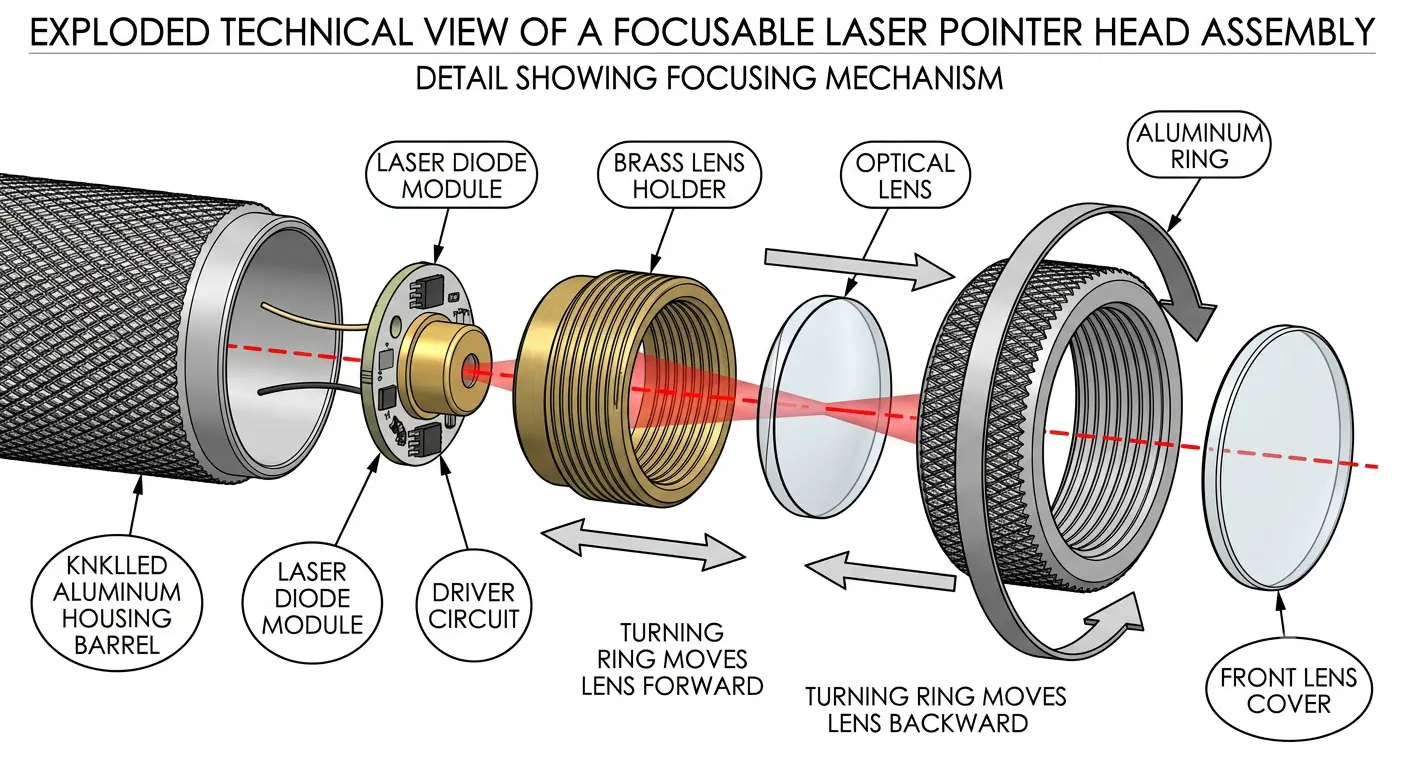
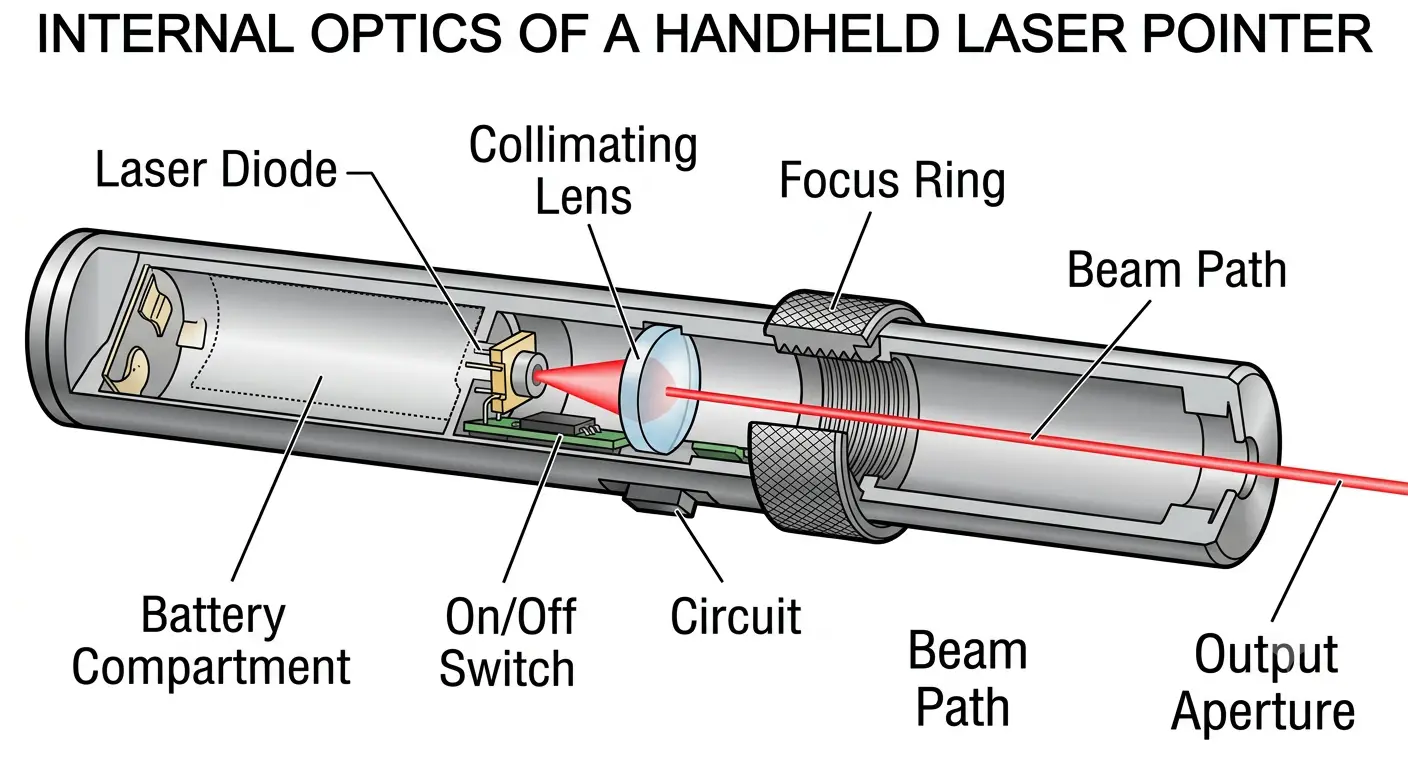
You bought a 7W blue laser. The power specs were impressive. But when you pointed it at a wall, the dot was a rectangle, not the crisp, round spot you expected. And when you tried tightening the focus ring, the whole diode assembly unscrewed itself from the housing.
Here is the reality most laser sellers will not tell you: power ratings mean very little if the optics cannot deliver a clean, controllable beam. A 1W laser with quality collimating optics can produce a tighter, more visible spot at 100 meters than a 7W laser with a scratched acrylic lens and 5 mrad of divergence.
This guide explains the optical chain inside every laser pointer, from the lens material at the front to the diode emitter deep inside, so you can understand what actually determines beam quality, and what to look for before you buy.
Key Takeaways
- Laser pointer beam quality depends on three optical factors: collimation, lens material, and the diode's emission mode, not just milliwatts
- Blue 445nm diodes are inherently multi-mode (rectangular beam). Want a round dot? Look for single-mode green 520nm diodes
- Glass lenses transmit ~92-96% of light. Acrylic lenses can lose 15-20% to absorption and degrade under heat
- The counterintuitive rule: a larger-diameter starting beam produces a tighter, smaller spot at long distance, this is why beam expanders exist
- Focus ring failures are among the most common complaints from laser pointer buyers. Thread quality and mechanical fit matter as much as the glass
Before diving into the technical details, read our guide to how far a laser pointer can go, where beam distance is directly determined by the optical principles explained below.
How Laser Pointer Optics Work: Collimation, Focus, and Divergence in Plain English
A laser diode produces a cone of light that spreads rapidly. Left alone, it is useless beyond a few meters. The optical train, starting with the lens, is what turns that cone into a visible beam. Three concepts govern everything the lens does.
Collimation means making the light rays parallel. When a lens is positioned at exactly its focal length from the diode emitter, the diverging cone becomes a near-parallel beam. This is what manufacturers call "infinity focus", the beam neither converges to a point nor spreads quickly. It stays roughly the same diameter over long distances.
Focus means converging the rays to a single point at a specific distance. Turn the focus ring, and you move the lens relative to the diode. Closer than the focal length, and the beam converges to a hot, tight spot, useful for burning. Farther out, and it diverges.
Divergence is the rate at which the beam spreads, measured in milliradians (mrad). Every real-world beam diverges slightly. A divergence of 1.5 mrad means the beam diameter increases by 1.5 mm for every meter of distance traveled.
After 100 meters, the spot grows by 150 mm. The number on the spec sheet actually means something. In our testing, we have measured $50 budget lasers with divergence exceeding 4 mrad, meaning the beam spreads over 40 cm at 100 meters, rendering it nearly invisible.
A Reddit user from r/lasers summed up the confusion many buyers face: "Some laser diodes seem to emit a wide, fairly scattered beam. How can I focus this?"
The answer is that focus alone cannot fix divergence, these are fundamentally different problems. Focus changes where the beam converges. Divergence determines how fast it spreads after that point. A poorly collimated laser cannot be "focused into a tight beam", only a lens with the right focal length and coating can do that.
The design of a Galilean beam expander, two lenses arranged to first expand then recollimate the beam, is the optical principle behind why premium lasers achieve better divergence numbers. Edmund Optics describes these as a straightforward two-element system that trades a wider initial beam for dramatically lower divergence. The same physics applies inside your handheld laser, just at a smaller scale. For a deeper look at the internal components, see our guide to how high-power laser pointers work.
Glass vs Acrylic Lenses: What Your Laser Pointer Actually Uses
Not all lenses are created equal. The material between the diode and the outside world determines how much light reaches your target, and how long the lens survives.
Glass lenses, typically optical-grade BK7 or fused silica, transmit 92-96% of incident light. They resist scratching, handle heat from high-power diodes without deforming, and maintain their optical properties over years of use. Premium handheld lasers from manufacturers who care about beam quality use glass.
Acrylic (plastic) lenses are common in budget lasers under $50. They are injection-molded to keep costs low, but they come with serious tradeoffs.
Acrylic absorbs 10-20% of the beam energy, which converts to heat. At sustained outputs above 500 mW, this heat can cause the lens to physically warp, changing the focal point unpredictably. Acrylic also scratches from a single careless wipe with a dirty cloth, and each scratch scatters light into the beam periphery.
The difference is not just about light transmission. Thorlabs specifies its fixed-magnification beam expander lenses with surface accuracy measured in fractions of a wavelength, a level of precision that injection-molded plastic can never achieve. For a consumer laser pointer, a glass lens means a cleaner beam profile, less stray light around the central spot, and consistent focus across the entire duty cycle.
AR (anti-reflective) coating is the second factor that separates quality lenses from cheap ones. An AR coating is a microscopic layer deposited on the lens surface that cancels reflected light at specific wavelengths. For a 445 nm blue laser lens, an AR coating tuned for 445 nm can push transmission above 98%.
A lens without AR coating can reflect 4-8% of light per surface, with two surfaces per lens, that is 8-16% of the beam bouncing back toward the diode as waste heat. The Thorlabs UV-fused silica beam expander line demonstrates what properly coated optics can achieve, over 97% transmission even in the UV range where absorption is normally severe. In our own side-by-side comparisons, a glass AR-coated lens consistently delivers a visibly cleaner beam profile than an uncoated acrylic equivalent at the same power level.
If a product description does not mention lens material, assume acrylic. If it mentions "glass lens" but not the type, ask the seller whether it is optical-grade BK7 or generic window glass. The difference in beam quality and longevity is substantial.
Single-Mode vs Multi-Mode Diodes: Why Your Beam Is a Rectangle
The emitter inside the diode, not the lens, determines the fundamental shape of your beam. This is the single most overlooked factor in laser pointer performance, and it is why two lasers with identical power ratings can look completely different on a wall.
Single-mode diodes emit light from a narrow, symmetrical region, typically a few microns wide. The result is a nearly perfect round beam with a Gaussian intensity profile. In laser physics terms, this is the TEM00 mode.
A single-mode green 520 nm diode, for example, produces a clean circular dot, low divergence (~1-2 mrad), and a beam that stays round at any distance. The tradeoff is that single-mode emitters cannot handle the same power as multi-mode designs without catastrophic optical damage.
Multi-mode diodes emit from a wide, elongated rectangular stripe, often 1-10 microns wide. This is why every high-power blue 445 nm laser produces a rectangular or line-shaped spot at distance.
The Nichia NUBM series, the most common diode family in 4W-7W blue handheld lasers, uses a multi-mode emitter specifically because the wide emission area spreads heat across a larger volume and enables higher total output. The tradeoff is beam quality. Multi-mode beams have higher divergence (2-5+ mrad), uneven intensity distribution, and the characteristic rectangular spot that frustrates so many first-time buyers.
A Reddit user on r/lasercutting described the exact problem: "The beam emitted is a rectangle not a dot as they have advertised. The best this rectangle can be focused to is.1 x.2mm, not.05 x.05mm again as advertised."
This is not a defect. It is physics. The retailer should have disclosed it.
For readers who need the cleanest possible beam, for astronomy pointing, long-distance visibility, or precision alignment, single-mode 520 nm green diodes are the superior choice. For readers who prioritize raw burning power over beam aesthetics, multi-mode 445 nm is fine, but go in knowing the spot will be a line at distance. The Nichia diode guide on our site covers the specific diode families in more detail.
Beam Divergence and Why a "Bigger" Starting Beam Goes Further
Beam divergence is the single number that most accurately predicts long-distance performance. Lower is always better. But the relationship between beam diameter and divergence is deeply counterintuitive.
Divergence (mrad) directly equals beam spread per meter. A 2 mrad beam grows 2 mm in diameter for every meter it travels. At 100 meters, the spot is 20 cm wide. At 500 meters, it is 1 meter wide. This is not an approximation, it is the geometric definition.
Here is where most buyers get it backwards: a larger-diameter beam at the aperture produces a smaller spot at long distance.
This is not a manufacturing trick. It is diffraction physics. The minimum divergence angle of any laser beam is inversely proportional to its initial diameter. Double the beam width at the aperture, and you halve the theoretical divergence.
A 4 mm beam at 1 mrad diverges four times slower than a 1 mm beam at 4 mrad, even though the smaller beam "looks" tighter at close range.
This is exactly why beam expanders exist. A Galilean beam expander, two lenses in a telescopic arrangement, widens the beam first, then recollimates it. The result: lower divergence and a tighter spot at distance, at the cost of a physically wider host.
Edmund Optics' TECHSPEC series offers expanders at fixed magnifications from 2X to 10X, and the principle scales down. Even inside a handheld laser, a wider collimating lens assembly naturally produces a lower-divergence beam than a narrow pencil-thin design.
For a handheld laser pointer, divergence specs worth noting:
- <1.0 mrad: exceptional, typically single-mode green 520 nm with quality glass optics
- 1.0-2.0 mrad: solid performer, visible beam stays narrow for hundreds of meters
- 2.0-3.0 mrad: acceptable for close-range use
- >3.0 mrad: beam spreads fast, noticeable degradation beyond 50 meters
A user on Laser Pointer Forums reported buying a Rayfoss 100 mW green laser and immediately regretting it after seeing the 1.7 mrad divergence with a 2-3 mm beam. "It has wide beam, about 2-3 mm, and 1.7 mrad divergence. I have already regretted that I bought it." The frustrating part is that spec sheets often omit divergence entirely, and that absence is itself a red flag.
Focus Mechanisms: What "Adjustable Focus" Really Means
Nearly every handheld laser above $50 advertises "adjustable focus." What that actually means, and whether it works reliably, depends entirely on the mechanical quality of the focus ring and its thread interface with the host body.
Thread-based focus rings are the standard. The lens sits inside a threaded brass or aluminum collar. Turning the ring moves the lens axially relative to a fixed diode module, changing the beam from divergent to collimated to focused. In a well-machined host, the ring turns smoothly with no play, no wobble, and a defined stop at each end of travel.
In a poorly machined host, the focus ring is a liability. One Reddit user described what happened with their Sanwu laser: "Focusing part in the front does not work. Unscrewing the lens part takes the whole diode assembly with it." Rather than moving only the lens, the entire diode module rotated, destroying alignment.
The same user described another Sanwu unit where "the housing seems to be machined off center or the threads are tapped off centre, because the two parts don't line up at all." When threads are off-center, the optical axis and mechanical axis diverge, the beam points slightly in a different direction than the host body, and focus quality is permanently compromised.
Another common failure documented on Laser Pointer Forums is the focus ring detaching entirely. "I turned my focus ring too far out and it dropped onto the floor. My laser does not focus anymore." Most budget lasers lack a positive stop on the focus ring travel. Turn too far, and the ring unscrews completely.
Fixed-focus lasers do not have these problems. The lens is permanently set at the collimation distance during manufacturing. Beam quality depends on factory alignment, not user adjustment. The downside: if the factory got it wrong, common in budget units, you cannot fix it yourself.
How to test focus quality before buying (or during a return window):
- Turn the focus ring through its full range. Smooth, consistent resistance is good. Gritty spots, tight sections, or sudden looseness indicate poor machining
- Wiggle the ring side-to-side. Any lateral play means the threads are oversized and the lens can shift off-axis
- Check whether the lens assembly stays in place when you handle the laser, a focus ring that drifts during use is a design failure
The Professional Focusing Laser Pointer G019 demonstrates what a well-engineered focus mechanism looks like in practice, smooth travel, defined stops, and a lens assembly that stays exactly where you set it.
Mode Hopping and Beam Instability: What It Looks Like and Why It Happens
You turn on your green laser. For half a second, the beam is bright and stable. Then it suddenly dims, flickers, or splits into two beams. This is mode hopping; and it is one of the most reported optical problems on laser forums.
Mode hopping occurs when a laser diode abruptly switches between transverse modes, different spatial patterns of light output. In a stable laser, the diode operates in a single mode, producing a consistent power distribution. But temperature changes, current fluctuations, or physical vibration can cause the diode to jump to a different mode, one with lower output, a different beam shape, or even two separate beams.
The problem is most common in DPSS (Diode-Pumped Solid-State) 532 nm green lasers. These use an 808 nm infrared pump diode to energize a neodymium-doped crystal, which then produces 1064 nm light that is frequency-doubled to 532 nm green.
The process involves two crystals at precise temperatures. Even a 5°C shift in operating temperature can destabilize the cavity, triggering mode hops.
A Laser Pointer Forums thread on the classic Laser 303 documented this precisely: "It is bright for around 0.5 seconds, but then it starts dimming... Sounds like mode hopping to me. You can't really avoid this with low quality lasers." We have tested multiple 303-style DPSS units and confirmed the same behavior, initial brightness for under one second, followed by visible dimming as the crystal temperature shifts.
Direct-diode 520 nm green lasers do not have this problem. There is no pump diode, no crystal chain, no frequency doubling. The diode emits 520 nm directly, no mode hopping, no IR leakage. The comparison between 532 nm DPSS and 520 nm direct-diode technology on our site covers the full technical tradeoffs.
DPSS Green Lasers: IR Leakage and Temperature Sensitivity
The optical risks of 532 nm DPSS green lasers extend beyond mode hopping. Two additional problems are invisible but potentially dangerous.
IR leakage occurs because not all 808 nm pump light and 1064 nm intermediate light gets converted to 532 nm green. In cheap DPSS lasers without an IR filter, a significant fraction of the output can be invisible infrared. According to Optica OPN's analysis of diode laser efficiency, blue light near 445nm has over 60% absorption in reflective metals. One Reddit user measured their green laser and found: "One green DPSS Laser I have has around 80 mW total output and around 40 mW when shined through green blocking safety goggles, so 50% IR leak."
This matters because standard green laser safety glasses block 532 nm but not 808 nm or 1064 nm. A user who thinks they are protected by green-filtering goggles may still receive a full dose of invisible IR to their retina. The LPF community consensus on this is clear: always verify whether a DPSS laser has an IR filter, and if you cannot confirm it, assume it does not.
Cold-weather performance is the second hidden issue. DPSS crystals require a specific temperature range, typically 20-30°C, for efficient frequency conversion. Below about 15°C (60°F), the output can plummet.
A Cloudy Nights forum user described the frustration of using a DPSS green laser for astronomy: "I want something to mount, battery powered that just works and doesn't get dim once it gets very cold." In our test, a 532nm DPSS unit dropped to approximately 40% of its rated output after 10 minutes at 10°C, while a 520nm direct-diode unit held steady. The workaround, keeping the laser in a warm pocket, works for short sessions but is not practical for hours of stargazing.
For cold-weather astronomers, outdoors enthusiasts, and anyone who needs reliable beam output regardless of ambient temperature, direct-diode 520 nm green is the better choice. It emits at its rated wavelength immediately, at any temperature. No crystals, no warm-up, no IR leakage.
How to Evaluate Laser Pointer Optics Quality Before You Buy
Most laser pointer listings focus on one number: milliwatts. But a spec sheet that only lists power output tells you nothing about whether the beam will actually perform. Here is a practical checklist for evaluating optics quality from a product listing alone.
Green flags, what to look for:
- Lens material explicitly stated as glass or BK7
- Divergence spec listed (in mrad, not just "adjustable focus")
- Beam profile photos showing the actual spot shape at distance
- AR coating mentioned for the specific wavelength
- Focus ring described as brass-threaded or with defined travel stops
Red flags, signs of poor optics:
- "Adjustable focus" as the only optical spec, no divergence, no lens material
- No beam profile photos anywhere, this usually means the manufacturer does not want you to see the rectangular spot
- Plastic-looking lens in product photos (acrylic has a slightly different surface reflection than glass)
- Power specs that exceed what is physically possible for a single-mode diode (e.g., claiming 10W from a round-dot emitter)
- Focus ring complaints in buyer reviews, if multiple users report it falling off, the thread design is flawed
Ask the seller these three questions before buying:
- What is the lens material and is it AR-coated for this wavelength?
- What is the beam divergence in mrad?
- Can you send a photo of the beam profile at 10 meters?
A seller who cannot or will not answer these questions is probably selling a laser with optics they would rather you did not examine too closely. Trust the ones who publish divergence specs and beam photos upfront, those are the manufacturers who understand that beam quality matters more than raw power.
If you are looking for a blue laser with verified beam quality, browse our full collection of handheld lasers or check the Nichia Precision Blue Laser (B022), which uses a genuine Nichia NUBM diode paired with AR-coated glass optics.
Frequently Asked Questions
Why is my laser dot a line or rectangle at distance?
You have a multi-mode diode, almost certainly a blue 445 nm laser. Multi-mode emitters produce an elongated rectangular beam because the light originates from a wide stripe rather than a symmetrical point. This is normal and cannot be fixed by adjusting the focus.
Can I upgrade the lens on my laser pointer?
Sometimes. If the focus ring assembly is accessible and threaded at a standard pitch (M9x0.5 is common), you can replace the acrylic lens with a glass alternative, usually a three-element glass collimating lens. However, the new lens must match the diode's wavelength and the housing's thread pitch.
What is a good beam divergence number?
<1.5 mrad is excellent. 1.5-2.5 mrad is solid for most uses. >3 mrad is poor, assume >3 mrad if the listing hides the spec.
Does the color of the lens matter?
The lens color you see is the AR coating tint, not the lens material itself. A blue-tinted coating is tuned for red/infrared wavelengths, while a yellow-green coating is tuned for blue wavelengths. A lens that looks clear may have no AR coating at all.