
Laser Pointer Diffraction Caps Guide: Star Caps, Pattern Heads & Safety (2026)
Everything you need to know about laser pointer diffraction caps and star pattern heads, how they work, which thread sizes actually fit, the hidden IR danger, whether you can DIY a custom pattern, and why a $5 cap does the same as a $95 one.
Image Gallery
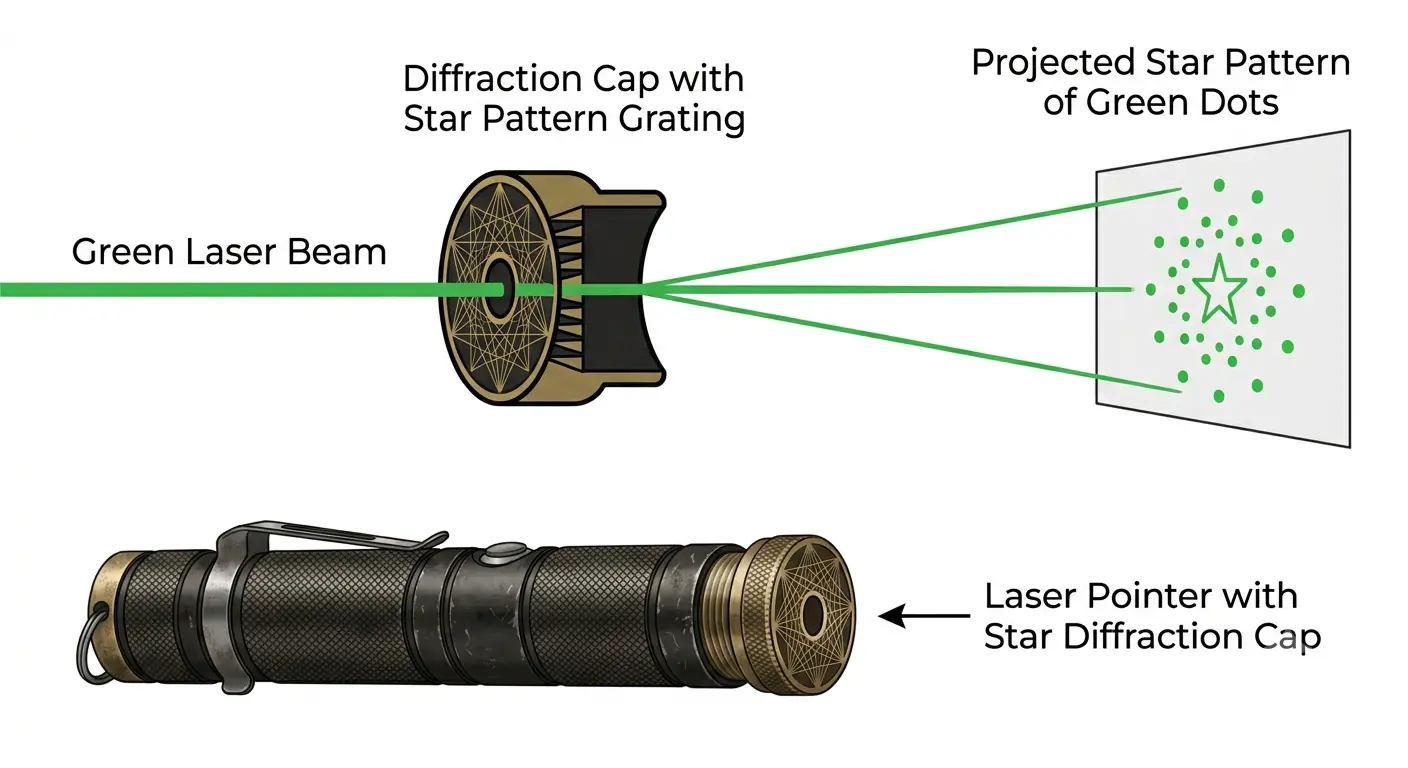
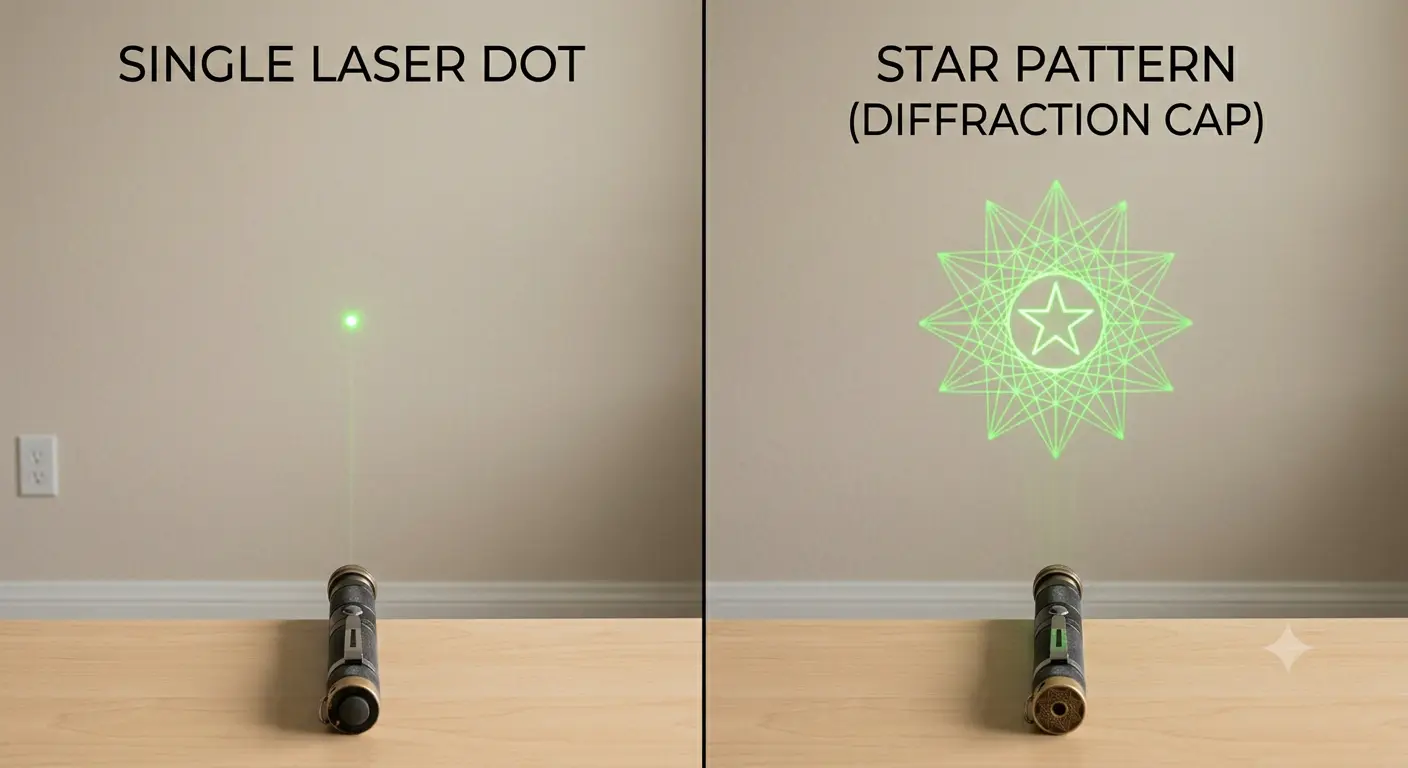
A laser pointer diffraction cap, also called a star cap, pattern head, or kaleidoscope cap, screws onto the front of your laser and splits the single beam into a pattern of dots, lines, or starbursts. Instead of one red or green dot on the wall, you get a scatter of stars, a grid, or a spinning kaleidoscope effect.
Sounds simple. The reality is messier than any buyer guide admits. Thread sizes are chaos, the same "303-style" laser from two different sellers can use incompatible caps.
Cheap green lasers leak invisible infrared that passes straight through your cap, something zero top-ranking guides warn about. And the forum consensus that you can't make custom caps yourself? That advice went obsolete in 2024.
Key Takeaways
- Diffraction caps split a laser beam into star fields, grids, and kaleidoscope patterns by passing light through a microscopic grating, green lasers spread wider than red because of the wavelength difference
- Thread sizes are a minefield: M8, M9, M9.5, M10, and M11 all circulate on common laser hosts, and the same brand can ship different threads across production batches
- NIST testing found ~90% of green laser pointers exceed the 5mW legal limit, and a diffraction cap does block the invisible infrared that leaks from cheap DPSS green lasers
Learn what power level you actually need before accessorizing, our laser pointer power guide breaks down the mW ranges that matter.
What Are Laser Pointer Diffraction Caps? (What They Do, Not a Physics Lecture)
At its simplest, a diffraction cap is a lens with thousands of microscopic grooves etched into it. When your laser beam hits those grooves, the light fans out in a predictable pattern, stars, grids, circles, spirals, instead of staying as a single dot.
The cap itself is a small metal or plastic ring that threads onto the front of your laser where the dust cap normally sits. Inside the ring is a thin piece of glass or plastic carrying the grating. Twist it on, fire the laser, and the pattern appears.
The one practical physics fact worth knowing: green lasers (532nm) produce a wider pattern spread than red lasers (650nm) through the same cap. Blue lasers (450nm) produce the tightest pattern. This is simply because green is a longer wavelength than blue, so the light bends more at each groove. If your star pattern looks cramped with a blue laser and spread out with a green one, that's why, not a defect in the cap.
What about the industry terms? You'll see "DOE" (diffractive optical element), "diffraction grating," and "beam splitter" used interchangeably. They're not exactly the same thing, a DOE is the broad family, a diffraction grating is one type, but for practical buying purposes, if a listing says any of these, you're looking at the right product category.
Types of Diffraction Caps: Rotating, Fixed, and Everything In Between
There are three formats. Each has different trade-offs, and none of them are hard to understand.
Rotating multi-grating caps have a ring you twist to cycle through different grating sections. Turn the ring, change the pattern, stars become grids become spirals. The GloFX Kaleidoscope Cap is the most recognized example, using a 360-degree rotating stainless-steel body. The downside: the rotating mechanism is a mechanical part, and mechanical parts wear out.
Fixed single-pattern caps do one pattern per cap. They're sold in multi-packs, five caps, five patterns, one price. The FreeMascot 5 Sky-Patterns Cap Set on Amazon is the standard example. Fixed caps have no moving parts to fail, but the build quality on budget sets is often terrible (more on that below).
Integrated pattern pointers have the diffraction element built permanently into the laser housing. The Laserpointerstore 2-in-1 Dual Colors Laser Pointer ships this way. You don't choose or swap patterns, what you buy is what you get.
The material matters independently of the grating quality. Long-time Laser Pointer Forums member paul1598419 noticed a manufacturing decline across production generations: "The recent star caps that have come out that have silver paint over the plastic are of a much cheaper quality than earlier ones used on the 303 style lasers. I have both and the difference is obvious."
How to tell aluminum from silver-painted plastic before you buy: aluminum feels cold to the touch and has weight. Painted plastic is light, warms quickly in your hand, and the silver finish flakes off after repeated use. At the threads, where the cap screws onto the laser, painted plastic strips almost immediately.
Thread Size Chaos: M8, M9, M9.5, M10, M11, What Actually Fits Your Laser?
Every top-ranking buyer guide lists two thread sizes: M9×0.5 and M10×0.75. The reality on the market is that M8, M9, M9.5, M10, and M11 all circulate on common "301" and "303" style hosts, and the same brand can ship different threads on production batches made months apart.
A Laser Pointer Forums breakdown of the 301 host family found that green 301s use M10 lens holders and green 303s use M8. If you own two green laser pointers bought from different sellers at different times, the caps are not guaranteed to be interchangeable between them.
The problems this creates are predictable and common. From customer complaints aggregated by the Alibaba Caps Guide: "First cap arrived cross-threaded," "plastic [cap] stripped first try." LPF user Lagomorpha posted a typical SOS: "I don't know if it's striped or what. It worked earlier, and now the cap is stuck on my Thor H series. I didn't over screw it and I don't think I cross-threaded?"
How to not be that person: before you order a cap, remove the existing dust cover from your laser. Measure the outer diameter of the male threads on the aperture with calipers. The measurement in millimeters is your thread size. If you get 9.5mm, you have an M9.5 host, and a cap sold as "M9×0.5 universal" will not fit, no matter what the listing says.
Cross-threading on first install damages both the cap threads and your laser's aperture threading. On a sub-$30 host, the repair is not worth the cost. Measure once, buy the right cap the first time.
If you're buying a new laser and want to avoid thread compatibility headaches entirely, our Laser Pointer Build Quality Guide explains what separates well-machined threads from budget cost-cutting.
How to Choose a Diffraction Cap: Four Specs That Actually Matter
Ignore the marketing copy. Four things determine whether a cap works for you.
Pattern count and type. A "5-pattern cap set" means five separate screw-on caps, each with one fixed pattern, you swap the whole cap to change the pattern. A "rotating kaleidoscope cap" gives you variable patterns from one cap. If you only want one look (stars, for example), buy a fixed cap and save the rotating mechanism as a failure point.
Material. Aluminum caps survive repeated threading and unthreading. Silver-painted plastic caps are consumables, expect to replace them. At 5mW (legal pointer power), the cap material is cosmetic. At higher power, and NIST data says most cheap green pointers are higher than labeled, a metal cap at least won't deform under sustained beam exposure.
Diffraction efficiency. This is simply how much of your laser's power actually makes it into the pattern versus getting lost as heat or scatter inside the cap. Good lab-grade gratings reach 92–96% efficiency. Consumer-grade plastic caps are lower, typically 60–90%. The practical effect: a cap with poor efficiency produces a dimmer, muddier pattern even if your laser is bright.
Compatibility. Measure your thread before ordering. If the listing does not specify thread size, assume M9×0.5, the lowest common denominator that fits the broadest range of budget hosts. If you own a Thor, Wicked Lasers, or Sanwu host, check the manufacturer's spec sheet before buying a third-party cap. Premium hosts sometimes use proprietary thread sizes.
For more depth on what makes one laser diode and lens system produce a cleaner beam than another, our Laser Pointer Optics Guide covers beam divergence, lens types, and collimation.
The Hidden Danger: Laser Pointer Diffraction Caps Do Not Stop Infrared
This is the safety fact that appears in zero top-ranking guides. If you use a green laser pointer and add a diffraction cap, you may be projecting invisible infrared radiation through the cap alongside your visible green pattern.
Here is why, in plain terms. Most cheap green laser pointers use a technology called DPSS (diode-pumped solid-state). The laser starts with an infrared diode, converts some of that to green using a crystal, and, if the manufacturer skipped the IR filter to save cost, vents the leftover infrared straight out the front.
A diffraction cap scatters the visible green light into a pattern. It does not filter, block, or scatter the infrared.
The numbers from NIST, the U. S. National Institute of Standards and Technology, are not subtle. In 2010, NIST researchers measured one cheap green pointer leaking 20mW of invisible infrared during normal operation.
In 2013, they scaled up: testing 122 randomly purchased pointers, they found nearly 90% of green and 44% of red pointers exceeded federal power limits. The highest measured unit hit 66.5mW, more than 10 times the 5mW legal limit. Over 75% of green units emitted excess infrared.
The hazard chain is simple and documented in NIST Technical Note 906138: infrared is invisible, so your blink reflex does not activate. You can sustain retinal damage without any awareness it is happening. The 0th-order spot, the brightest dot in your star pattern, carries both visible green and invisible IR straight through the grating.
There is a practical test you can do at home, described in the same NIST paper. Point your laser through a CD (which acts as a crude grating) and observe the projected pattern through an IR-sensitive webcam or a phone camera with its IR filter removed. If you see a bright spot at the center position that your naked eye cannot see, your pointer is leaking infrared, and your diffraction cap is not blocking it.
The fix: direct-diode green lasers at 515–520nm do not have this problem. RP Photonics confirms in their laser buyer's guide that direct green diodes "are more robust and stable" and eliminate the DPSS infrared conversion pathway entirely. If you plan to use a diffraction cap regularly, buy a direct-diode green, not a cheap DPSS.
For the full regulatory picture, what the FDA's 5mW limit actually means, what ANSI Z136.1 classifies, and how to read your laser's safety label, our Complete Laser Pointer Safety Guide is the reference article.
Why Your 100-Point Star Is Dimmer Than You Expect
A cap advertising "100-point star pattern" sounds like you get 100 bright dots from one laser. The reality is a division problem, and it's worth understanding before you buy.
Your laser's total output gets divided across every spot in the pattern, but not evenly. The center spot always claims the largest share, typically 30–40% of whatever power reaches the cap. The first ring of spots around it each gets a smaller fraction. Spots further out get progressively dimmer.
Even the cap's efficiency limits you. If your laser outputs 5mW and your cap is 90% efficient, only 4.5mW reaches the pattern. The center spot grabs roughly 1.5–2mW of that. The remaining few milliwatts are distributed across dozens of side spots, each one barely visible except in a dark room.
This matters for safety in a way most buyers miss: "scattered" does not equal "safe." If your green pointer is actually outputting 50mW, and NIST found that ~90% of tested green pointers exceeded the 5mW limit, adding a diffraction cap does not reduce total output. It redistributes it. The center spot of your star pattern, the one your eye instinctively tracks because it is brightest, can carry 15–20mW of visible light plus whatever IR is leaking. That is enough to cause retinal injury at close range.
No top-ranking diffraction cap guide quantifies any of this. They mention "patterns wash out in daylight" without explaining why, or what it means for someone using a high-power host indoors.
6 Real Complaints From Actual Diffraction Cap Users
Top-ranking guides read like marketing copy. Here is what people actually report, direct quotes from the forums and reviews where real buyers post.
1. Caps get stuck and threads strip on first install. LPF user Lagomorpha: "I don't know if it's striped or what. It worked earlier, and now the cap is stuck on my Thor H series. I didn't over screw it and I don't think I cross-threaded?" Forum member's reply: "Star caps are usually plastic so it's easy to strip."
2. New-production caps are worse than old ones. LPF member paul1598419 documented the decline: "The recent star caps that have come out that have silver paint over the plastic are of a much cheaper quality than earlier ones used on the 303 style lasers. I have both and the difference is obvious." Same brand, worse product over time.
3. You can't find the specific pattern you want. From an LPF thread titled "I'm looking to buy a specific laser pointer head": "No luck on ebay, froogle, or amazon…does anybody know where I can buy one?" The user wanted a middle-finger pattern head, a novelty that existed years ago but has since disappeared from mainstream sellers.
4. Pattern caps are limited to dots, lines, and basic shapes. Reddit user Pyronious explained: "The laser 'image' filters you mention are generally just diffraction gratings or fresnel lenses. As such, you don't have a lot of control over creating specific shapes like a square." Stars, grids, spirals, yes. Letters, logos, photographs, no, not with a stock cap.
5. Caps fall off, patterns blur, and instructions do not exist. Aggregated from real reviews in the Alibaba Star Cap Guide: "Cap fell off after two uses," "Stars looked blurry beyond 5 meters," "No safety instructions included."
6. Cross-threading damages cap and host on first try. From the Alibaba Caps Guide: "Most complained: 'First cap arrived cross-threaded,' 'plastic [cap] stripped first try.'" Once the threads are damaged on either the cap or the laser aperture, the accessory ecosystem for that host is effectively closed.
Can You Make a Custom Diffraction Cap at Home? (Yes, Since 2024)
For years, the answer on Laser Pointer Forums was a hard no. A 2019 thread titled "How can I make laser pointer cap" carried the consensus that you simply cannot. In 2024, that consensus was disproven.
The Thought Emporium, an applied-science YouTube channel, demonstrated a complete DIY method covered by Hackaday in August 2024. The process uses computer-generated holography (CGH): you compute the diffraction pattern for the image you want, transfer it to photographic film, and mount the film in front of your laser. The result: a custom projection of whatever you encoded, letters, shapes, patterns that no commercial cap can produce.
The Thought Emporium also demonstrated a practical application: using one of these CGH patterns as a telescope focusing aid for astrophotography. This directly contradicts the Reddit claim that diffraction caps "can't create specific shapes like a square", they can, you just need to compute the pattern yourself instead of buying it off the shelf.
The barrier is real and worth stating honestly. A holography expert noted in a Facebook forum thread that "custom mandala pattern caps for laser pointers are feasible with multi-level diffractive optics or holographic approaches, but may be expensive." You need a high-resolution printer or film exposure setup and the software to compute the hologram. This is not plug-and-play. But it is no longer impossible, and none of the current top-ranking guides mention it.
For a detailed look at how far pattern projections remain visible and what changes with distance, see our Guide to Laser Pointer Distance and Visibility.
Buying Guide: What to Pay, What to Skip
The diffraction cap market breaks into three price bands. At legal power levels, the differences are in materials and branding, not optical performance.
Budget plastic 5-cap kits ($2–$8). The FreeMascot sets and generic Alibaba multi-packs land here. Wholesale pricing confirms the floor: $0.95–$2.01 per pack in bulk. At retail, expect $2–$8. These are consumables, buy them, use them until the threads strip or the silver paint flakes, then replace them. Patterns work fine indoors at close range in a dark room.
Mid-range rotating aluminum caps ($10–$30). A single cap with a rotating multi-grating mechanism and an aluminum body. The grating is typically higher quality than the budget packs. The failure point is the rotation mechanism, if the ring feels gritty or the detent loosens, the cap is on its way out.
Premium branded caps ($30–$95+). GloFX, Wicked Lasers, and similar brand-name accessories. You get consistent threads, brand accountability, and a precisely manufactured grating. The Alibaba Star Cap Guide explicitly questions whether the premium matters: at 5mW, a $95 metal cap produces functionally the same pattern as a $5 plastic cap. The premium buys finish quality, tight threads, and, if you are running a high-power host, thermal tolerance that prevents a plastic cap from deforming.
If you are shopping for a laser to pair with a diffraction cap, the Laser 303 Green Laser Pointer ships with a tactical star cap pre-installed. For the safer baseline (direct-diode green, no infrared risk), the Elite 520nm Green Laser uses a 520nm direct diode. High-power users should check the Compact Green Laser 1.5W, 520nm direct diode in a pocket-sized format, ideal for diffraction cap use at longer range. Compare all current options in our full product selection.
Buying checklist (print this before you order):
- Measure your host's thread with calipers. 8.0mm, 9.0mm, 9.5mm, 10.0mm, or 11.0mm, write it down. "Universal fit" means M9×0.5 nine times out of ten.
- Rotating vs. fixed: rotating for variety, fixed for reliability. If you only want one pattern, skip the rotating mechanism.
- Inspect product images. Mirror-finish silver at a budget price means painted plastic. Real aluminum caps have a brushed or matte finish, and cost more.
- Know your laser's actual power. If your pointer is a cheap green DPSS, NIST data says it probably exceeds 5mW. A metal cap is not a safety upgrade, it's just a cap that won't melt.
Laser Pointer Diffraction Cap Safety & Legal FAQ
The rules for laser pointers do not change when you screw on a diffraction cap. The cap scatters the pattern but does not reduce total power, and it does not reclassify the device.
FDA and the 5mW rule. Under 21 CFR 1040.10 and 1040.11, laser pointers sold in the U. S. must be Class IIIa, 5mW or less in the visible 400–710nm range. Class IIIb devices (5–500mW) cannot legally be promoted or sold as pointers. Adding a diffraction cap to a Class IIIb laser does not make it Class IIIa. The FDA's manufacturer notice is the primary regulatory source.
The real-world non-compliance problem. NIST's 2013 test of 122 pointers found ~90% of green units exceeded federal limits. That means the laser you own is statistically more powerful than its label claims. The Health Physics Society, authored by a Certified Laser Safety Officer at Lawrence Livermore National Lab, confirms that Class 3a pointers are "hazardous if viewed even briefly," and green appears about five times brighter than red at equal power.
FAA and aircraft. FAA field testing found a 5mW green laser can cause retinal burns at 14 meters, flash-blindness at 350 meters, and sufficient vision interference to force aborted landings at 3 kilometers. Pointing any laser at an aircraft, diffraction cap or not, is a federal felony. The case of New Jersey stargazer David Banach, who received two years probation for accidentally crossing an aircraft with his laser during a star tour with his daughter in 2005, is not an outlier, it is the standard legal response.
Cats and laser toys. A 2021 peer-reviewed study (Kogan et al.) found that laser-pointer play "may be associated with the development of compulsive behaviors in cats." The mechanism: the light is uncatchable, leading to frustration. Adding a star cap to produce a scattered pattern does not solve the underlying issue, the light is still physically impossible for the cat to catch.
ANSI Z136.1. The American National Standards Institute's Z136.1 standard defines Maximum Permissible Exposure levels and laser safety controls. Lasers exceeding Class 3R limits "may be hazardous and should be subject to more rigorous controls such as training." This is the U. S. occupational laser safety standard, referenced by OSHA and the FDA.
Frequently Asked Questions
What does a laser pointer diffraction cap actually do?
It takes your laser's single beam and splits it into a pattern, dots, lines, stars, or grids, by passing the light through a microscopic grating. Screw it on where your dust cap normally sits, and the single dot becomes a pattern on whatever surface you point at.
Will a star cap fit my laser?
Measure first. The market uses M8, M9, M9.5, M10, and M11 threads, not just the two sizes listed in buyer guides. Remove your dust cap, measure the thread diameter with calipers, and match that number. "Universal fit" with no specification means M9×0.5.
Does a star cap block infrared from a green laser?
No. A diffraction cap scatters visible light but has no IR filter. The brightest spot in your pattern carries both visible green and any leaked infrared straight through.
NIST found over 75% of cheap green DPSS pointers exceed IR limits. A direct-diode green laser (515–520nm) eliminates the risk because it has no IR conversion step.
Is a $95 metal cap worth it over a $5 plastic one?
At 5mW, the legal limit, no. The Alibaba Star Cap Guide states that the premium "buys no functional benefit." You pay for tighter threads, a more durable body, and, on high-power hosts, thermal tolerance that keeps plastic from deforming. For a legal-power pointer used indoors, the $5 cap produces an optically identical pattern.
Can I make my own custom diffraction pattern?
Yes. In 2024, the Thought Emporium demonstrated a method using computer-generated holography: compute the pattern, transfer it to film, and mount it in front of your laser. This is not a beginner project, it requires a high-resolution printer or film setup and hologram computation software, but it is proven and publicly documented.
Can I legally import a 50mW laser with a pattern cap?
No. The FDA restricts pointers to 5mW. A 50mW device is Class IIIb regardless of what cap you attach. U. S. Customs detains non-compliant imports. Pattern caps do not change a laser's legal classification.
Why is my star cap pattern dim or blurry?
The most common cause is a dirty grating, dust or skin oil on the lens scatters light unpredictably. Clean with a microfiber cloth and lens cleaner, never paper products. If the pattern stays dim after cleaning, the grating itself may have delaminated, which is a permanent failure.
Why does my pattern disappear in daylight?
Each spot in a diffraction pattern carries a fraction of your laser's total power. In a bright room, those fractions cannot compete with ambient light. Diffraction patterns are best used in the dark or at close range indoors. Even high-power hosts cannot overcome this, the limit is contrast, not raw output.
The bottom line: Diffraction caps are simple accessories with a surprising number of ways to go wrong. Thread sizes no seller documents correctly. Infrared from cheap green lasers that your cap cannot block. Forum advice that is years out of date. And a price gap, $5 to $95, that buys nothing in optical performance at legal power levels. Know your laser's real output, measure your threads with calipers, and if a green pattern looks too bright to be 5mW, it probably is.