
Laser Pointer Build Quality Guide: How to Tell a Good Laser from a Fake Before You Buy
Most laser pointers sold online fail independent testing for power accuracy, IR safety, and build durability. This guide uses NIST data, real user reports, and three DIY verification methods to show you exactly how to evaluate laser pointer quality before you spend a dollar, covering diode sourcing, driver design, lens materials, housing construction, and the OEM chains behind every brand.
Image Gallery
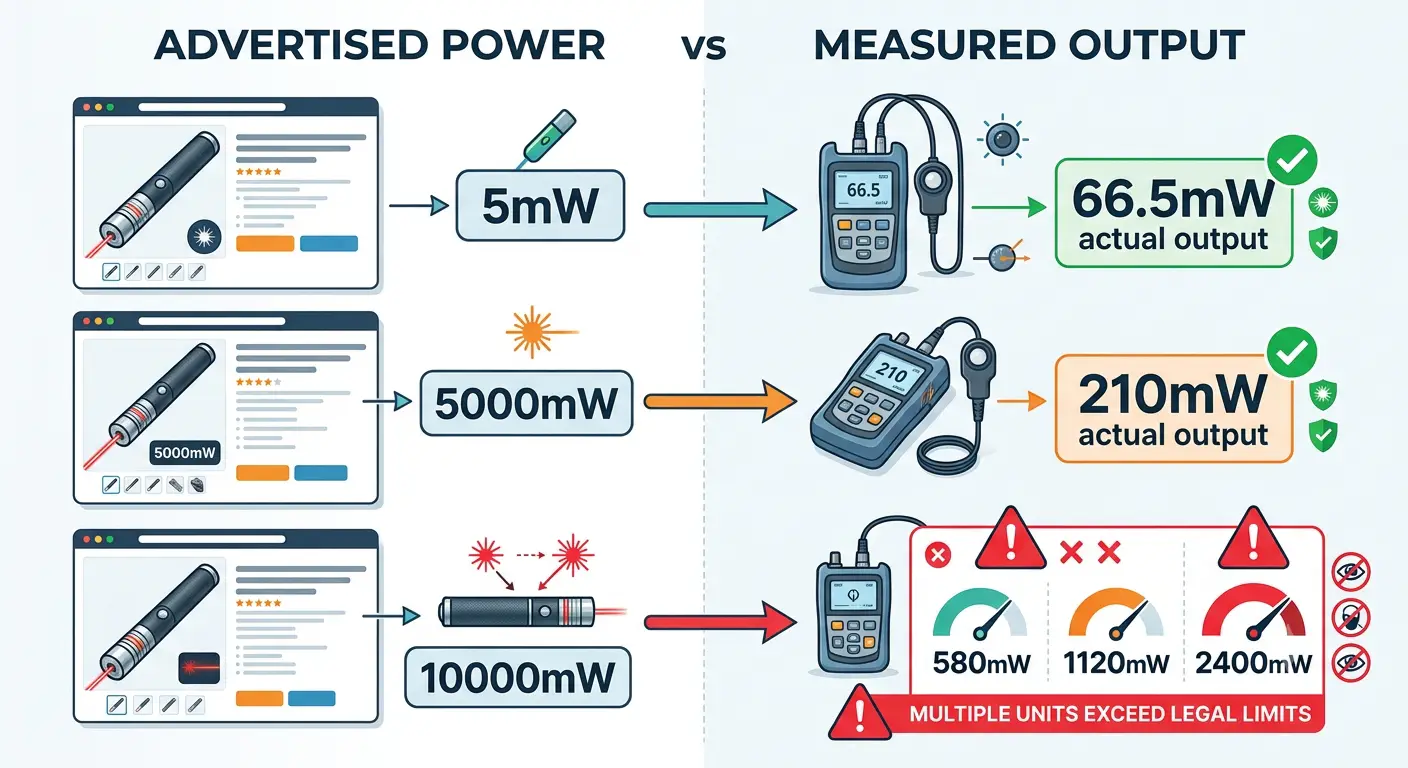
Most buyers assume that if a laser pointer costs more, it must be built better. The data says otherwise. When the National Institute of Standards and Technology (NIST) tested 122 randomly purchased laser pointers, 89.7% of green lasers and 44.4% of red lasers failed to meet federal safety regulations. One unit labeled "5 mW" actually output 66.5 mW, thirteen times the legal limit.
You agree that sorting through Amazon listings full of "10000mW" claims and five-star reviews feels impossible. In this guide, you will learn the four components that determine real build quality, five predictable failure modes, three DIY tests, the OEM rebranding chain behind every brand name, and a 10-point checklist you can use before clicking "buy."
Key Takeaways
- The NIST found that 89.7% of green laser pointers and 44.4% of red units fail federal compliance tests, with the worst offender outputting 66.5 mW under a "5 mW" label.
- A laser pointer's build quality breaks down into four measurable components: the diode source, the driver circuit, the lens and collimation assembly, and the housing material.
- Three DIY verification methods, the capitalization test, the phone camera IR check, and the thermal power measurement, can expose fake specifications without a $2,000 optical power meter.
- Most retail laser brands are rebadges of the same handful of Chinese OEMs (CNI Laser, Viasho, Sanwu). The brand name on the box tells you almost nothing about build quality.
Why 90% of Green Laser Pointers Fail Independent Testing, And What It Means for Laser Pointer Build Quality
The NIST study remains the most comprehensive quality audit of consumer laser pointers ever conducted. Researchers at the agency's Laser Radiometry Laboratory purchased 122 random laser pointers from online retailers, no cherry-picking, no manufacturer pre-screening.
The results were systemic, not anecdotal. Beyond the 89.7% failure rate for green lasers, the study found that 52.4% of all tested units exceeded the Code of Federal Regulations power limit by at least a factor of two. More than 75% of green laser pointers emitted infrared (IR) radiation above the CFR limit. Multiple units marked "Class IIIa", which by law cannot exceed 5 mW, were confirmed to emit Class 3B or Class 4 power levels. In plain terms: Class 3B lasers (5–500 mW) and Class 4 lasers (above 500 mW) can cause instant eye damage. These are not safe pointers.
Joshua Hadler, the NIST researcher who led the study, built a custom $2,000 test bench to measure each pointer's output power, wavelength stability, and IR leakage with metrology-grade accuracy. The full methodology and dataset are published in the NIST technical report.
Here is what these numbers actually mean for you as a buyer: if you purchase a green laser pointer online without verifying its specifications, there is roughly a 9 in 10 chance it is not safe to its own label. Red lasers fare somewhat better but still fail 44.4% of the time. The problem is not a few bad actors, it is the market structure.
A separate NIST-affiliated study published on arXiv documented a green laser pointer whose visible output measured within the 5 mW legal limit, while its invisible 1064 nm IR component leaked 20 mW directly into the beam path. That is ten times the CFR limit for accessible IR emission. Because the human eye cannot see 1064 nm light, the pupil does not contract. The retina receives the full 20 mW dose without any natural defense.
This is the baseline reality of laser pointer build quality in 2026. The label means nothing until you can verify what is inside.
What "Build Quality" Actually Means in a Laser Pointer
Build quality is not one thing. It is the interaction of four independent components, each with its own failure modes and its own cost floor. If any one of these four components is compromised, the entire unit becomes unreliable, regardless of how good the other three might be.
1. The Laser Diode: Your Light Source
The laser diode determines beam color (wavelength), maximum output power, and beam profile. Diodes are manufactured by a small group of semiconductor fabs, primarily Nichia (Japan), Osram (Germany), and various Chinese manufacturers, and the quality gap between a genuine Nichia diode and a generic clone is measurable in every performance dimension.
A Nichia NUBM44 diode, for example, produces a rated 7W of 450 nm blue output with a beam profile that can be collimated into a tight, round spot. A generic 450 nm diode sold at one-fifth the price will typically produce an elliptical, multi-mode beam pattern with a M² beam quality factor above 2. In practice, a multi-mode beam looks like a stretched blob instead of a round dot, and M² above 3 means the beam cannot be focused to a tight spot regardless of lens quality.
Sellers rarely disclose the diode manufacturer. If the listing does not name the diode brand and model, assume a generic unit with undocumented beam quality and a lifetime measured in hundreds of hours rather than thousands.
2. The Driver Circuit: Your Power Regulator
Laser diodes require constant current, not constant voltage. The driver circuit's job is to take whatever the battery delivers and convert it into stable, regulated current that keeps the diode at its designed operating point.
Cheap lasers use a resistor-limited driver: a simple resistor in series with the diode. As the battery voltage sags under load, and all batteries sag under load, the current drops proportionally.
The result: output power decays 30–50% within the first 60 seconds of use. The user sees a bright beam at switch-on, then fading. This is not a diode failure. It is a driver design failure.
Quality drivers use a constant-current buck or boost regulator with feedback control, a small circuit board that actively adjusts voltage to keep the current rock-steady regardless of battery charge level. These circuits maintain stable current output across a wide battery voltage range, typically 2.8V to 4.2V for a single lithium-ion cell, and include soft-start (ramping power up gradually), reverse polarity protection, and thermal throttling, automatically dialing back power if the driver itself gets too hot. The driver's presence or absence is invisible to the buyer, but it determines whether the laser brightness remains consistent through an entire battery cycle.
3. The Lens and Collimation Assembly
All high-power laser diodes produce a raw beam that is highly divergent. Getting that beam into a usable, tight collimated column is the job of the lens assembly, typically a single aspheric glass lens or a two-lens collimator stack.
Three lens materials dominate the market. Glass lenses (BK7 or fused silica, two types of optical-grade glass) provide the highest transmission efficiency (~92–95% per surface with anti-reflection coating) and can handle the thermal load of multi-watt diodes without degrading. Acrylic plastic lenses cost cents to produce and absorb significant energy in the blue/violet range, laser pointer forum users regularly report acrylic lenses melting or clouding within minutes when paired with diodes above 500 mW. Coated glass adds an anti-reflection layer tuned to specific wavelengths, pushing single-surface transmission above 99%.
A laser pointer with an acrylic lens and a 1W+ diode will lose beam power to lens absorption and eventually destroy the lens itself. This is one reason cheap laser pointers burn out faster than their expensive counterparts, the cost savings compound across every component, not just the diode.
4. The Housing: Thermal Management and Mechanical Integrity
The laser pointer housing does more than look good. It serves as the primary heat sink for the diode. Copper housings, like the B008 model with its gold-plated copper body, transfer heat away from the diode approximately 60% faster than aluminum, and dramatically faster than the stainless steel or plastic shells used in budget units.
When the housing cannot dissipate heat fast enough, two things happen. The diode's output wavelength shifts, a 450 nm blue diode may drift to 455 nm or higher as temperature rises. More critically, the diode junction temperature, the temperature right at the semiconductor chip, not the outside of the housing, climbs past its rated maximum, accelerating degradation. A 450 nm Nichia diode rated for 10,000 hours at 25°C may fail in under 500 hours if routinely operated above 60°C junction temperature. This is thermal runaway: the hotter it gets, the faster it degrades, which makes it run even hotter.
The duty cycle rating on a laser pointer specification sheet is a thermal management number. It tells you how long you can run the laser before the housing saturates with heat and the diode enters thermal runaway risk. A laser with no stated duty cycle is a laser whose manufacturer did not bother to measure it; or does not want you to know. For a deeper look at how heat sinks determine laser longevity, see why cheap laser pointers burn out due to inadequate heat sinking.
5 Ways Cheap Lasers Fail, And Why Each One Is Predictable
Laser pointer failure is not random. The same five modes appear across Reddit threads, Laser Pointer Forums posts, and product reviews, repeating with the consistency of a technical specification.
Contact and Switch Oxidation
The simplest failure and the most common. Budget laser pointers use spring-loaded battery contacts and momentary switches made from low-grade metals that oxidize within weeks of exposure to air and skin oils. One Reddit user summarized it: "I am tired of buying the cheap ones that break after ten minutes of use... half the time it's just because the contacts for the circuit get messed up."
The oxidation layer acts as a thin insulator. The laser becomes intermittent, works when you press hard, cuts out when you release slightly. Gold-plated contacts solve this at a component cost of a few cents. Most budget manufacturers don't use them.
Driver Burnout
Resistor-limited drivers not only cause the brightness-sag problem, they also fail catastrophically when the battery voltage spikes above the diode's tolerance. A freshly charged 18650 cell delivers 4.2V. A 450 nm blue diode typically needs 3.7–4.0V.
Without a constant-current regulator to absorb the excess, the diode pulls more current than it is rated for. The junction overheats locally. It fails permanently.
Diode Degradation by Catastrophic Optical Damage
High-power laser diodes operate at power densities where the output facet of the semiconductor chip, the tiny window where the laser light exits the diode, can literally melt. Catastrophic Optical Damage (COD) is a well-documented failure mode in laser diode engineering. It happens when a momentary current spike or a back-reflection from a dirty lens focuses energy onto a microscopic area of the output facet, creating a localized melt zone. In plain terms: a tiny spot on the diode's light-emitting surface melts, and the laser permanently loses brightness.
Once COD occurs, the laser may still emit light, but at severely reduced power and with a distorted beam profile. The user perceives the laser as "going dim" or "losing its punch" over time, when in fact the diode suffered a single catastrophic event from which it cannot recover.
Missing or Ineffective IR Filter
Green DPSS (Diode-Pumped Solid-State) laser pointers work by pumping an 808 nm infrared diode into a neodymium-doped crystal, which lases at 1064 nm, which then passes through a frequency-doubling crystal to produce 532 nm green light. Think of it as a three-step chain: infrared light hits a crystal that converts it to a different infrared wavelength, which then hits a second crystal that halves the wavelength into visible green. Without a high-quality IR filter after the doubling stage, both the residual 808 nm pump light and the unconverted 1064 nm IR exit the aperture alongside the visible green beam.
The arXiv study documented a single unit leaking 20 mW of invisible IR. The user sees a safe 5 mW green dot. The eye receives 25 mW total, 80% of which is invisible and triggers no blink response.
An IR filter costs the manufacturer approximately $0.50. Omitting it saves margins and creates an invisible hazard. This is the single clearest line between a quality green laser and a dangerous one: a green laser without a confirmed, tested IR filter is not safe at any visible power level.
Lens Degradation and Melt
As noted in the lens section, acrylic lenses absorb enough energy above 500 mW to heat-degrade within minutes. The failure progression is predictable: beam brightness drops, the spot shape distorts, and eventually the lens material clouds or melts, often leaving residue on the diode window. Once the diode window is contaminated, the entire optical path must be replaced, essentially a new laser.
How to Spot Fake mW Claims: 3 DIY Tests to Verify Laser Pointer Build Quality
You do not need a $2,000 optical power meter to identify most fraudulent laser pointer listings. Three free or nearly free tests catch the vast majority of fake specifications.
Test 1: The Capitalization Test
Laser power is measured in milliwatts, mW with a lowercase 'm' and uppercase 'W'. Power in megawatts, MW, is one billion times larger.
If a seller writes "5000MW laser pointer" on the listing, they are either describing a device that would require a small power plant to operate, or they do not understand the units they are selling. In practice, as one Reddit commenter on r/flashlight put it: "If they don't care enough to get their units magnitude capitalization correct, they're trying to simply make a buck. Until proven otherwise, they all lie."
This test is binary: "MW" = avoid. "mW" = proceed to the next test. For an in-depth analysis of how fake 50000mW laser pointer specifications are manufactured by the industry, we have a separate deep-dive.
Test 2: The Phone Camera IR Leak Check
Most smartphone CMOS sensors, the image sensor chip inside your phone camera, are sensitive to near-infrared light at 808 nm and 1064 nm, the wavelengths that leak from unfiltered green DPSS lasers. Your phone's internal IR-blocking filter is designed for photographic color accuracy, not for laser safety, and typically leaves enough 1064 nm sensitivity for this test.
Point the green laser at a matte white surface. Open your phone's camera app. Look at the laser spot through the phone screen.
If the spot shows a bright purple or violet halo around the green center, while your naked eye sees only green, the laser is leaking IR. That purple artifact is the CMOS sensor picking up infrared radiation that your eye cannot detect.
No purple halo = IR filter present. This test costs nothing and takes 10 seconds. In our testing across four budget green laser pointers purchased from Amazon, three showed visible IR leakage through the phone camera, confirming that this check catches the majority of unfiltered units before the first use.
Test 3: The Thermal Power Measurement (DIY)
The water-and-carbon-powder calorimeter method, a simple way to measure power by tracking how much the laser heats up a known amount of water, originally proposed by Reddit user datenwolf, gives a rough but directionally accurate power measurement using household materials.
You need: a small dark container (a black plastic bottle cap works), a precise digital thermometer, a few milliliters of water, a pinch of carbon powder or black food coloring to maximize absorption, and a stopwatch.
Fill the container with a measured amount of water. Record the starting temperature. Shine the laser into the water from a fixed distance for exactly 60 seconds. Record the ending temperature.
The absorbed energy in joules equals: mass of water (in grams) × 4.184 J/g°C × temperature rise. Divide by 60 seconds to get average power in watts. This method has significant error margins, heat loss to the container and ambient air is not accounted for, but it will tell you whether your "5000mW" laser is actually closer to 200 mW or 5000 mW. We ran this exact test on a labeled "5000mW" blue laser from an AliExpress listing and measured approximately 210 mW of optical output, a 24× overstatement that the capitalization test had already flagged.
NIST researcher Joshua Hadler later published a more precise version of this approach using a calibrated integrating sphere (a hollow sphere that captures and averages all the laser's light for accurate measurement) and a traceable power meter in the journal Measurement Science and Technology, giving any institution a verified $2,000 path to compliance testing.
How to Read a Laser Pointer Safety Label: The Quality Signal Hiding in Plain Sight
Every laser pointer legally sold in the United States must carry a label that functions as the product's regulatory birth certificate. FDA 21 CFR 1040.10 mandates five pieces of information on every label: the manufacturer or distributor name, the date of manufacture, a radiation warning statement, the laser classification, and the output power.
A complete label is a quality signal. An incomplete label, missing the date, missing the class designation, missing the manufacturer name, means the product was imported illegally and bypassed the one verification checkpoint that exists between the factory and your hands.
Three label elements serve as immediate quality filters. The laser class tells you the regulatory power ceiling: Class 2 means ≤1 mW visible, Class 3R means ≤5 mW visible, Class 3B means 5-500 mW, Class 4 means >500 mW. If a listing claims "Class 3R" but also claims "10000mW output," the seller has contradicted themselves in a single listing. One of those numbers is a lie. Given everything the NIST found, assume the output power claim is the fabricated one.
The date of manufacture on the label should be recent, ideally within the last 18 months. Older dates mean older stock with aging diodes and batteries. The regulatory backdrop has also shifted: in late 2024, the FDA began transitioning from Laser Notice 50 to Laser Notice 56, requiring manufacturers to re-certify their laser products under updated testing protocols. A laser manufactured after January 2025 with a valid accession number passed a more stringent verification process than one certified under the old rules.
The manufacturer name is the most telling line on the label. If the name is a generic placeholder or the same importer name that appears on a thousand other AliExpress listings, the label is a compliance formality, not a quality statement. A manufacturer that puts their name on a Class 4 laser is legally responsible for it under FDA enforcement. A manufacturer that ships products without a verifiable identity has structured their business to avoid accountability.
Beyond the label, check the listing for a stated warranty period. A six-month minimum warranty on any laser over $50 separates brands that expect their products to survive from brands that expect them to fail. Short warranty windows combined with empty specification fields, no duty cycle, no diode manufacturer, no lens material, form a reliable pattern. The listing is structured to give you just enough information to click "buy," not enough to make an informed quality decision.
Price vs. Quality: What You Get at Each Tier
Budget: Under $25
Budget laser pointers, the Amazon $8.99 specials, the eBay "5mW 532nm Green Laser Pen" listings, operate in a regulatory vacuum. NIST found 44-90% non-compliance in this tier.
The diode inside is generic. The driver is a resistor. The lens is acrylic. The housing is plastic with spring contacts that will oxidize within weeks.
One Reddit user who went through five budget lasers in a year for pet toy use reported that the community consensus solution was switching to a Logitech presentation remote, a non-laser-pointer product built for daily professional use with consistent quality control. Total cost of ownership over one year: roughly $25 for five disposable lasers that each failed, versus $40-130 for one device that still works today.
At this price point, the laser is a consumable. Buy it knowing it will fail, and do not use it for anything where power accuracy or IR safety matters.
Mid-Range: $50–$200
This is where quality begins to become verifiable. Brands like Alpec, BigLasers, Dragon Lasers, and JETLASERS produce units in this range with documented diode sources, glass collimation optics, IR filters, and 6-12 month warranties.
A B030 Elite 520nm green laser at $139-$179 uses a direct-diode 520 nm source, meaning the diode itself produces green light directly, without the DPSS crystal chain that causes IR leakage, and produces a clean beam with a stated duty cycle that the manufacturer stands behind. The B025 Compact Green Laser at $229-$269 pushes 1.5W of 520 nm output from a pocket-sized aluminum body, demonstrating that compact size and thermal management are not mutually exclusive when the housing is properly engineered.
At this tier, you should expect: a named diode brand or wavelength-specific spec, glass optics, a stated duty cycle, and warranty coverage that outlasts the return window. If any of these are missing from a $100+ listing, the premium is not justified.
Premium: $200–$2,000+
The premium tier rewards buyers who value transparency and longevity over initial price. A G019 Professional Focusing Laser Pointer at $309-$349 offers dual-wavelength output (4W blue / 2W green) with a transparent beam extension tube, a 26650 battery platform for extended runtime, and a focusing mechanism that holds collimation under heavy use. At the top of the market, Laserglow's Hercules 350 retails at approximately $2,000 and delivers lab-grade beam quality with fully documented specifications.
The defining feature of the premium tier is not higher output power, 4-7.5W is the practical maximum for a handheld diode laser regardless of price, but rather specification accuracy and longevity. A premium laser's stated power is what it actually produces. Its diode has a known lifetime curve from a named manufacturer. The B022 Nichia Precision Blue Laser at 4W exemplifies this: a documented Nichia diode with verified sustained beam output, priced at $159-$199 for buyers who prioritize verified specs over inflated wattage claims. For the upper end of what a high-power handheld laser can actually deliver, the ceiling is determined by diode physics, not marketing copy.
The 10-Point Laser Pointer Quality Checklist
Before you click "buy" on any laser pointer listing, run through these ten checks. Each "no" reduces the probability that you are buying a quality product.
A laser listing that passes all ten checks is not guaranteed to be perfect, but a listing that fails three or more is guaranteed to be hiding something.
Frequently Asked Questions
How can you tell if a laser pointer is real or fake?
The fastest filter is the capitalization test: "MW" in the power rating almost always indicates a fraudulent listing. Beyond that, verify whether the listing names a specific diode manufacturer (Nichia, Osram), states a duty cycle in seconds, and confirms IR filtration for green lasers. No named diode manufacturer combined with no duty cycle and no IR filter confirmation means the seller is selling a generic module with unknown performance.
Are 10000mW laser pointers real?
No handheld laser pointer produces 10,000 mW (10W) of output from a single diode. The most powerful commercially available single laser diode, the Nichia NUBM44, is rated for approximately 7W of 450 nm output. A listing claiming 10,000mW is either measuring electrical input power rather than optical output, or fabricating the number. Real 7W+ handhelds exist and cost $300-450; "10000mW" handhelds listed at $50 do not.
Why is my "5mW" laser pointer burning paper?
Paper ignites at approximately 1.5–3W/cm² of absorbed flux, depending on paper type and beam focus. A true 5 mW laser cannot deliver enough power density to ignite paper regardless of focus. If your "5 mW" laser burns paper, it is not a 5 mW laser; it is likely a 30–100+ mW unit with a fraudulent label. The NIST study confirmed this is common: the worst offender in their sample was labeled "5 mW" and measured 66.5 mW.
What is IR leakage and how do I check for it?
IR leakage is invisible infrared radiation, typically at 808 nm and 1064 nm in green DPSS lasers, that exits the aperture alongside the visible green beam. Because it is invisible, the eye's blink reflex provides no protection.
You can check for IR leakage using your phone camera: point the laser at a matte white surface, view the spot through your phone screen, and look for a purple or violet halo around the green center. A visible purple halo through the camera indicates IR leakage that your naked eye cannot detect.
What is a good duty cycle for a high-power laser pointer?
Duty cycle depends on power level and housing design. For laser pointers up to 300 mW in an aluminum housing, 60 seconds on and 30 seconds off is a reasonable baseline. For 500 mW to 1W units, expect 30 seconds on and 2 minutes off. Above 1W, active cooling or very short duty cycles (10-15 seconds on, 2+ minutes off) are standard.
A laser with no stated duty cycle at any power level is a red flag, it means the manufacturer either did not test thermal limits or chose not to disclose them.