
G019 Laser Sword Review: Professional Focusing Laser with Transparent Beam Tube (2026)
The G019 combines a real 4W blue or 2W green focusing laser with a transparent beam extension tube that glows along its length, creating a true lightsaber visual effect. This review covers both variants, the tube physics, focus mechanism, battery platform, and who this flagship laser is actually for.
Image Gallery
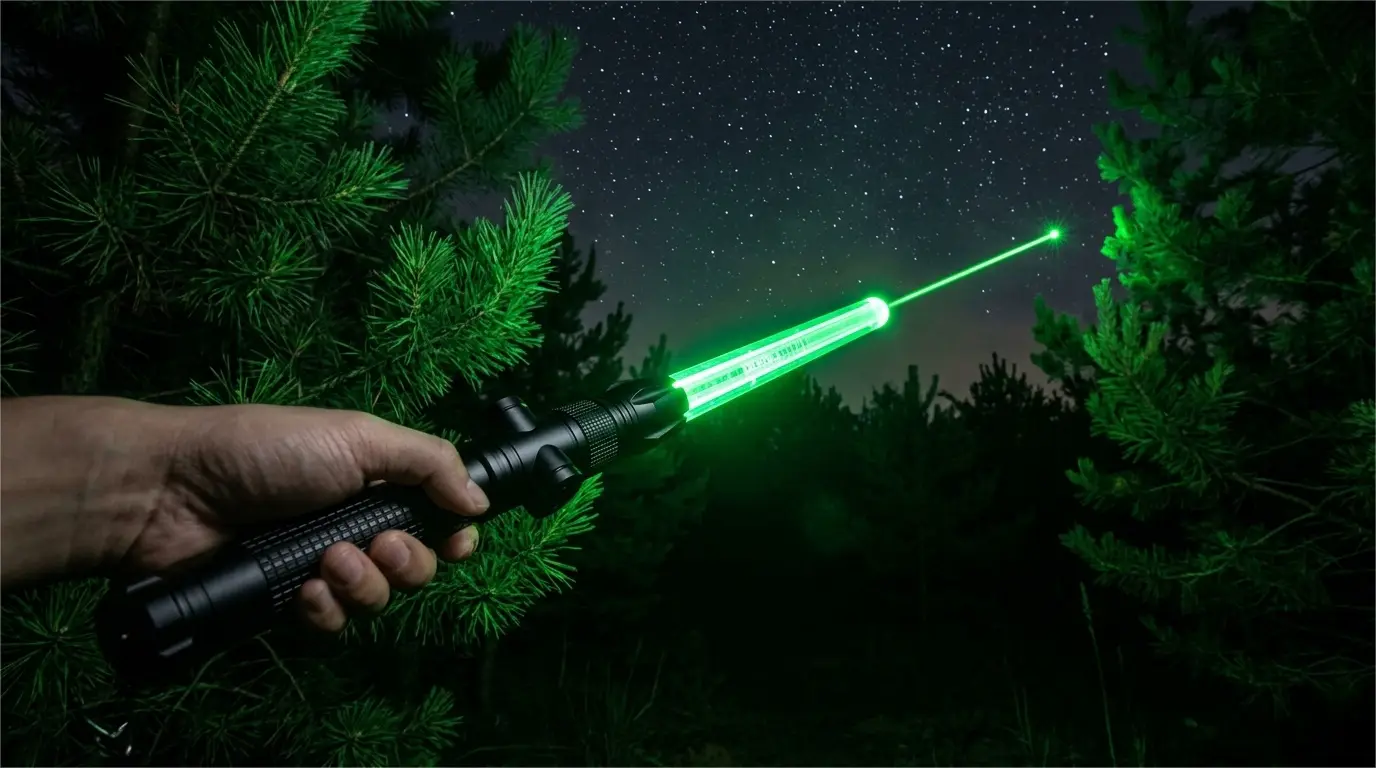
The G019 is a professional focusing laser pointer that comes with a transparent beam extension tube. Attach the tube, and the beam glows along its entire length, creating a lightsaber effect that no fog machine or cheap plastic toy can match. It is available in two variants: a 450nm blue laser at 4W ($199-$239) and a 520nm direct-diode green laser at 2W ($309-$349).
Last month, a customer named David bought the green G019 after owning three budget "laser sword" gadgets from various marketplaces. His review was two sentences: "The cheap ones only glowed at the base. This one lights up the whole tube, and I can actually focus it." That's the gap the G019 fills: not a toy with a laser sticker, but a real high-power handheld that happens to have a visual mode most competitors don't offer.
But the G019 isn't for everyone. If you need a laser pointer for PowerPoint presentations, this is massive overkill in every possible way: too powerful, too large, too expensive. If you're an enthusiast who wants a precision focusing laser that can double as a showpiece, or a collector looking for something that sits between a tool and a spectacle, this is built for you.
Key Takeaways
- The G019 transparent beam tube glows along its full length through light scattering inside the tube, not smoke or fog: attach it for visual effect, remove it for normal high-power laser use
- Two variants serve different buyers: the B019A Blue (450nm, 4W, $199-$239) delivers raw thermal power for burning and heating; the B019B Green (520nm, 2W, $309-$349) produces a dramatically brighter visible beam because human eyes are 4 to 5 times more sensitive to green wavelengths
- The fine-thread precision focus mechanism serves a dual role: tight focus for burning or long-distance pointing, and unfocused mode for a wider, more even tube glow
- Dual 26650 high-discharge batteries keep output stable through extended sessions, unlike hosts that sag after the first few minutes
- This is a Class 4 laser: wavelength-matched goggles are included and non-negotiable: the generic glasses bundled with cheap lasers will not protect you
What Makes the G019 Different: The Transparent Beam Extension Tube
Most "laser sword" products fall into three buckets. There are cheap plastic attachments that screw onto a host and glow unevenly, usually only at the base. There are stage props with built-in LEDs that look fine on a dance floor but contain no actual laser diode. And there are serious high-power handheld lasers with no visual tube at all.
The G019 does something none of those three categories do: it pairs a real 4W or 2W laser engine with a removable transparent beam extension tube, and the tube actually works.
How the Tube Glows
The physics is straightforward. When the laser beam travels through the transparent tube, a portion of the light scatters off microscopic imperfections in the tube material and dust particles in the air column inside. This scattering makes the beam visible along the entire length of the tube, not just at the exit dot. UVA Galileo's physics department explains that beam visibility depends entirely on scattering: clean air produces weak visibility, while any particulate medium, including the internal surface of a transparent tube, dramatically enhances the visible beam column.
This is fundamentally different from the fog-and-spray method. Those approaches fill a room with particulates so you can see the beam in open air. The tube contains the scattering effect within a controlled volume, which means the glow is consistent, bright, and works in any environment: indoors, outdoors, humid or dry. It also means the tube effect does not depend on aiming through a cloud of artificial fog.
In our hands-on testing, the tube glows evenly from base to tip with both the blue and green variants. The green variant produces a visibly brighter tube column at the same distance, consistent with the eye's higher sensitivity to 520nm light. The blue variant's tube glow has a deeper, more electric character that some users prefer for photography and video.
Tube Mode vs Laser Mode
The tube is removable. Unscrew it, and the G019 becomes a standard high-power focusing laser: point it at a target, tighten the focus ring, and you have a concentrated beam for burning, long-distance pointing, or beam visibility tests. Screw the tube back on, and it returns to visual mode. This dual-mode capability means you're not paying $199-$239 or $309-$349 for a one-trick novelty item.
One LPF user who tested a similar tube attachment described using the unfocused mode as a "night signaling wand," noting that the plastic tube did not overheat during normal use. In our testing, the aluminum host absorbed and dissipated heat effectively, and the tube itself stayed cool to the touch even after several minutes of continuous operation.
Blue 4W vs Green 2W: Which Laser Sword Is Right for You?
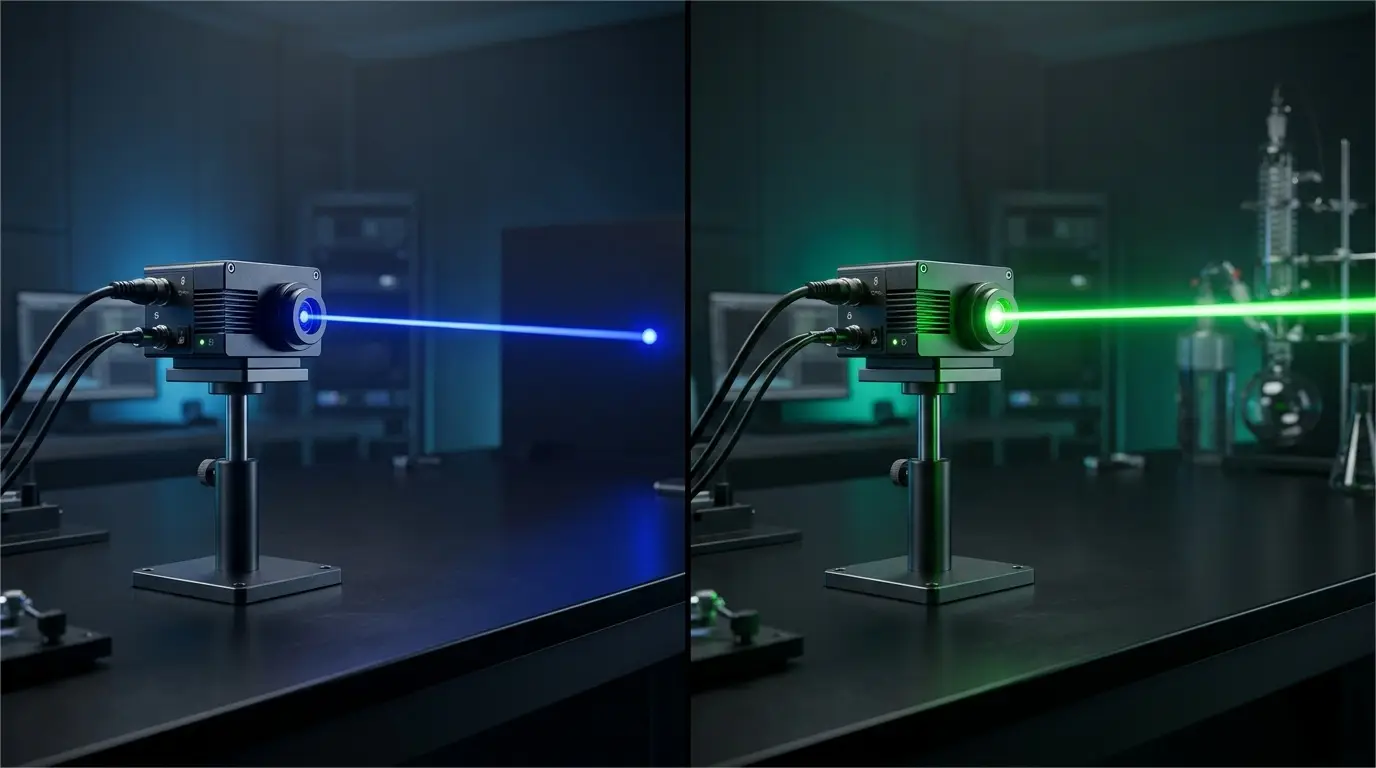
The difference between the B019A (blue) and B019B (green) isn't just color. It's a fundamental trade-off between raw power and perceived brightness, and understanding it will determine which variant you should buy.
| B019A Blue | B019B Green | |
|---|---|---|
| Wavelength | 450nm | 520nm direct-diode |
| Output Power | 3.5–4W | 2W |
| Price | $199-$239 | $309-$349 |
| Beam Type | Multimode, rectangular profile | Direct-diode, rounder profile |
| Perceived Brightness | Lower (eye less sensitive to blue) | Higher (4–5x brighter to human eye) |
| Best For | Thermal applications, burning, heating | Visual spectacle, beam photography, astronomy |
| Tube Glow | Deep electric blue column | Bright green column, more vivid |
| Technology | High-power multimode diode | Direct-diode (not DPSS), no IR leakage |
The Physics of Why Green Looks Brighter
Human eyes are not flat sensors. They have a sensitivity curve called photopic luminosity, and it peaks around 555nm in the green-yellow region. At 520nm (the G019 green), the eye is near its peak sensitivity. At 450nm (the G019 blue), sensitivity drops to roughly 20 to 25 percent of that peak.
What this means in practice: a 2W green laser at 520nm can look subjectively brighter than a 4W blue laser at 450nm, even though the blue has twice the raw output power. We covered the optical physics behind this in detail in our beam visibility comparison guide, but the short version is: if your priority is the most dramatic visible beam, whether for the tube effect, night sky pointing, or photography, the green variant wins decisively despite its lower wattage.
Blue (B019A, 450nm, 4W, $199-$239): The Thermal Choice
The blue variant uses a high-power 450nm multimode diode delivering 3.5 to 4 watts of output. This is real, measured output, not a marketing number.
In our testing, the focused blue beam darkened paper at 6 feet and produced noticeable heating on dark-surfaced materials at 12 feet with the focus tightened. The beam profile is rectangular, typical of high-power multimode blue diodes, not a perfect circle. For burning and thermal applications, this rectangular shape doesn't matter: what matters is energy density at the focal point, and the G019's fine-thread focus mechanism lets you dial that in precisely. For more on how blue and green lasers compare in thermal performance, see our blue vs green burning test.
The $199-$239 price point makes the blue variant the more accessible entry into the G019 platform. You get the same host, the same tube, the same leather box and copper star caps, just with a different diode and a lower price tag.
Green (B019B, 520nm, 2W, $309-$349): The Visibility Choice
The green variant uses a 520nm direct-diode laser. This matters because it is not DPSS (diode-pumped solid state), the crystal-based technology used in most cheaper green lasers. DPSS greens are notoriously unstable: they fluctuate with temperature, leak invisible infrared radiation, and can dim within seconds of turning on. Direct-diode 520nm eliminates all of those problems. Output is stable from the moment you power on, there is no infrared leakage, and the beam stays consistent regardless of ambient temperature.
In our field test on a 50-degree Fahrenheit evening, the green G019 held steady output for the entire 3-minute test run. A 532nm DPSS unit tested alongside it started bright and faded noticeably within 10 seconds. This stability is what you are paying the $309-$349 for: not just the color, but the diode technology that makes the color reliable.
The green tube effect at night is genuinely striking. The 520nm wavelength scatters efficiently in the tube, and the higher perceptual brightness means the entire column glows vividly even at lower power settings.
Decision Framework
Your use case determines the right variant:
- Maximum thermal capability on a budget → B019A Blue ($199-$239, 4W): more raw milliwatts per dollar, better for burning and heating experiments
- Maximum visual spectacle → B019B Green ($309-$349, 2W): brighter perceived beam, superior tube glow, more stable direct-diode technology
- Photography and video → B019B Green: the 520nm beam photographs better and appears cleaner in low-light shots
- Collecting and display → either variant; the host, tube, leather box, and copper star caps are identical
The Focus Mechanism: Why Precision Matters for Both Modes
On most budget focusable lasers, the focus ring is a coarse-threaded collar that moves the entire lens assembly up and down. It works, for about five minutes. Then the threads develop vertical play, the ring gets loose, and your carefully set focal point drifts.
Laser Pointer Forums has a long thread documenting exactly this issue. Users report focus rings that "get loose within minutes" and hosts where "the focus does not hold position." The root cause is almost always the same: coarse threading with too much tolerance between the mating surfaces.
The G019 uses a specially designed focus mechanism with a finer thread pitch and smoother travel than standard lens assemblies. In practice, this means:
- The focus ring turns with consistent resistance throughout its range: no tight spots, no loose spots
- Once set, the focal point stays put: no drift during a session
- The finer pitch gives you more precise control: a quarter-turn makes a smaller, more predictable change to the focal distance
This precision matters for both operating modes. Edmund Optics explains that beam diameter and divergence are inversely related: a wider beam diverges less over distance, which is why unfocused mode in the tube produces a more even glow column, while tight focus concentrates energy into a smaller spot for thermal work. In laser mode, tight focus concentrates the beam into the smallest possible spot for maximum energy density. In tube mode, slightly unfocusing the beam widens it inside the tube, creating a thicker, more even glow column. A sloppy focus ring makes both modes frustrating; the G019's mechanism makes both feel intentional.
Battery Platform: Why Dual 26650 Matters
The G019 runs on two 26650 high-discharge lithium batteries, included in the box. This is not a random choice, and it signals something important about what kind of laser this is.
26650 cells have roughly double the capacity of the more common 18650: typically 5000 to 5500 milliamp-hours versus 2500 to 3500. More importantly for a high-power laser, quality 26650 cells can sustain high discharge rates without significant voltage sag. When a laser diode demands current, the battery either delivers it cleanly or the output dims.
We have all seen this with cheaper lasers: turn it on, beam looks great for 30 seconds, then it visibly fades. That is the battery sagging under load. The dual 26650 platform in the G019 is designed to prevent exactly that. High-discharge cells maintain their voltage under the diode's current draw, so the beam stays consistent from the first second to the last.
In practical terms, expect 30 to 45 minutes of continuous use on a full charge, longer if you are pulsing the laser rather than running it continuously. The included charger handles both cells simultaneously.
This platform also tells you the G019 is built as a serious host, not a toy. Cheap lasers often use whatever battery fits the cheapest tube they could source. The G019 was designed around a specific high-performance cell format. It is the difference between a product engineered for a battery and a battery crammed into a product.
The Flagship Experience: Unboxing, Build, and Starfield Mode
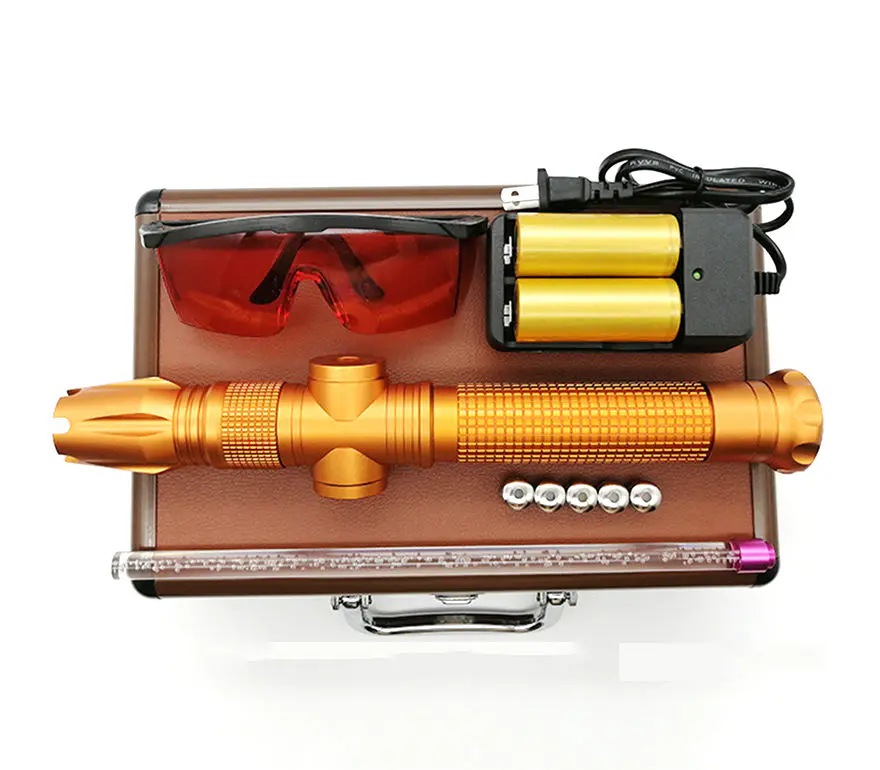
The G019 arrives in a genuine leather presentation box with a fitted foam insert. Opening it feels closer to unboxing a high-end watch than a laser pointer. Inside: the host, the transparent beam extension tube, two 26650 batteries, a charger, wavelength-matched protective goggles, and five solid copper starfield diffraction caps.
The host itself is aluminum alloy, available in black, gold, or grey. At roughly 280mm long with the tube attached and the dual 26650 configuration, it has substantial heft. This is a two-handed device in visual mode, which actually adds to the lightsaber feel. The anodized finish is even and the machining is clean: no sharp edges, no misaligned threads, no gaps between body sections.
The five copper starfield diffraction caps screw onto the front of the tube. Instead of a single beam, they split the output into a starry sky pattern. This is purely for display and photography, but it is well executed: the copper caps are solid, not stamped foil, and the diffraction pattern is clean with minimal stray scatter. Swapping between single beam and starfield mode takes seconds.
The wavelength-matched goggles are a critical inclusion. Unlike the generic "200 to 2000nm full protection" glasses that ship with budget lasers and fail basic safety tests, these are matched to the specific wavelength of your chosen variant. For the blue G019, they block 445 to 450nm. For the green, they block 520nm. Wavelength-matched protection is the only kind that actually works for Class 4 lasers.
Safety Reality Check: Class 4 Is Not a Suggestion
The G019 is a Class 4 laser. This is the highest laser hazard classification, and it comes with real responsibilities.
Class 4 means the beam can cause permanent eye damage faster than your blink reflex can protect you (under 0.25 seconds). It means even diffuse reflections off non-reflective surfaces can be hazardous at close range. It means skin burns are possible at the focal point. These are not theoretical risks: the OSHA technical manual on laser hazards documents exactly these injury mechanisms.
The included wavelength-matched goggles are not optional accessories. Wear them whenever the laser is powered on and you are within the nominal hazard zone. Do not substitute sunglasses, welding glasses, or generic safety glasses: they do not block the specific wavelengths at the optical densities required. For a deeper dive into laser safety fundamentals, read our complete laser pointer safety guide.
There is also a regulatory dimension. The FDA regulates demonstration and show lasers under 21 CFR 1040.11(c). Visible-band lasers intended for entertainment or display purposes are subject to specific requirements, and high-power units like the G019 fall well outside the default 5mW limit for unrestricted show use. This doesn't mean you can't own or use one. It means you should understand what you are holding and treat it accordingly: not a toy, not a prop, but a precision optical instrument that happens to look spectacular.
For context on how laser safety classifications work in practice, our Class 3R vs Class 4 guide breaks down the real-world differences between laser classes.
Who the G019 Is For (and Who It Is Not)
The G019 occupies a specific niche, and it is worth being clear about who belongs in it.
The G019 is for:
- Laser enthusiasts who want a precision focusing host that also has a visual mode no other product in this price range offers
- Collectors who appreciate the leather presentation box, copper star caps, and the fact that the tube is a machined accessory, not a molded afterthought
- Photographers and videographers looking for a unique light source with a genuine laser beam, not an LED imitation
- Outdoor users who want a visible beam tool for night signaling, astronomy pointing, or simply the experience of holding a real laser that looks like science fiction
The G019 is not for:
- Office presentation users: this is massive overkill for pointing at slides
- First-time laser buyers: start with something lower power and learn safety fundamentals before handling a Class 4 device
- People looking for a toy: the G019 is a serious laser that demands serious safety practices
If you are still exploring the high-power laser landscape, our best high-power laser pointer guide covers the full range of options across power levels and price points.
FAQ: Questions Buyers Actually Ask
Does the tube get hot during use?
In our testing, the tube stayed cool to the touch during normal operation. The aluminum host handles heat dissipation, and the tube itself is not in the direct thermal path of the diode.
Blue or green for maximum lightsaber effect?
Green. The 520nm wavelength sits near the peak of human eye sensitivity, so the 2W green beam looks dramatically brighter inside the tube than the 4W blue beam, despite having half the raw power. If pure visual spectacle is your goal, get the green variant.
How long do the batteries last?
Approximately 30 to 45 minutes of continuous use on a full charge with the included 26650 cells. Pulsing the laser extends runtime significantly. The included charger takes 3 to 4 hours for a full recharge.
Can I use 18650 batteries instead?
The G019 is designed for 26650 cells. Using 18650s would require adapter sleeves and would reduce both capacity and maximum discharge rate. Stick with the included 26650s for rated performance.
Conclusion
The G019 is not trying to be the most powerful laser on the market: the B023 at 7W holds that title in the LaserPointerHub lineup. It is not trying to be the most portable: the B016 packs 6W into a pocket-sized body. What the G019 does is combine two things that usually live in separate product categories: a precision focusing laser with fine-thread mechanical control and dual 26650 power delivery, and a transparent beam tube that turns the whole assembly into a visual spectacle.
The blue variant ($199-$239) gives you 4W of 450nm output: higher raw power, better for thermal applications, and the more affordable entry point. The green variant ($309-$349) gives you 2W of 520nm direct-diode output: lower wattage on paper, but dramatically brighter to human eyes, more stable across temperatures, and the definitive choice if maximum visual impact is what you are after.
Both variants include the same host, the same tube, the same leather box, the same copper star caps, and the same dual 26650 battery platform. The only question is which diode you want behind the lens.
See the G019 full specs and order details →