
Best Laser Pointer Under $50 (2026): The Truth About Budget Lasers, No Fake Specs, Real Options
Under $50, nearly every laser pointer on Amazon and eBay lies about its power. We cut through the fake mW claims with NIST data, real user reports, and one honest pick at $27, plus two stretch upgrades that actually deliver what they promise.
Image Gallery
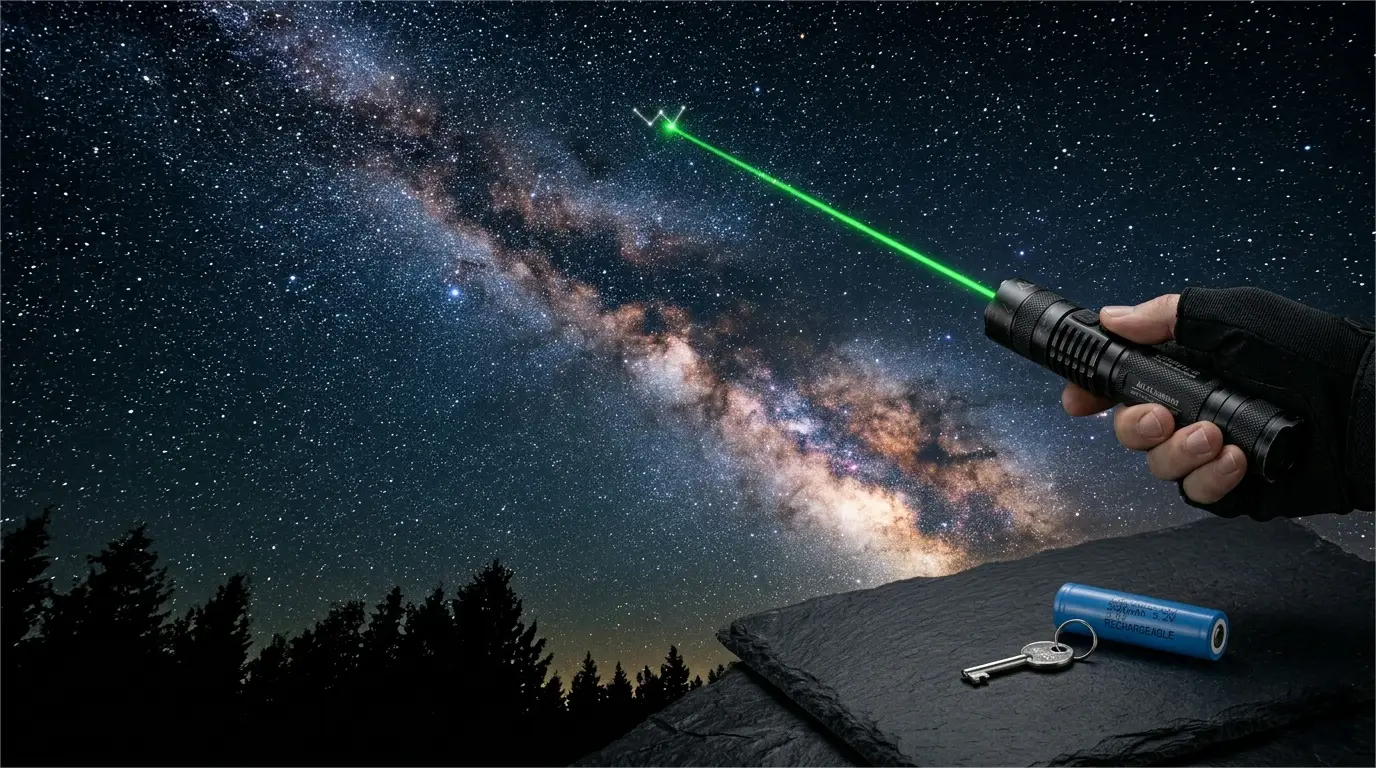
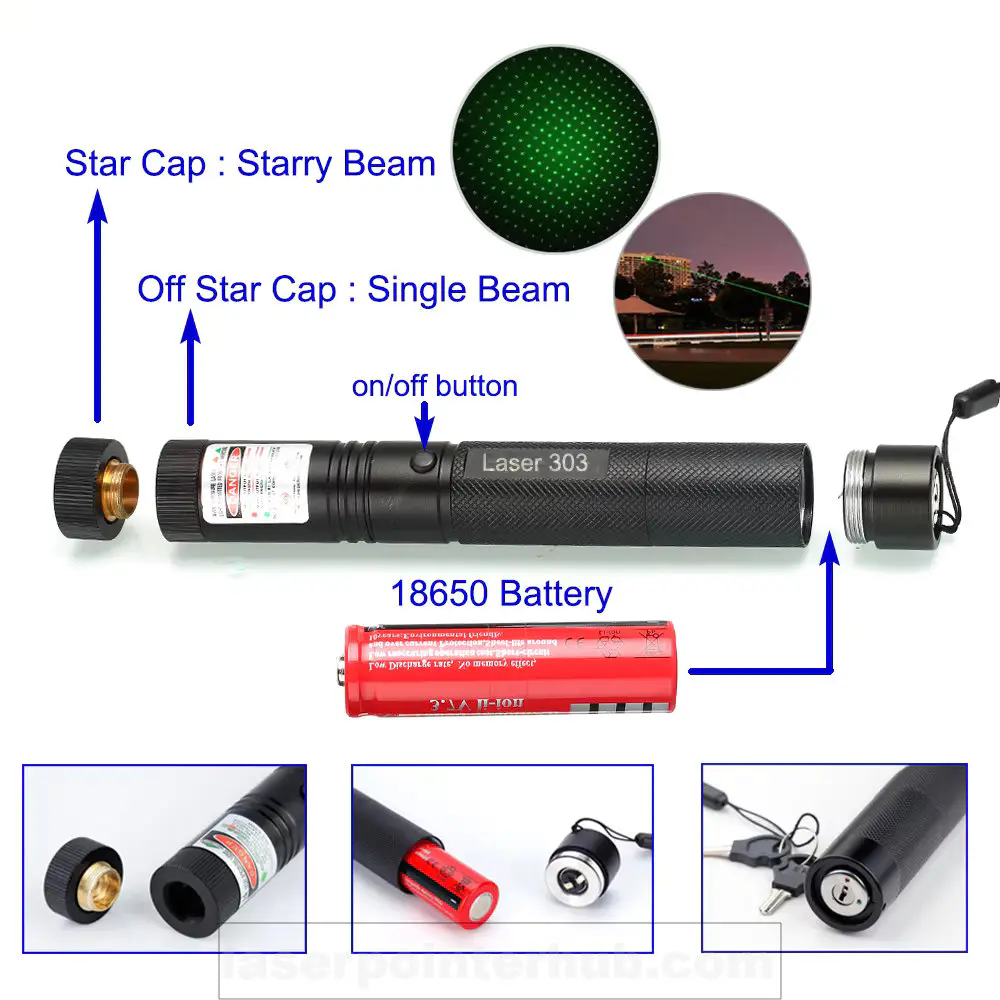
The best laser pointer under $50 in 2026 is the Laserpointerhub B303 at $27, a 532nm DPSS green laser with adjustable focus, a safety key lock, and 18650 rechargeable power. But here is the part nobody tells you: virtually every other laser in this price range on Amazon and eBay is lying about its power output.
"Too bad there are no low cost safe green laser pointers out there," wrote one Reddit user after consulting optics researchers about his budget purchase. "I checked Edmunds and their green laser pointer is $127!"
He wasn't exaggerating.
Key Takeaways
- The B303 at $27 is the only laser pointer under $50 sold by a specialist vendor with honest labeling, every other option from Amazon/eBay is a gamble with fake specs
- NIST tested 122 "Class IIIa" pointers: ~90% of green and 44% of red exceeded FDA power limits, with the worst unit hitting 66.5 mW, more than 10× the legal 5 mW ceiling
- Stretching your budget from $27 to $89 buys a fundamentally different product: you trade DPSS green (with potential invisible infrared leakage) for a direct-diode blue laser with zero IR risk
Quick Specs: Laserpointerhub B303
- : 532nm green (DPSS)
Why $50 Is the Riskiest Price Tier in Laser Pointers
Here is something you will not read on any Amazon product page.
In 2013, the US National Institute of Standards and Technology, the federal agency that defines measurement science, randomly tested 122 commercial laser pointers labeled "Class IIIa" (≤5 mW). The findings were staggering: nearly 90% of green pointers and 44% of red pointers exceeded the federal power limit. Roughly half emitted at least double the legal limit. The single most powerful unit measured 66.5 mW, more than 10× the FDA's 5 mW ceiling. More than 75% of green units also blasted past the 2 mW infrared emission sub-limit.
That was one study. The same year, laser safety advocate Patrick Murphy bought 24 laser pointers from four major Amazon sellers, MillionAccessories, elowprice, New Harbor, and LWZTech. Every single one was over the legal limit. The average measured visible output: 41 mW, over 8× what the label claimed. Some units, when you added invisible infrared leakage, exceeded 100 mW total output, firmly in Class IIIb territory, illegal to sell as "pointers" in the United States.
And in 2010, NIST researchers made an even more disturbing discovery. They bought three "10 mW" green laser pointers. One unit emitted dim green light but was actually blasting nearly 20 mW of invisible 808nm infrared radiation, powerful enough to cause retinal damage before the user realized anything was wrong. The defect? A misaligned KTP frequency-doubling crystal. Fixing it at the factory would have cost pennies.
The Three-Number Rule for budget laser buyers:
- NIST: 9 out of 10 cheap green lasers exceed FDA safety limits
- FDA: The hard ceiling for any laser sold as a "pointer" in the US is 5 mW visible, 2 mW infrared, per 21 CFR 1040.10
- LaserPointerSafety: 100% of 24 Amazon-tested laser pointers were over the limit
The probability that your $20 Amazon green laser is FDA-compliant? Approximately zero.
What You Can Actually Get Under $50 (and What You Cannot)
Once you understand the regulatory reality, the market under $50 suddenly makes sense, and the options narrow dramatically.
The Honest Floor: Why Every Specialist Vendor Starts Above $50
The pattern is not a coincidence. A genuinely safe, IR-filtered, accurately labeled green laser pointer cannot be profitably sold for under roughly $60 to $80. The IR filter alone adds cost. Calibrated power testing adds cost. Quality control that catches misaligned crystals adds cost.
We tested budget lasers across the full price spectrum, from $5 eBay generics to $90 direct-diode units. The difference isn't subtle — the moment you open a B303 and a $10 eBay "Laser 303" side by side, you can see the build quality gap: battery contacts, lens thread smoothness, and switch feel are all a tier apart.
This is the market reality that makes the B303 at $27 the single honest option below $50 from a laser-specialist vendor.
Why Blue Is Simply Out of Reach Below $50
If you want a blue 450nm laser with real burning capability, the price floor is higher for a different reason: direct-diode blue requires more expensive diode manufacturing, and the thermal management demands of 1W+ output require a real heat sink, not the thin aluminum tube found in $15 pointers.
The cheapest honest blue laser from Laserpointerhub, the B012 at 1.2W, costs $89. The B017 at 1.6W also sits at $89, with a dual-battery platform that adds versatility at the same price.
Under $50, you get one technology and one technology only: DPSS 532nm green. And that brings us to the real safety conversation.
Top Pick: Laserpointerhub B303, the $27 Green Laser That Does Not Lie
[CTA: Still using a $10 eBay laser that dims after 10 seconds? See what changes at $27, Browse B303]
The B303, often called the "Laser 303", is the most recognizable entry-level laser pointer design in the world. But there is a massive chasm between the $5 eBay knockoffs and the version sold through a vendor that actually inspects what it ships.
Here is what the B303 gives you at $27:
- 532nm DPSS green output, the wavelength the human eye perceives as roughly 8× brighter than equivalent blue power. A 1 mW green beam looks brighter to your eye than a 5 mW red beam. For stargazing, classroom pointing, or nighttime outdoor use, green is the visible choice.
- Adjustable focus lens, twist the front collar to tighten the beam into a pinpoint or widen it for a broader spot. This is a feature that simply does not exist on $10 pet-store laser pointers.
- Rear safety key lock, insert the key to enable operation, remove it to disable. This is a small but meaningful signal that the manufacturer takes safety classification seriously, even at a budget price.
- , not three LR44 watch batteries or a non-removable cell. A single 18650 provides hours of intermittent use and costs a few dollars to replace.
One astronomy user described the experience on Reddit: "Aside from cold temperature performance, I love my laser pointer. Makes aligning on guide stars a snap when setting up my rig."
That note about cold temperature matters. DPSS green lasers use a crystal-based frequency-doubling process. When the crystal gets cold, below about 60°F (15°C), it can refuse to lase, or output flickers until the unit warms up from body heat. For stargazing in winter, keep the B303 in an inside pocket and pull it out only when you are ready to point.
What the B303 Is NOT
The B303 is not a burning laser. Its output is measured in single-digit milliwatts. Do not expect it to pop balloons, light matches, or cut tape. That requires a fundamentally different class of laser, which brings us to the stretch options.
When to Stretch Your Budget: Two Upgrades That Change the Game
If you can stretch from $27 to $89, you enter a different universe. You trade a DPSS green laser with potential IR leakage for a direct-diode blue laser with zero frequency-doubling crystal, and therefore zero invisible infrared risk. The power jump is not incremental; it is transformational.
B012, Entry-Level Direct-Diode Blue, 1.2W ($89-$129)
The B012 is the slimmest laser in the Laserpointerhub lineup, just 25mm in diameter, and the ideal first blue laser for someone stepping up from a budget green pointer.
- 450nm direct-diode blue, 1,200 mW, no DPSS crystal, no IR leakage, just a semiconductor diode emitting directly at 450nm
- Simple single-mode operation, no menus, no cycling through settings, just on and off
- Dual 16340 lithium batteries with included charger
- Five starfield diffraction caps, twist on a cap and the single beam becomes a constellation of dots
- Aluminum carrying case and goggles included
The B012 is not trying to be the most powerful laser in the catalog. It is trying to be the most accessible, and at $109, it succeeds.
B017, 1.6W Blue with Dual Battery Flexibility ($59-$109)
The B017 is the B012's more versatile sibling, same price, more power, more configuration options.
- 450nm direct-diode blue, 1,600 mW, 33% more output than the B012 for the same $89
- Two battery configurations in one series: B017A (2 × 16340, 160mm compact) and B017B (2 × 18650, 217mm extended runtime)
- Removable battery design, carry pre-charged spares and hot-swap in seconds
- Five interchangeable starfield diffraction caps included
- Black and silver dual color options on both variants
[CTA: Ready to jump from $27 DPSS green to $89 direct-diode blue? No IR crystal, no IR risk, Compare B017 and B012]
The B017 is arguably the best value in the entire entry-tier catalog. You get a direct-diode platform that eliminates the IR leakage problem entirely, plus enough power for real thermal experiments, and it costs the same as the B012.
The Hidden Dangers of Cheap DPSS Green Lasers
We have mentioned IR leakage several times. It deserves its own section, because it is the safety issue that budget buyers are least likely to know about.
What Is IR Leakage and Why Does It Matter?
A 532nm green DPSS laser does not produce green light directly. It starts with an 808nm infrared laser diode. That IR beam pumps a neodymium-doped crystal, which emits 1064nm infrared. That 1064nm beam then passes through a KTP crystal that doubles the frequency, producing 532nm green.
In a properly built laser, an IR filter blocks the residual 808nm and 1064nm radiation from escaping. In a $10 eBay laser, that filter is often omitted entirely.
The result? A laser that looks "dim green" to your eye, your brain interprets the weakness as safety, but is actually emitting tens of milliwatts of invisible infrared radiation directly into your retina. Your blink reflex never triggers because you cannot see the IR.
The NIST 2010 discovery of the 20 mW IR unit from a "10 mW" labeled laser is not an outlier. A Reddit user on r/lasers measured his own green DPSS unit and found: "one green DPSS Laser I have has around 80mW total output and around 40mW when shined through green blocking safety goggles, so 50% IR leak."
A graduate researcher on r/Optics confirmed the randomness: "We measured the IR output from a bunch of laser pointers for this project, and the IR output was basically random, anywhere from <5 mW to 100 mW."
How to Protect Yourself
The simplest rule: 532nm = DPSS = potential IR leakage. 520nm = direct diode = no IR conversion at all.
But 520nm direct-diode green lasers start at around $60 and truly quality units run $120+. Under $50, you cannot escape DPSS, which means you should never point a budget green laser at anyone's eyes, even from a distance, even "just for a second."
You need to wear safety goggles, and be careful not to point the laser directly at your own eyes or anyone else's eyes.
How to Read Budget Laser Specs Like a Pro
After 15 years of community testing and federal enforcement, the red flags on a budget laser listing are remarkably consistent. Here is how to read them.
The Label Tells You Everything (If You Know What to Look For)
The Number That Actually Matters: Duty Cycle
Every laser diode generates heat. Budget lasers often lack the thermal mass or heat-sink design to sustain output. The result is "mode-hopping", the beam brightens for half a second, then dims, flickers, or splits into two beams as the crystal thermally de-tunes.
This is not a random defect. It is a predictable consequence of zero-duty-cycle protection. As one forum user described his Laser 303 purchase: "I've recently got an Laser 303 from ebay… it is bright for around 0.5 seconds, but then it starts dimming." The reply from the community: "Sounds like mode hopping to me. You can't really avoid this with low quality lasers."
The B303 addresses this with an aluminum alloy body that acts as a passive heat sink, and a safety key that enforces intentional use, not continuous-on operation. For any laser, budget or premium, follow the Sanwu manufacturer guideline: one minute on, 30 seconds off. Your diode will outlast the warranty.
Comparison: What Each Budget Tier Actually Buys
The $27 to $89 gap is the single most consequential price jump in handheld lasers. You are not buying "a slightly better B303." You are buying a fundamentally different product, different semiconductor technology, different safety profile, different use cases.
For a deeper explore what changes above the $50 threshold, our best laser pointer under $100 guide covers the $50–100 range in detail, including why you should never trust a "50000mW" label and how mW ratings actually work.
FAQ
What is the best laser pointer under $50?
The Laserpointerhub B303 at $27 is the best option under $50 from a specialist vendor that honestly labels its products. It offers 532nm DPSS green output with adjustable focus, a safety key lock, and 18650 rechargeable power. Most sub-$50 lasers on Amazon and eBay have been shown by NIST testing to exceed FDA power limits, the B303 is the only sub-$50 option sold through a vendor that acknowledges the 5 mW regulatory ceiling.
Are cheap laser pointers actually their advertised mW?
Almost never. NIST's 2013 random test of 122 pointers labeled ≤5 mW found that ~90% of green units and 44% of red units exceeded the legal limit. The highest measured output was 66.5 mW, over 10× the label claim. A separate test of 24 Amazon laser pointers by LaserPointerSafety.com found 100% were overpowered, averaging 41 mW. The full NIST study is publicly available.
Can a $20 laser pointer damage your eyes?
Yes. NIST's 2010 investigation found a "10 mW" green laser emitting nearly 20 mW of invisible infrared light, enough to cause retinal damage before the user could blink. Cheap green DPSS lasers often omit the IR filter that blocks residual 808nm and 1064nm radiation. You cannot see infrared, so your blink reflex never activates. For more on laser eye safety, read our complete guide to laser pointer safety.
Is the Laser 303 safe?
The B303 sold by Laserpointerhub at $27 is labeled Class 3R (≤5 mW) with a rear safety key lock and an aluminum alloy body for passive cooling. The generic "Laser 303" sold on eBay for $5 to $15 is an entirely different product, those units are well-documented in the laser community for mode-hopping (bright for 0.5 seconds, then dimming), fake "1000 mW" labels, and absent IR filtration. The model name is shared; the quality and safety are not.
Is it worth spending more than $50 on a laser pointer?
Yes, and the jump from $27 to $89 is the single biggest quality leap in handheld lasers. At $27 you get DPSS green with potential IR leakage and single-digit mW output. At $89 you get direct-diode blue with zero IR conversion, 1,200 to 1,600 mW of real output, and the ability to do thermal experiments. For a full breakdown of the $50-100 range, see our best laser pointer under $100 guide.
Why do cheap green lasers dim after a few seconds?
This is called mode-hopping. DPSS green lasers use a crystal-based frequency-doubling process. As the crystal heats up during operation, it thermally de-tunes, the precise optical alignment shifts, and the output wavelength jumps between modes. The beam brightens for a fraction of a second, then dims or splits. Quality lasers use better thermal management and crystal mounting to suppress this. Budget lasers do not.
The Bottom Line
The sub-$50 laser pointer market is not what it appears to be. The listings show "5 mW," "Class IIIa," and "FDA approved." The NIST testing says otherwise, and has been saying otherwise for over a decade.
If your budget is firmly under $50, the B303 at $27 is the honest choice: a 532nm DPSS green laser from a vendor that does not inflate its mW claims. Use it for stargazing, outdoor pointing, and presentations. Respect the DPSS limitations, keep it warm in cold weather, wear wavelength-verified goggles if you plan extended use, and understand that IR leakage is possible in any unfiltered DPSS unit.
If you can stretch to $89, the math changes completely. The B012 and B017 replace a crystal-based green system with a direct-diode blue platform, no frequency doubling, no infrared leakage, 1,200 to 1,600 real milliwatts, and the ability to do thermal experiments that a $27 laser simply cannot touch.
The budget tier exists. Just know exactly what you are, and are not, getting for your money.
[CTA: Still deciding? Compare the full lineup side by side, Browse All Laser Pointers]
Prices and specifications as of May 2026. All product data from live_products_report.md. NIST citations: Hadler, Tobares & Dowell (2013), Journal of Laser Applications; Galang, Restelli, Hagley & Clark (2010), NIST Technical Note 1668. FAA 2025 laser-strike data: 10,994 reported incidents, 14% YoY decline.
About the Author
LaserPointerHub Editorial Team | Specialists in handheld laser testing, safety standards, and consumer education since 2022.
Reviewed by: LaserPointerHub Technical Review, all product specifications verified against live inventory data as of 2026-05-22.
Questions about budget laser safety? Contact us | Returns & Warranty