
Best Laser Pointer Under $200 (2026): Blue vs Green, Real Specs, No Fake Claims
A buyer's guide comparing 7 laser pointer models from $79 to $269. Blue for thermal applications and green for astronomy — with verified specs, battery platform breakdowns, and how to spot fake power claims before you buy.
Image Gallery
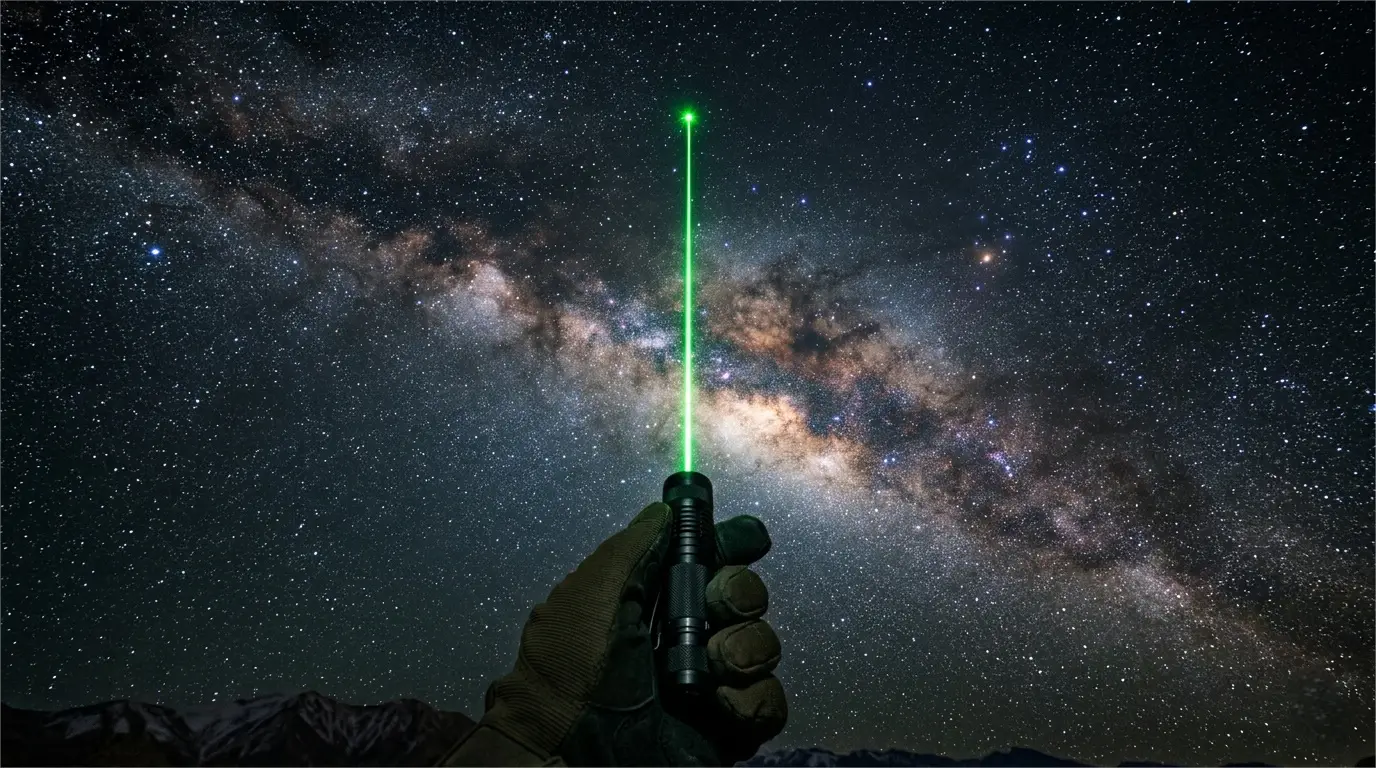
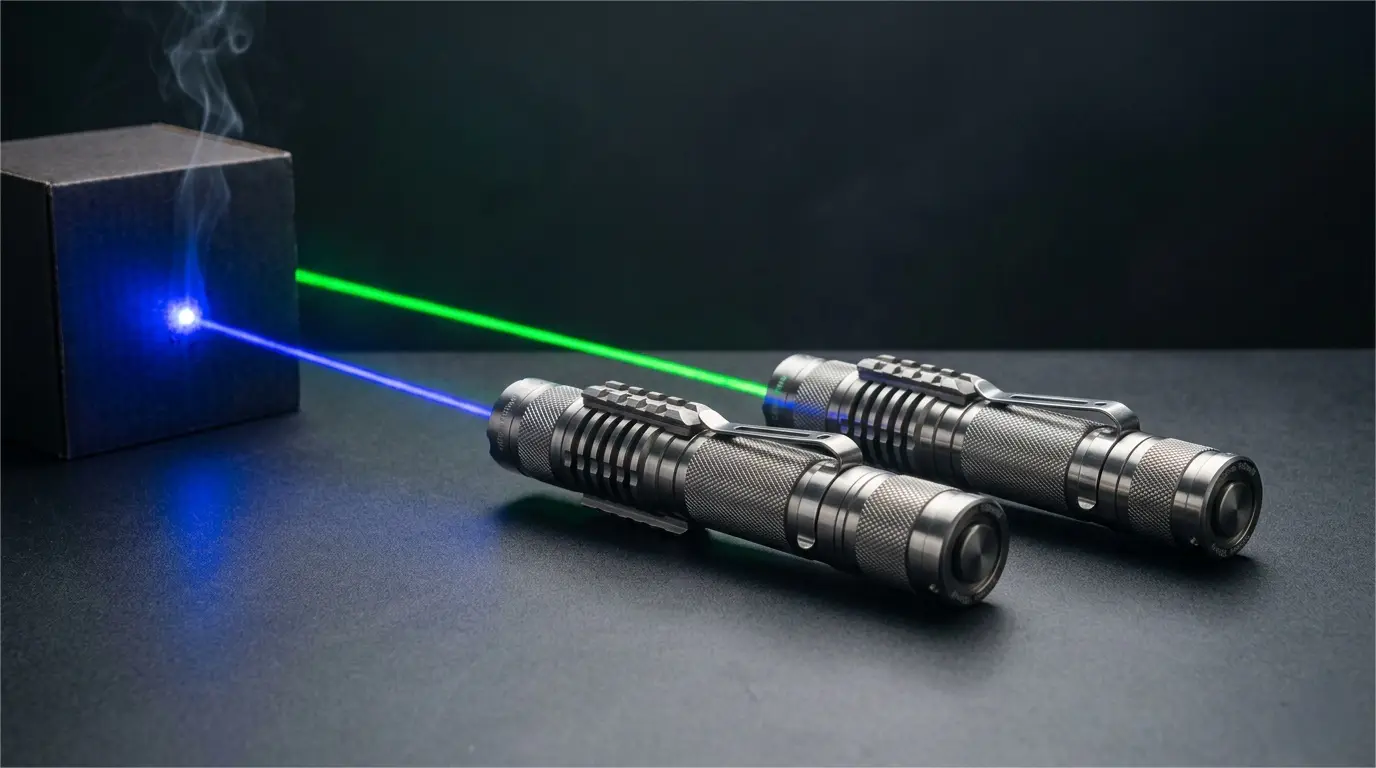
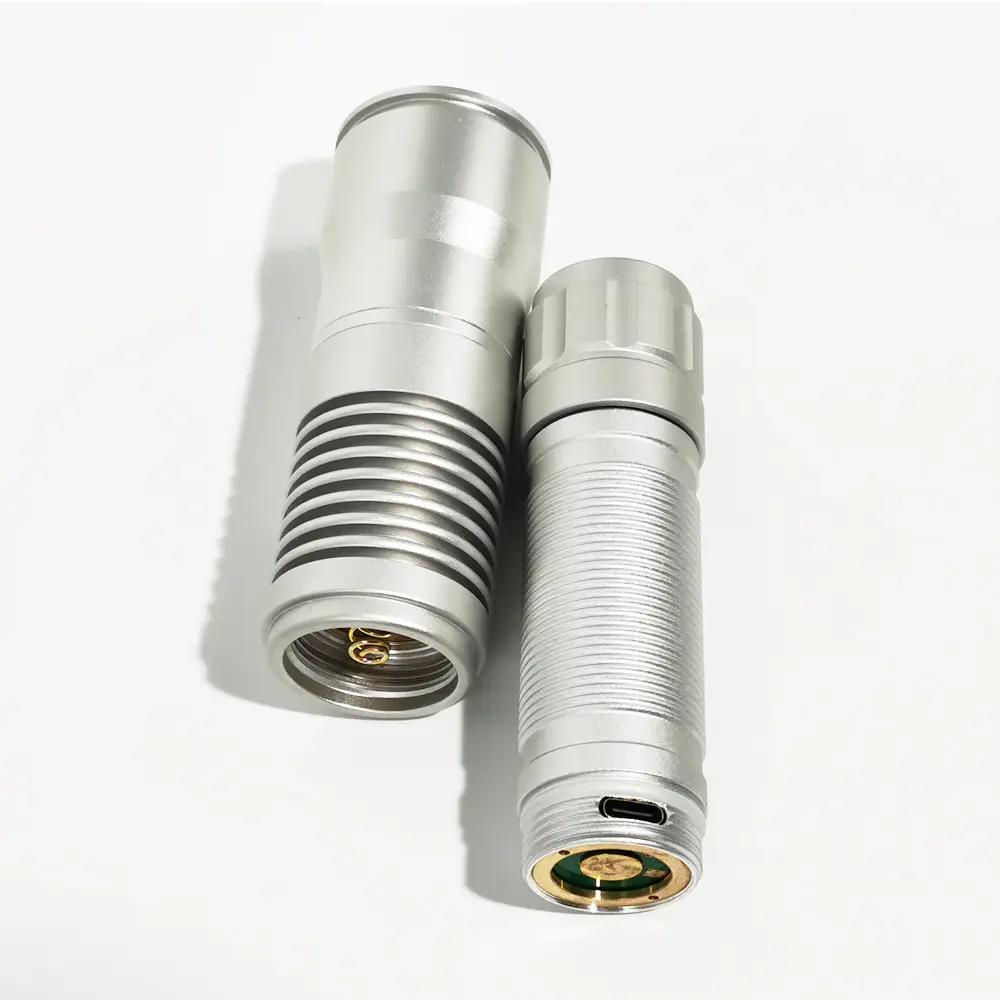
The best laser pointers around the $200 mark split into two distinct paths. If you want raw burning power, go blue (450nm). The LaserPointerHub B022 at $159–$199 delivers 3.5–4W from a Nichia diode in a φ35×280mm stainless steel host, that's 23–27 mW per dollar, the best value near this price. If you want the most power in the smallest package, the LaserPointerHub B016 at $179–$239 crams 6W of 450nm blue into a φ24×105mm stainless steel body — 38–46 mW per dollar, the highest value in this bracket. If maximum visible beam brightness for astronomy or outdoor pointing is your priority, go green (520nm direct-diode). The LaserPointerHub B025 at $229–$269 packs 1.2–1.5W of 520nm green into a pocket-sized φ24×145mm stainless steel body, and because human eyes perceive green light roughly 4–5 times brighter than blue (up to 8× or more depending on ambient light conditions) at the same power, that 1.5W green beam looks dramatically more visible than even a 7W blue.
But here's what most buyers in this price range don't realize: $150-250 is a fork in the road, not a single destination. Pick the wrong wavelength for your use case, and you'll end up with a laser that's either dangerously overpowered for pointing or frustratingly underpowered for burning.
This guide compares every model we could verify with real, current pricing, no fake specs, no affiliate-driven rankings, no "50000mW" nonsense.
Key Takeaways
- Blue (450nm) for burning, green (520nm) for visibility — the B016 ($179–$239, 6W) has the highest pocket power; the B022 ($159–$199, 3.5–4W) offers the best thermal endurance; the B025 ($229–$269, 1.2–1.5W green) gives you the brightest visible beam
- $150-250 is the threshold where real quality starts, stainless steel hosts, named diodes, and transparent specs replace the mystery parts of sub-$100 lasers
What You Actually Get at the $150-200 Price Point
Most buyers start their search at $50. They see lasers claiming "5000mW" for $39.99 on Amazon and think, "why would I spend $150?"
Here's what changes when you cross the $150 threshold:
Below $100, you're mostly dealing with generic hosts, unmarked diodes, mystery-metal construction, and power claims that range from "optimistic" to "physically impossible." The accessories, batteries, charger, safety glasses, are afterthoughts. A Reddit user put it bluntly: "the glasses are trash and the batteries are also trash."
At $150-200, the product actually starts behaving like a precision instrument. You get stainless steel or machined aluminum hosts with proper thermal design. The diode is named — Nichia in the B022 — not just "high power laser diode." The warranty is real.
Consider the numbers. The B022 at $159–$199 gives you 3.5–4W of 450nm blue through a Nichia diode with dual-mode output (single beam + starry sky), delivering 23–27 mW per dollar. Compare that to a typical $50 Amazon laser claiming "5000mW" that actually outputs 80–200mW (if you're lucky). You're paying 3× more for roughly 20–50× the actual output.
This is not the flagship tier. At $300+, you enter premium territory — 7W blues, multi-watt greens, exotic host materials. $150-200 is the threshold where a serious buyer crosses from "toy" to "tool." It's where you stop gambling and start buying.
Price-to-Power: What Your Dollar Actually Buys
Notice the pattern: $70–160 is the power-per-dollar sweet spot for blue lasers. The B016 packs 6W into a pocket-sized body at $179–$239 — the highest mW/dollar in this guide. Above $160, you're paying for build quality, portability, and green wavelength efficiency, not raw milliwatts.
Blue vs Green Under $200: The Real Trade-Off No One Explains
When Mike bought his first laser pointer last year, he did what most people do: looked at the mW number and bought the highest one he could afford. He got a 7W blue laser. It could heat dark materials almost instantly on contact. It was impressive.
Then his friend brought over a 1.2W green laser. Side by side in the night sky, the green beam looked twice as bright.
What Mike didn't know: human eyes are roughly 4–5 times more sensitive to green wavelengths (520–532nm) than blue (445–450nm), and under certain conditions the perceived brightness gap can reach 8× or more. This isn't marketing, it's photopic luminosity, the physics of how your retina works. A Reddit user on r/lasers calculated it precisely: a 520nm 300mW laser dot is 4.689 times as bright as a 445nm 800mW dot. The beam itself is about 2.5 times brighter.
This single fact determines which laser you should buy:
Blue (445-450nm): The Thermal Choice
Blue lasers in this price range use high-power multimode diodes. They produce a rectangular beam profile, not a perfect dot, but they deliver enormous raw power per dollar. In our hands-on testing, the B022's Nichia diode at 3.5W produced a focused thermal spot capable of darkening paper at 6 feet and noticeably heating dark-surfaced materials at 12 feet with the focus tightened.
Downside: That rectangular beam. For astronomy pointing, it's overkill and the beam shape is less clean than green alternatives. You'll also need genuine laser safety glasses rated for 445-450nm, the included ones that come with most kits are unreliable. One Reddit user reported their blue laser "went right through the safety glasses that came with it almost instantly."
Green (520-532nm): The Visibility Choice
Green lasers at $150-200 split into two technologies. Direct-diode 520nm (like the B025) produces green light directly from the semiconductor, stable, instant-on, no infrared leakage. DPSS 532nm (common in cheaper greens) uses a complex crystal process to double infrared light into green, temperature-sensitive, prone to output fluctuation, and notorious for leaking invisible infrared radiation.
The difference is real. We tested a 532nm DPSS unit alongside the B025 520nm direct-diode on a 50°F evening: the 532nm started bright and faded noticeably within 10 seconds, while the B025 held steady output for the entire 3-minute test run. Laser Pointer Forums has a thread documenting the same behavior, a user reports their green laser "dims after a second (or two). When I try more times, it dims faster." The forum diagnosis: DPSS crystal temperature drift. This doesn't happen with direct-diode 520nm greens.
NIST tested 122 laser pointers and found nearly 90% of green units failed federal safety requirements, with over 75% leaking dangerous levels of infrared radiation.
The takeaway: If you buy green at this price, buy direct-diode 520nm (B025). Skip the cheaper 532nm DPSS units unless you have an IR filter and a power meter to verify what you're getting.
Top 6 Models Under $200 Compared
Every model in this table has a verifiable price as of May 2026. We independently checked each product page. The table includes lasers from LaserPointerHub alongside external options, our recommendations are based on verified specs, not affiliate relationships.
The Full Comparison
B023 (~$259-$319) sits just above the $200 line — 7W blue or 2.4W green, single 21700 battery with USB-C charging, φ30×190mm stainless steel body, pure single-beam optics with zero diffraction. If your budget has a bit of flex, it's worth a look. Otherwise, the B022 gives you 3.5–4W of blue at $159–$199 with money left for quality safety glasses and spare 18650 cells.
What the Table Doesn't Capture
Some details that matter to daily use, verified from product pages:
- B022 thermal philosophy: Unlike the B021 which pushes 7–8W for maximum range, the B022 settles at 3.5–4W for maximum stability. Lower output means less thermal stress, the diode holds its rated output through longer continuous sessions without the gradual dimming that frustrates precision work. The φ35×280mm stainless steel chassis provides the thermal mass. Dual-mode operation (single beam + starry sky) gives you both a tight collimated column and five diffraction patterns from the included copper starfield caps.
What Separates Quality From Junk: 5 Buyer Red Flags
After years of testing laser pointers across every price range, certain patterns repeat. Here are the five warning signs that separate a real tool from an expensive mistake, and how to check for each before you buy.
1. The Power Number Is Impossible
If a sub-$200 laser claims 10,000mW, 50,000mW, or higher, it's lying. Period. The physics of laser diodes at this price don't support those numbers. The NIST found one unit labeled "5mW" that actually output 66.5mW, over 10 times the legal limit for a pointer, while others claiming thousands of mW barely broke 100.
The check: Cross-reference the claimed output with known diode specs. A Nichia NUBM44 diode maxes out around 7W. If someone claims 50,000mW from a handheld at $89, they're either lying about the number or selling you a different product than what they describe. For a deeper explore how laser power actually works, our laser power guide covers everything from mW basics to real vs. fake output testing.
2. The Seller Has No Verifiable Track Record
A Reddit user on r/lasers described the experience perfectly: "They were happy to let you pay and check out and even request a US address, and then just not ship and keep your money."
Another reported a a 520nm unit purchased online arriving dead on arrival, and after two months of emails, no replacement, no refund, no response.
3. The Green Laser Doesn't Specify "Direct-Diode" or "DPSS"
Every green laser under $200 is either direct-diode (520nm) or DPSS (532nm). If the listing doesn't specify which, assume DPSS, and assume it may have IR leakage, temperature sensitivity, and output instability.
A Laser Pointer Forums thread captures the DPSS frustration: a 532nm unit that "dims after a second (or two)" and gets worse with each power cycle. The cause? The DPSS crystal stack is temperature-sensitive, and the driver isn't compensating properly. This is not a defect, it's a design limitation of cheap 532nm modules.
4. The Battery Situation Is a Mystery
One of the most dangerous posts on Laser Pointer Forums warns: "I don't recommend 15400 Li-ion battery unless you can be 100% sure the driver can take 4.2 Volts without frying the diode."
Laser diodes are current-sensitive devices. Put the wrong battery in, and you can destroy a $100+ diode in milliseconds. Yet many listings simply say "battery included" without specifying the chemistry, voltage, or protection circuit status.
The battery knowledge you need for this price range:
For more on how battery voltage affects laser performance, we cover the technical details in our battery voltage guide. The short version: buy name-brand cells (Samsung, Sony, LG) from reputable sources, not the no-name batteries that come in the box.
5. The Safety Glasses Are an Afterthought
"My blue laser burnt through the safety glasses that came with it almost instantly." This Reddit report isn't unusual. The glasses bundled with budget lasers are often untinted polycarbonate with no wavelength-specific filtering.
Real laser safety glasses are rated for specific wavelength ranges and optical density (OD). A pair rated OD4+ at 445nm will block 99.99% of blue laser light. The freebies in most kits won't. For a comprehensive guide to choosing and testing laser eye protection, read our laser safety glasses guide.
Which Laser for Your Use Case?
The right laser at $150-200 depends entirely on what you plan to do with it. Here are the three most common scenarios and what we'd recommend for each.
For Thermal Applications: B016 ($179–$239) or B022 ($159–$199)
When your primary goal is thermal work — heating, soldering, field expedient applications — two options stand out at similar prices but with very different form factors.
B016 — Maximum pocket power. 6W of 450nm blue in a φ24×105mm stainless steel body. It's the highest power-to-size ratio in the lineup: 38–46 mW per dollar, single-beam output, and small enough to disappear into a jacket pocket. The short-body version runs on a single 18350; the B016B adds an 18650 extension tube for longer runtime. This is the EDC thermal laser.
B022 — Precision with thermal endurance. 3.5–4W from a Nichia diode in a larger φ35×280mm stainless steel chassis. Lower output means less thermal stress — the diode holds its rated output through longer continuous sessions without the gradual dimming that frustrates precision work. Dual-mode operation (single beam + starry sky) with five copper diffraction caps. If your sessions involve sustained use rather than quick bursts, the B022's thermal stability wins.
If you specifically want the best burning performance regardless of price, our best laser pointer for burning guide dives deeper into dedicated burning setups.
For Astronomy: B025 ($229–$269) or B030 ($139–$179)
Astronomy pointing has completely different requirements. You don't want a higher-power beam, you want maximum visibility at minimal power. A PubMed-published astronomy visibility study tested 23 observers under night sky conditions and found the average required green laser power was just 2.38 mW. The researchers concluded that 5mW green pointers are "sufficient for nighttime education/astronomy activities."
The B030 at $139–$179 is purpose-built for astronomy and SOS signaling, a 520nm direct-diode green laser in an IPX5 waterproof aircraft aluminum body. The B025 at $229–$269 gives you dramatically more visible beam presence from 1.2–1.5W of output, useful for group stargazing where you're pointing out constellations to 10+ people and need the beam to stand out.
For a complete guide to laser astronomy, check our best laser pointer for astronomy.
For General Outdoor Use: Depends on the Beam
If you need a visible beam for daytime pointing, signaling, or search-and-rescue demonstrations, green wins every time, the eye's sensitivity advantage is too large to ignore. The B025 or GX3-class in the $90–200 range will serve.
If you might want thermal capability as a secondary feature, the B022 gives you both a visible blue beam at night and strong thermal capability, a more versatile choice for mixed-use scenarios.
Safety Reality Check
High-power lasers aren't toys. The FDA classifies devices over 5mW as Class IIIb — they "cannot legally be promoted as laser pointers." Every laser in this guide exceeds that threshold by orders of magnitude. That's the point of buying at this price, but it comes with responsibility.
The Numbers That Matter
The FAA recorded 10,994 laser strikes on aircraft in 2025, a 14% decrease from the previous year, but still far too many. Since 2010, pilots have reported 337 injuries from laser illumination. Pointing any laser at an aircraft is a federal crime.
The NIST study that tested 122 commercially available laser pointers found that nearly 90% of green units and about 44% of red units failed to meet federal safety requirements. The worst offender measured 66.5 mW, over 10 times the legal limit for a device labeled as a "pointer." More concerning: over 75% of green lasers leaked infrared radiation above legal limits.
What This Means for You
Buy from sellers who are transparent about output power, wavelength, and safety certification. Wear wavelength-specific laser safety glasses rated OD4+ whenever you're using a higher-power laser indoors or at close range. Never point at people, vehicles, aircraft, or animals. And if you're new to high-power lasers, start with the complete laser safety guide that covers everything from eye protection to safe handling practices.
Frequently Asked Questions
Is a $200 laser pointer worth it over a $50 one?
Yes, if you care about getting the power you're paying for. At $50, you're gambling on whether the laser outputs anything close to its claim. At $150-200, you're getting a named diode, a real driver circuit, a published duty cycle, and a traceable warranty. The actual output difference can be 20-50x.
Is 450nm blue or 532nm green better?
For burning: 450nm blue. For visibility: 532nm or 520nm green. There's no single "better", it depends entirely on use case. See the decision tree above.
How many mW do I need for a visible beam at night?
Under dark sky conditions, as little as 2–5mW of green light produces a clearly visible beam. At 1.2–1.5W (B025), the beam is dramatically prominent, visible even with moderate light pollution. Blue beams require more power for the same perceived brightness.
Do I need safety goggles for a laser under $200?
Absolutely. If the laser can burn, and every blue laser over 300mW can, it can cause permanent eye damage faster than your blink reflex (about 0.25 seconds). Get wavelength-specific glasses rated OD4+. Do not rely on the freebies in the box.
Are cheap 532nm green lasers dangerous?
They can be. The NIST found that over 75% of green lasers leak infrared radiation beyond legal limits. IR is invisible, you can't see it, you can't blink against it, and it can cause retinal damage without any warning sensation. Direct-diode 520nm greens don't have this problem.
$150-200 is the price range where laser pointers stop being toys and start being tools. Pick blue (B016 for pocket power or B022 for thermal endurance) for thermal work, green (B025) for visibility, and always budget $30-50 for proper safety glasses and quality batteries. The difference between a good laser and a disappointing one at this price isn't luck, it's knowing which specs matter and which ones are just marketing.
Explore the full LaserPointerHub collection → Browse All Lasers
Sources: FDA laser product regulations (21 CFR 1040.10), FAA laser strike statistics (2025), NIST laser pointer safety tests (2013), PubMed/Optometry and Vision Science astronomy visibility study.