
Best Astronomy Laser Pointer 2026: The Complete Buying Guide for Stargazers
Find the best green laser for stargazing in 2026. We compare 520nm vs 532nm, explain cold-weather performance, show how to verify real 5mW compliance, and recommend the top astronomy laser pointers by use case.
Image Gallery
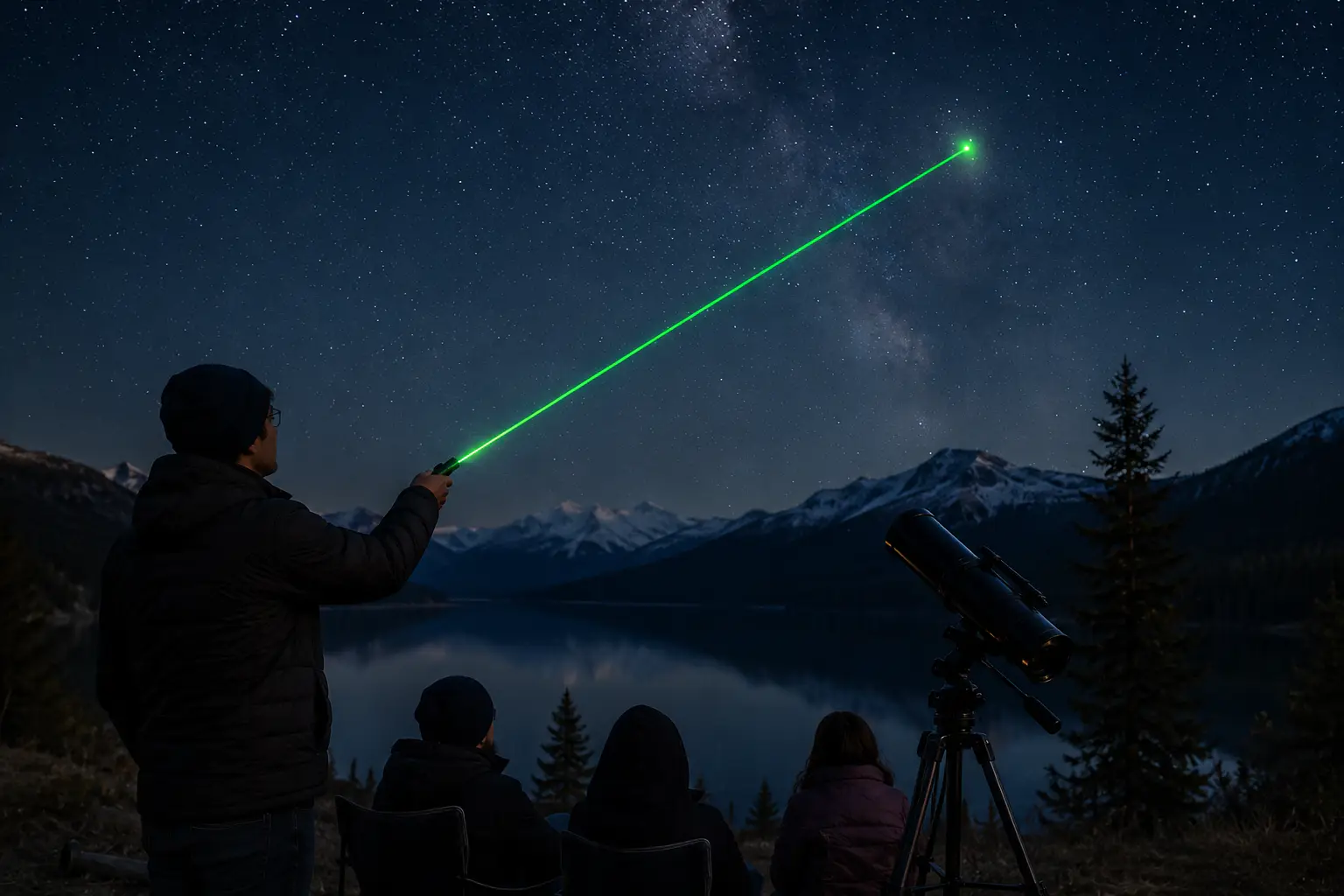
Most people shopping for an astronomy laser pointer ask the wrong question. They ask "how many milliwatts?" when they should be asking "will this laser actually work at 30°F during a winter star party?"
The best astronomy laser pointer in 2026 starts reliably in cold weather, stays within legal power limits, and does not leak invisible infrared that can damage eyes without warning.
This guide covers the difference between 520nm direct diode and 532nm DPSS, why cheap AAA-powered lasers fail within weeks, how to spot fake 5mW labels, and which astronomy laser pointers actually deliver on their promises based on real user experience and independent testing data.
Key Takeaways
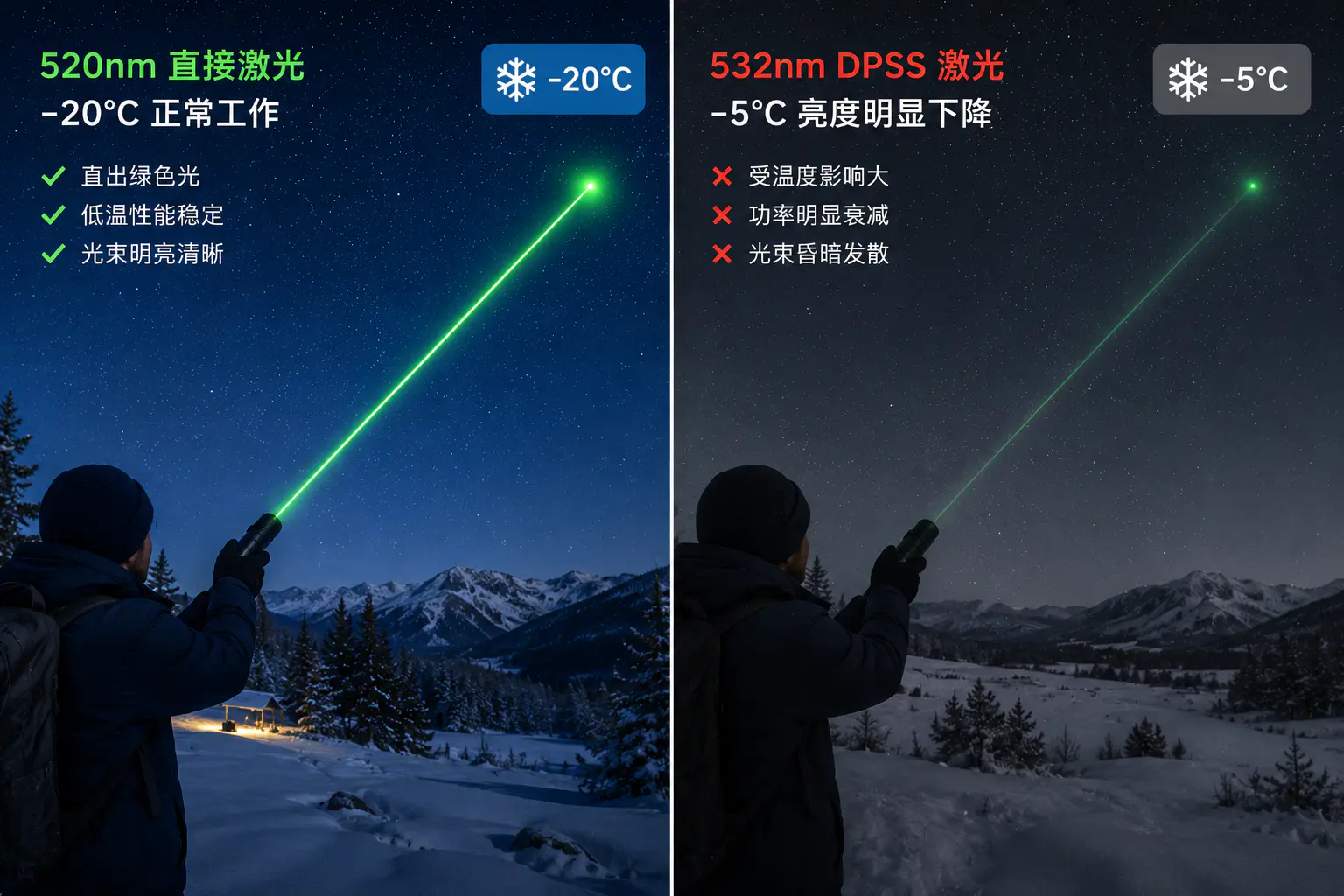
- 520nm direct diode lasers outperform 532nm DPSS in cold weather, operating down to -20°C while DPSS fails below -5°C.
- NIST random testing found nearly 90% of green laser pointers violate federal safety limits, with one unit measuring 66.5mW, 13 times the legal limit.
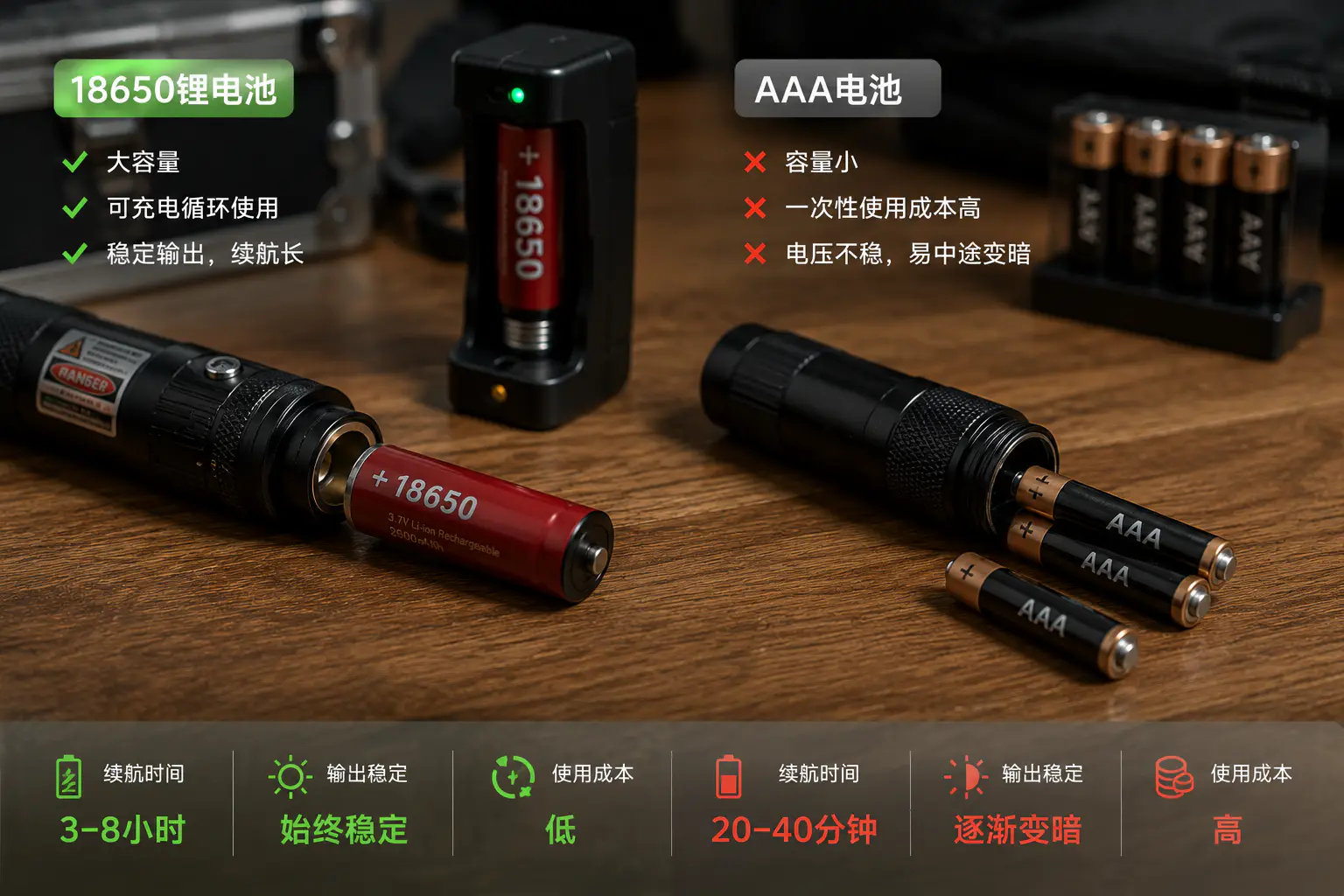
- AAA-powered astronomy lasers are the most complained-about category, with fresh batteries failing to survive a single 10-minute stargazing session.
What Makes the Best Astronomy Laser Pointer 2026
Five factors determine whether a laser will serve you well for stargazing. Ignore any of them and you risk buying something that looks good on paper but fails in the field.
Wavelength technology is the most overlooked factor when choosing an astronomy laser pointer. Green lasers come in two flavors: 532nm DPSS (diode-pumped solid state) and 520nm direct diode. Each behaves very differently in cold weather. This matters because astronomy happens at night, often in winter.
Legal compliance matters more than output power. The FDA limits laser pointers sold in the US to 5mW maximum in the visible spectrum. Lasers above that threshold cannot legally be marketed as pointers. Yet NIST testing found that nearly 90% of green laser pointers violate these limits, some by a factor of 13.
Battery system determines real-world usability. AAA-powered lasers are notorious for dying mid-session. Rechargeable lithium-ion platforms (18650, 21700, 26650) provide consistent power output and eliminate the battery budget problem.
Cold tolerance separates serious astronomy tools from fair-weather toys. A laser that dims or stops working below 40°F is useless for winter observing, which is when the clearest night skies often appear.
Beam visibility at distance depends on wavelength, power, and atmospheric conditions. Under Rayleigh scattering, green light is scattered more than red, making the beam column visible from the side, essential for group pointing.
Night adaptation further enhances green sensitivity. Dark-adapted eyes perceive 520nm light at roughly 10 times the brightness of red 650nm. Reddit users consistently report cheap lasers failing within two months. A well-built laser with a metal housing, proper thermal management, and a safety key lock will outlast a dozen disposables.
Best Astronomy Laser Pointer 2026: 520nm Direct Diode vs 532nm DPSS
This is the single most important technical decision you will make when buying an astronomy laser, and almost no buying guides cover it.
532nm DPSS is the traditional green laser technology. It uses an infrared pump diode (usually 808nm) to excite a Nd:YVO4 crystal, producing 1064nm infrared. That infrared passes through a frequency-doubling KTP crystal to generate green 532nm light. The process operates at only 20-30% optical efficiency.
DPSS lasers are temperature-sensitive because the KTP crystal's phase-matching condition shifts with temperature. Below about -5°C, crystal alignment drifts and output power can drop by 50% or more. DPSS lasers also emit residual infrared that requires an IR filter for eye safety.
520nm direct diode uses a semiconductor laser diode that natively emits green light, no crystal, no frequency doubling, no infrared leakage from the pump process. Direct diode lasers operate at higher efficiency (40-50%) and maintain stable output across a much wider temperature range: typically -20°C to +60°C. The trade-off is cost: 520nm direct diode lasers are generally more expensive than equivalent 532nm DPSS units.
Which should you buy? If you stargaze in climates where winter temperatures drop below freezing, a 520nm direct diode laser is the safer choice. It will start reliably, maintain consistent brightness, and eliminate IR leakage concerns from the pump diode.
If you observe only in mild weather and want the lowest entry price, a quality 532nm DPSS laser with an IR filter can still serve well. Laser Components published a detailed comparison confirming that 520nm direct diode offers significantly wider operating temperature range and better power stability.
The Laserpointerhub 520nm vs 532nm guide covers this comparison in more technical depth if you want the full engineering breakdown.
Why Cheap Astronomy Lasers Fail in the Cold
Temperature-dependent behavior is not a niche concern. It is the most consistent complaint across astronomy forums.
One Reddit user summarized the experience bluntly: "Cheap lasers are horribly unreliable and don't work in cold weather. A decent one costs $70." Another reported: "I have gone through two of these cheapo ones and they each stopped working after less than two months."
The physics behind this is straightforward. In 532nm DPSS lasers, the KTP crystal must maintain a specific temperature for phase-matched frequency doubling. When the crystal cools below its design range, the 1064nm infrared passes through unconverted, and the visible green output drops dramatically. The user sees a dim beam or nothing at all, even though the laser diode is still pumping full power, now in the invisible infrared band, which presents its own safety risk.
Direct diode lasers avoid this problem entirely. A 520nm semiconductor diode emits green light directly, with no temperature-sensitive crystal in the optical path. This is why the B030 direct diode laser maintains stable output across a wide temperature range, and why it is specifically positioned for astronomy use.
Battery chemistry also contributes to cold failure. Alkaline AAA batteries lose significant capacity below freezing. Lithium-ion cells (18650, 21700, 26650) retain much more of their capacity in cold conditions and deliver stable voltage under load, which matters for maintaining consistent laser output.
How to Spot Fake 5mW Labels and Unsafe IR Leakage
The gap between advertised specs and actual performance in the laser pointer market is staggering, and it is backed by hard data.
The National Institute of Standards and Technology tested 122 commercial laser pointers and found that nearly 90% of green lasers violated federal safety regulations. The highest measured output was 66.5mW, 13 times the legal limit of 5mW for pointer-class devices. In a separate test, NIST found one green laser labeled 10mW that appeared dim in visible green light but emitted nearly 20mW of invisible infrared through the aperture. Adding a simple IR filter reduced the leakage by 100 to 1,000 times.
The FDA is clear: handheld lasers sold as pointers are limited to 5mW maximum in the visible 400-710nm range. Class IIIb and Class 4 lasers above 5mW cannot legally be marketed as laser pointers.
Here is how to verify a laser before buying:
Look for measured power certification. Some manufacturers include a handwritten or printed power measurement with each unit. This is a strong signal of quality control.
Check for explicit IR filter language. A quality 532nm DPSS laser will state that it includes an IR filter. A 520nm direct diode laser does not need one for the pump path (no frequency doubling), but the specification should still be stated.
Verify the laser class is stated. FDA-compliant astronomy lasers should clearly state Class IIIa (5mW or less) on the product page. If the page emphasizes "high power" or "super bright" without mentioning class compliance, treat it as a red flag.
Read for operating temperature range. A laser that specifies an operating range (e.g., 14°F to 122°F) is telling you it has been tested. A laser that does not is likely a generic import with unknown cold tolerance. For more on how power ratings translate to real-world performance, see the laser pointer power guide.
A peer-reviewed study in PubMed tested exactly how much power is needed for night-sky pointing. Twenty-three observers adjusted a 532nm green laser to "just clearly visible" under heavy urban light pollution. The average power required was 2.38mW. All but one observer was below 5mW.
The conclusion is clear. Less than 5mW is adequate for night-sky education. You do not need more power, you need verified power.
Best Astronomy Laser Pointers by Use Case
The right laser for your situation depends on where and how you observe. Here are specific recommendations based on real-world scenarios, with all specifications verified from manufacturer data.
Premium All-Rounder: B020C 2W 520nm Green
For astronomers who want maximum beam visibility without compromising on build quality, the B020C delivers 2W (2000mW) of 520nm direct diode output. The 520nm wavelength provides approximately 8 times the human eye's perceived brightness compared to an equivalent blue laser. Its dual 26650 battery platform provides extended runtime for long observing sessions, and the full aluminum chassis serves as an integrated heat sink for sustained operation. At $319, this is a flagship investment for serious astronomy use.
Quick Specs: B020C 2W 520nm Green
- Wavelength: 520nm green (direct diode)
- Output Power: 2000mW (2W)
- Battery: 2 × 26650 high-discharge lithium-ion
- : Aluminum alloy with integrated heat sink
Compact EDC and Telescope Finder: B025 1.5W 520nm
For astronomers who need a compact laser that fits in a pocket and can serve as a telescope finder, the B025 is a 1.5W 520nm direct diode laser in a stainless steel body. Its 18650 battery with USB charging eliminates the need for a separate charger. The pocket-sized design makes it ideal for travel to dark sky sites
Cold-Weather Astronomy: B030 520nm Direct Diode
Specifically positioned for astronomy and outdoor use, the B030 is a 520nm direct diode laser with an On/Off safety key and intelligent cooling system. Its direct diode construction eliminates the cold-weather failure modes of DPSS lasers, making it the most reliable option for winter stargazing.
Advanced Options: B023B and G019B
For users who want maximum beam concentration, the B023B delivers 2.4W of 520nm in a pure single-beam design with USB-C charging. For educators running star parties, the G019B adds a precision focus mechanism and a transparent beam extension tube for large-group visibility with a leather presentation box.
The best laser pointer for astronomy guide covers additional considerations for matching laser features to specific observing scenarios.
When NOT to Use a Laser Pointer
Knowing when to keep the laser off is as important as knowing which one to buy. Real-world astronomy etiquette and safety considerations are not optional.
Near airports. The FAA recorded 10,993 laser strikes reported by pilots in 2025, with civil penalties reaching $32,646 per violation. If your observing site is within 10 miles of an airport, check local airspace before using any laser. One Reddit user noted: "An additional consideration I have is my primary astronomy site is about 12 miles away from a city airport." If you are unsure, choose a no-laser alternative such as a red-dot finder.
At star parties that ban lasers. Many astronomy clubs restrict laser use because mounted or handheld lasers can ruin astrophotography exposures. One club volunteer reported: "I had to revoke laser privileges from an old volunteer. He was shooting from the hip and kept blasting a laser beam across my nose as I was trying to operate my Dob."
Around astrophotographers. Even a brief sweep of a laser beam across an imaging setup can ruin a long-exposure frame. When sharing an observing site with imagers, ask before using your laser and keep the beam above their field of view.
Around children without supervision. A Reddit thread asking for "laser pointer recommendations for a 9 year old" highlights the real concern: lasers require adult supervision around children. If the laser has a safety key lock, use it to prevent accidental activation.
For a full breakdown of laser regulations by country, see the laser pointer laws guide. For comprehensive safety information covering eye protection and safe handling, visit the complete laser pointer safety guide.
Astronomy Laser Buyer Verification Checklist: 8 Things to Confirm Before Ordering
Use this checklist when evaluating any astronomy laser pointer. It covers what the marketing page will not tell you.
NIST and FDA provide the regulatory framework that separates legitimate products from non-compliant ones. Use their guidelines as your reference.
Frequently Asked Questions
Why do astronomers like green laser pointers?
Green laser pointers are preferred because the human eye is most sensitive to green light around 520-532nm under dark-adapted conditions. This means a green laser at 5mW appears significantly brighter than a red laser at the same power. The visible beam column makes it easy to trace constellations and point out celestial objects to a group.
Is 5mW enough for stargazing?
Yes. Peer-reviewed research published in PubMed had 23 observers adjust a 532nm green laser to "just clearly visible" under heavy urban light pollution. The average required power was 2.38mW, and all but one observer was below 5mW. A true, verified 5mW green laser is sufficient for most stargazing situations, including group demonstrations.
Do green laser pointers work in cold weather?
It depends on the laser technology. 532nm DPSS lasers often fail or dim significantly below freezing because their frequency-doubling crystal loses phase matching in cold temperatures. 520nm direct diode lasers maintain stable output down to -20°C because they have no crystal in the optical path. If you observe in winter, choose a direct diode laser.
Is it legal to use a laser pointer for astronomy?
Laser pointers are legal for astronomy use in most countries when used responsibly. The key restriction is that you must not shine the laser at aircraft. The FAA recorded 10,993 laser strikes in 2025 with penalties up to $32,646 per incident.
Always check for nearby airports and use common sense. Different countries have varying regulations, so check local laws.